
A history of tarot
Playing cards arrive in Europe
Tarot begins as an elaboration of the ordinary pack of playing cards. Cards reached Europe in the later fourteenth century, almost certainly from the Islamic world; their closest surviving relative is the Mamluk pack of Egypt and Syria, with suits of cups, coins, swords and polo sticks.
The European record begins abruptly in the 1370s. A reference from Bern dated 1367 is sometimes cited but its date is disputed. From 1377 the evidence is secure: the city of Florence regulated a new game called naibbe that year, and a Dominican friar in Freiburg, John of Rheinfelden, wrote a treatise describing a pack of four suits of thirteen cards, with a king and two marshals at the head of each suit.
Those early packs had no trumps and no Fool. The suits that the Italians settled on, cups, coins, swords and batons, are still used on Italian and Spanish playing cards today, and they are the same four suits that tarot readers now call cups, pentacles, swords and wands.
Triumphs at the Italian courts
What makes a tarot pack a tarot pack is the extra series of picture cards that outranks the ordinary suits. These appeared in northern Italy in the first half of the fifteenth century, at the courts of Milan and Ferrara and in the cities of Florence and Bologna. They were called trionfi, triumphs, and the word survives in English as trump.
An important forerunner was a pack made for Filippo Maria Visconti, Duke of Milan, and described by his secretary Marziano da Tortona, probably between about 1418 and 1425. Its sixteen cards of classical gods, set above suits of birds, were not yet a tarot, but they show a separate rank of picture cards taking shape at court.
The first records of cards actually called trionfi date from around 1440. A Florentine record of that year notes two packs of trionfi being passed to Sigismondo Malatesta, and the account books of the Este court at Ferrara mention them from the early 1440s. The standard form soon settled: the four suits of fourteen cards (king, queen, knight and jack, with ten numbered cards), a series of twenty-one trumps, and the Fool, who stood apart from both. The trump subjects, from Love and the Chariot to Death, the Sun and the World, come from the familiar imagery of late medieval Italy: virtues, triumphal processions, fortune and the Last Judgement.
The painted decks of Milan
The oldest tarot cards to survive are luxury objects. Around fifteen incomplete packs, known together as the Visconti-Sforza tarot, were painted in the middle of the fifteenth century for the Visconti dukes of Milan and their successor Francesco Sforza. Their backgrounds are often tooled gold leaf, their figures wear the clothes and heraldry of the Milanese court, and several are traditionally attributed to the workshop of the painter Bonifacio Bembo.
No Visconti-Sforza pack is complete. The best known, divided between the Morgan Library in New York, the Accademia Carrara in Bergamo and a private collection, is missing two trumps, the Devil and the Tower; the versions of those two cards seen in modern reproductions of it are modern reconstructions. Cheaper printed packs must have existed in far greater numbers, but cards that were played with wore out and were thrown away.
The engraved Sola Busca pack, usually dated to about 1491 and connected with Venice and Ferrara, is notable as the oldest complete 78-card tarot known, and for something it shares with the 1909 deck: every numbered card carries a picture of figures rather than a simple arrangement of suit signs.
A game called tarocchi
For its first three centuries tarot was a game, and nothing in the surviving evidence suggests anyone used it for fortune-telling. It was a trick-taking game in which the trumps beat the ordinary suits and the Fool excused a player from following suit.
Around 1500 the cards acquired a new name. In the early sixteenth century the word tarocchi appears in northern Italy, possibly to distinguish the game from another that had borrowed the name trionfi. The origin of the word is unknown, and all the confident explanations offered for it are guesses.
The game travelled with soldiers and traders. When French armies took Milan in 1499, during the Italian Wars, Milanese tarot came with them into southern France and Switzerland, and those regions began producing their own packs. Over the following centuries the game spread into most of continental Europe, though not to Britain, Ireland, Spain or Portugal. By the eighteenth century it was one of the most widely played card games on the continent, from France across Germany and the Habsburg lands, often under names like tarock.
The Tarot de Marseille
The pack most people picture as a traditional tarot is the Tarot de Marseille, a standard design reproduced with small variations by card makers in France and Switzerland from the seventeenth century onward. The earliest surviving Marseille-made example is by Philippe Vachier, dated 1639; well-known later versions include those of Jean Noblet of Paris around 1650, Jean Dodal of Lyon in the early eighteenth century and Nicolas Conver of Marseille in 1760.
In these packs the trumps carry Roman numerals and French titles: Le Bateleur, La Papesse, La Maison Dieu, Le Monde. The suit cards are plain arrangements of cups, coins, swords and batons, and Strength is numbered XI and Justice VIII.
The name itself is modern. It was coined in the nineteenth century, in 1856 according to the usual account, and was popularised in the twentieth, notably by the French publisher Paul Marteau's edition for the firm of Grimaud. It is this Marseille pattern, still a working gaming pack in eighteenth-century Paris, that the first occult writers on tarot happened to pick up.
Court de Gébelin and the Egyptian myth
Tarot's occult history starts in Paris in 1781. Antoine Court de Gébelin, a Protestant pastor and scholar working on an enormous study of the supposed universal civilisation of the ancient world, included an essay on tarot in the eighth volume of his Le Monde primitif. He said that on first seeing the cards he recognised them as the remains of an ancient Egyptian book of wisdom, preserved in disguise as a game and carried into Europe.
He offered no evidence, and none has ever been found. Hieroglyphs had not yet been deciphered; his Egyptian reading was imagination applied to a French gaming pack. The same volume printed an essay by the Comte de Mellet, who linked the twenty-two trumps to the twenty-two letters of the Hebrew alphabet and described a method of telling fortunes with the cards that he attributed to the Egyptians.
Historians now agree that tarot was invented in fifteenth-century Italy as a game, and that the stories of Egyptian priests, wandering Romani and ancient secret books all date from after 1781. The philosopher and historian Michael Dummett did more than anyone to separate tarot's real history from the invented one.
Etteilla and the first cartomantic deck
Fortune-telling with ordinary playing cards was already practised in France, and one of its professionals took up Court de Gébelin's ideas almost at once. Jean-Baptiste Alliette, who wrote under the name Etteilla (his surname reversed), had published a book on reading a 32-card piquet pack in 1770. Between 1783 and 1785 he issued a series of booklets on reading the tarot, and he became the first person known to have made his living by tarot divination. Following Court de Gébelin and the Comte de Mellet, he presented the cards as the Book of Thoth, a lost Egyptian text.
Etteilla did more than write. Around 1789 he produced a redesigned pack intended for divination rather than play, which is generally described as the first tarot made specifically for occult use. He renumbered and partly renamed the trumps to fit his own scheme, linked cards to astrology and the elements, and gave each card a meaning both upright and upside down, an idea that underlies the reversed meanings readers still use.
Versions of his deck were printed long after his death in 1791. Later occultists dismissed his rearrangements, but the practice he founded, reading the cards as a book of set meanings, is the direct ancestor of modern tarot reading.
Lévi, Papus and Wirth
The next turn came from Éliphas Lévi, the pen name of the French writer Alphonse-Louis Constant. In his Dogme et Rituel de la Haute Magie, published in 1854 to 1856, Lévi made tarot central to a whole system of magic and Kabbalah. He took up the idea of matching the twenty-two trumps to the twenty-two Hebrew letters but arranged it differently from his predecessors, assigning the first letter, aleph, to the Magician and placing the unnumbered Fool near the end. He described how some cards ought to look, and later designers followed him.
The terms Major Arcana and Minor Arcana, which tarot players never used, are usually credited to another French writer on magic, Paul Christian (Jean-Baptiste Pitois), later in the century.
In 1889 two works carried these ideas into print as cards and as a manual. Gérard Encausse, who wrote as Papus, published Le Tarot des Bohémiens, a long treatise on the tarot as a key to occult science. In the same year the Swiss-born occultist Oswald Wirth, working under the guidance of Stanislas de Guaita, issued a set of the twenty-two trumps redrawn from the Marseille pattern with occult symbols added. Wirth's cards are often counted as the first in the long line of esoteric decks that leads to the twentieth century.
The Golden Dawn
In 1888 three Freemasons, William Wynn Westcott, Samuel Liddell MacGregor Mathers and William Robert Woodman, founded the Hermetic Order of the Golden Dawn in London. This small, secretive society taught a graded course in ceremonial magic, Kabbalah, astrology and tarot. Its members included W. B. Yeats, Florence Farr, Aleister Crowley, Arthur Edward Waite and Pamela Colman Smith.
The Golden Dawn's tarot teaching was set out in a document known as Book T, circulated in manuscript among members and printed only later by former members. It built a single system that tied each trump to a Hebrew letter, a path on the Kabbalistic Tree of Life and a planet, sign or element, and tied the numbered cards to the decans of the zodiac. Unlike Lévi, it put the Fool first, on aleph. To make the astrology fit it swapped Strength and Justice, so that Strength, with its lion, sat with Leo and Justice with Libra. Members are said to have made their own copies of the cards by hand.
The order split in quarrels around 1900, and Waite later led one of its successor groups. Its tarot system survived the split and frames both of the twentieth century's most influential decks.
Waite, Smith and Rider, 1909
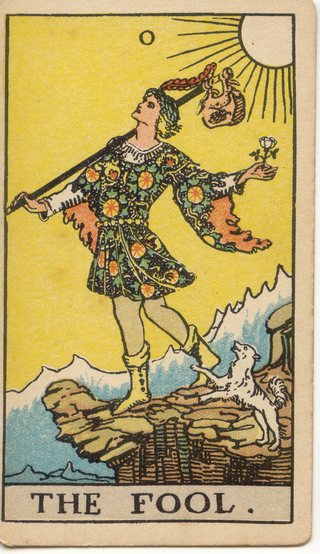
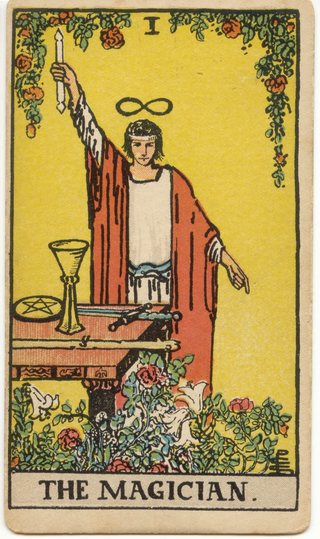
Arthur Edward Waite was a scholar of mysticism and a prolific writer on the occult, born in Brooklyn in 1857 and raised in England. In 1909 he commissioned Pamela Colman Smith, a fellow member of his branch of the Golden Dawn, to illustrate a new tarot. The cards were published in London by William Rider and Son in December 1909, accompanied by a small book of Waite's called The Key to the Tarot.
The division of labour seems to have been this. Waite set the overall symbolic scheme and gave detailed directions for the twenty-two trumps, which keep the Marseille sequence but follow the Golden Dawn in numbering Strength VIII and Justice XI. For the fifty-six suit cards he appears to have supplied little more than lists of meanings, so the scenes on those cards are largely Smith's invention. This was the deck's great novelty: every one of the seventy-eight cards shows people doing something, which gives readers a picture to interpret rather than an arrangement of suit signs to memorise. For some pip cards Smith seems to have drawn on the Sola Busca tarot, photographs of which had been given to the British Museum in 1907; her Three of Swords is the clearest echo.
Smith completed the artwork within a few months of 1909. Waite's book was expanded with black-and-white reproductions of all seventy-eight designs as The Pictorial Key to the Tarot, released at the end of 1910 with 1911 on its title page, and quoted on this site.
Pamela Colman Smith
Pamela Colman Smith was born in London in 1878 to American parents, spent part of her childhood in Jamaica and studied art at the Pratt Institute in Brooklyn. Back in London she worked as an illustrator and theatre designer and published two books of Jamaican folk tales. In 1907 Alfred Stieglitz exhibited her paintings at his New York gallery, until then a space for photography.
She appears to have been paid a single fee for the tarot, with no royalties. In a letter to Stieglitz, usually dated to November 1909, she described it as a big job done for very little cash. For most of the twentieth century the deck was sold as the Rider or Rider-Waite tarot, without her name, although her small monogram appears on almost every card.
Her later life was hard. She converted to Catholicism in 1911, moved to Cornwall after the First World War, and found fewer and fewer publishers for her work. She died in Bude in September 1951; her belongings were sold to settle her debts and her grave is believed to be unmarked. In recent decades historians and readers have restored her to the deck's story, and many now call it the Waite-Smith or Rider-Waite-Smith tarot. This site follows that usage.
Crowley, Harris and the Thoth deck
The other great Golden Dawn deck came a generation later. Aleister Crowley, a former member of the order, worked with the painter Lady Frieda Harris on a new tarot between 1938 and 1943, a project that grew from a quick revision into seventy-eight elaborate paintings.
The Thoth tarot renames several cards: Strength becomes Lust, Temperance becomes Art, Judgement becomes the Aeon, and the suit of coins becomes disks. Crowley's companion book, The Book of Thoth, appeared in 1944, but the cards themselves were not printed as a deck until the late 1960s, after both Crowley and Harris had died. The Thoth and Waite-Smith decks are siblings, sharing the Golden Dawn's attributions while looking nothing alike.
From Rider to the tarot boom
Rider kept the deck in print in various editions until the Second World War and then let it lapse for decades. Its revival came from the United States. In 1971 U.S. Games Systems, a company founded in 1968 by Stuart R. Kaplan, acquired the rights to publish the deck and sold it widely as the Rider-Waite tarot. Kaplan's Encyclopedia of Tarot, begun in 1978, remains a standard reference.
The timing suited the deck. Interest in the occult had been growing through the 1960s, and popular American guides, especially Eden Gray's, beginning with Tarot Revealed in 1960, taught readers using Smith's images. A deck in which every card shows a scene is far easier for a beginner than plain pips, and the Waite-Smith designs became the default picture of tarot in the English-speaking world. Most of the hundreds of decks published since borrow Smith's compositions for the minor cards.
Public domain and the recoloured editions
The original 1909 deck is in the public domain in the United States, where any copyright in a work published that long ago has expired. In the United Kingdom and other countries where copyright runs for the life of the author plus seventy years, the decisive date is Smith's death in 1951: protection ended at the close of 2021, and since 1 January 2022 her designs have been free for anyone to use. Waite, who died in 1942, passed into the public domain there earlier, and so did the text of his books.
That freedom applies to Smith's original drawings and colouring, not to every deck that carries her name. Publishers have issued many redrawn and recoloured versions, and the new work in them can be protected. U.S. Games, for example, claims copyright in the new material of its own editions, such as its card backs and packaging, and in recoloured decks it commissioned later, such as the Universal Waite.
The cards shown on arcanebra.com are scans of early printings of Smith's original deck, with its flat, slightly uneven colours and her hand-lettered titles. When our card pages mention a colour or detail, it is the one on these designs, which can differ from brighter modern editions.
A game still played
Tarot never stopped being a card game. Outside the English-speaking world, a great many people still play with tarot cards and give them no esoteric meaning at all.
In France the game of tarot is a national pastime. It uses a 78-card pack, but not the Marseille design: around 1900 French players adopted the Tarot Nouveau, a pack with ordinary French suits of hearts, diamonds, clubs and spades and trumps showing scenes of everyday life. The game grew rapidly after the Second World War, the Fédération Française de Tarot was founded in 1973 to run competitions, and tarot is now commonly described as the second most popular card game in France.
Related games survive elsewhere. Austrians and Hungarians play tarock games such as Königrufen, Italians in Bologna still play Tarocchini with a shortened pack, and versions are played in parts of Switzerland, southern Germany, Slovenia and Denmark. The card player and the card reader are using descendants of the same fifteenth-century invention.
Further reading
- Michael Dummett, The Game of Tarot: From Ferrara to Salt Lake City (1980). The foundational scholarly history of tarot as a card game, including the regional orders of the trumps.
- Ronald Decker, Thierry Depaulis and Michael Dummett, A Wicked Pack of Cards: The Origins of the Occult Tarot (1996). The occult tarot in France from Court de Gébelin and Etteilla to the mid-nineteenth century.
- Ronald Decker and Michael Dummett, A History of the Occult Tarot, 1870-1970 (2002). Lévi's successors, Papus and Wirth, the Golden Dawn, Waite and Smith, Crowley, and the twentieth-century revival.
- Michael Dummett and John McLeod, A History of Games Played with the Tarot Pack (2004). A survey of the rules of tarot card games, historical and current.
- Stuart R. Kaplan, The Encyclopedia of Tarot, volume 1 (1978). A catalogue and history of historical and modern decks; later volumes followed.
- Stuart R. Kaplan, Mary K. Greer, Elizabeth Foley O'Connor and Melinda Boyd Parsons, Pamela Colman Smith: The Untold Story (2018). The fullest account of Smith's life and work.
- Helen Farley, A Cultural History of Tarot: From Entertainment to Esotericism (2009). An academic overview of tarot's changing uses and meanings.
- Arthur Edward Waite, The Pictorial Key to the Tarot (1911). Waite's own guide to the 1909 deck, with black-and-white plates of Smith's designs; public domain.