Eight of Pentacles
Upright diligence · practice · craftsmanship · learning a skill · attention to detail
Reversed perfectionism · cutting corners · boredom · skill misused
- Arcana
- Minor · pip card
- Number
- Eight
- Element
- 🜃 Earth
- Astrology
- ☉ Sun in ♍ Virgo
- Golden Dawn title
- Lord of Prudence
- Yes or no
- Yes
Eight of Pentacles upright
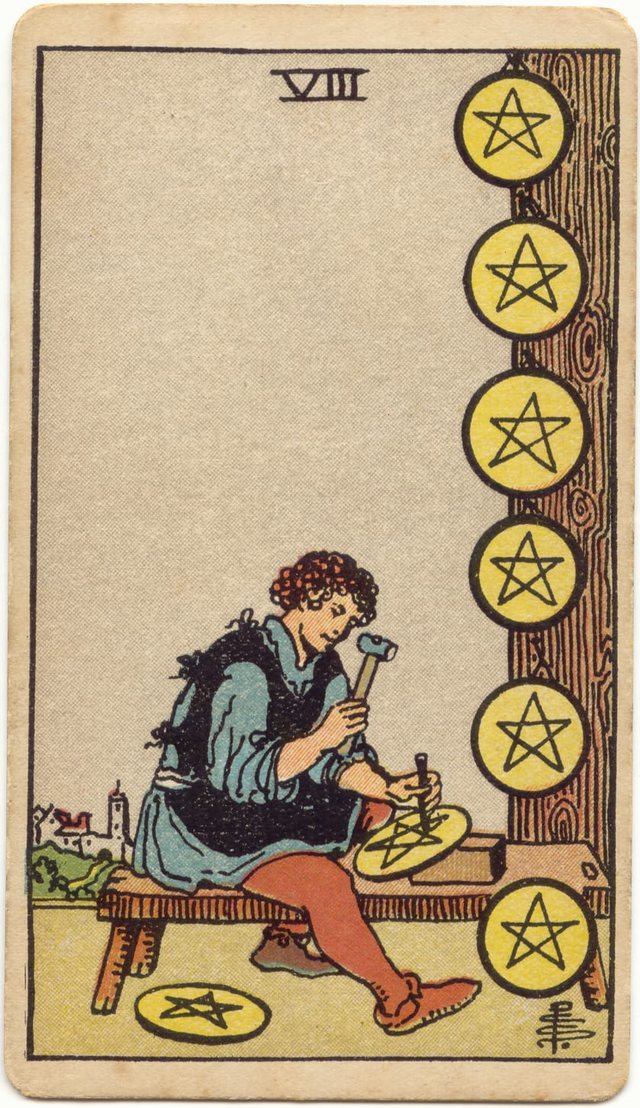
A young man with curly hair sits on a wooden bench, hammer raised and chisel in hand, carving a pentacle on the coin in his lap. Six finished coins hang one above the other on a tall post beside him, and one more lies on the ground at his feet. Far behind him, a small town with a tower sits on the horizon. He does not look up.
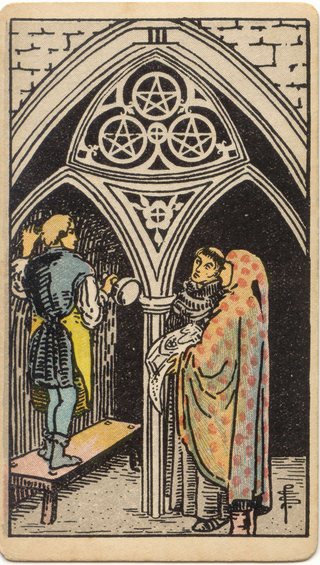
This is the card of practice. Unlike the Three of Pentacles, where the craftsman works in a cathedral with patrons around him, the Eight shows a person alone with the work, repeating the same task until it is right. Waite described "an artist in stone at his work, which he exhibits in the form of trophies", and the row of coins on the post is exactly that: proof of effort, piece after piece.
There is nothing glamorous here and the card does not pretend there is. Skill is built by doing the thing again, a little better each time. The town in the distance suggests the world is out there, but he has chosen to sit apart and concentrate. The card speaks well of that choice, while gently noting that sooner or later the work has to go back into the world to be used.
Eight of Pentacles reversed
The reversal is the bench abandoned or the work gone sour. Readers often see work rushed or done carelessly, a skill left unpractised, or boredom with a task that once absorbed you. It can also describe the opposite problem: perfectionism that keeps reworking the same coin and never lets it go.
Waite's reversed meanings include "voided ambition, vanity" and the idea of skill turned "to cunning and intrigue": cleverness used for the wrong ends. Readers who use reversals often take it as a prompt to check both the quality of the work and the reasons for doing it. Good craft serves something beyond itself.
In love and relationships
In love, the Eight of Pentacles describes effort and attention: learning how a partner thinks, practising patience, working steadily at the small things that make a relationship good. It is not a card of grand romance, but of reliability and care. It can also show a person so absorbed in work or study that love has to wait. Reversed, it may point to a relationship being neglected for other commitments, or to trying so hard to be a perfect partner that nothing feels natural.
In work and purpose
At work this card fits training, apprenticeships, study, detailed work and any period of steady improvement. It favours deliberate practice, quality over speed and pride in the finished piece. It can describe a job you are good at and quietly enjoy, or a time to invest in a new skill. Reversed, it suggests a routine that has become dull, work done to a low standard, or a perfectionist streak that is slowing everything down.
As advice
Pick up the tools and do the next piece, then the next. Give the work your full attention and let your skill grow by repetition rather than by waiting for inspiration. Take quiet pride in getting the details right, and do not compare your early work with someone else's finished one.
Yes or no?
Yes The card favours steady effort that pays off over time, so it reads as yes, provided you are willing to put in the work. How yes-or-no readings work here.
Questions to sit with
- What skill am I building right now, and how often do I really practise it?
- Where am I rushing work that deserves more care?
- Am I improving the piece in front of me, or polishing it to avoid finishing?
Symbolism in the card
The craftsman
A young man in a blue tunic with a black apron and red hose sits on a wooden bench with his head bowed over his work. His full attention on the task is the heart of the card: absorption, not ambition.
The hammer and chisel
He holds a mallet-like hammer raised in one hand and a chisel against the coin in the other. They are the plain tools of a trade, showing value being made by hand, stroke by stroke.
The coins on the post
Six finished pentacles hang in a column down a tall wooden post on the right. Waite called them trophies: the visible record of repeated work, each one a little proof of skill.
The coin being carved
A coin rests on the bench across his lap as he works on its pentagram. It is the piece in progress, the present moment of the craft.
The coin on the ground
One more pentacle lies on the ground by his feet. Some readers take it as the next piece waiting its turn; others as a reminder that the work never quite ends.
The distant town
On the far left, a small town with a red roof and a tower stands among green trees. It is the world where the finished work will be sold or used, kept at a distance while he concentrates.
“An artist in stone at his work, which he exhibits in the form of trophies. Divinatory Meanings: Work, employment, commission, craftsmanship, skill in craft and business, perhaps in the preparatory stage.”
Numbers, elements and astrology
Eight
Eight is movement and mastery: effort repeated until it becomes skill, and the momentum to leave what no longer serves.
Earth: the suit of Pentacles
Earth is the body, money, work, home and the slow growth of material things.
By Golden Dawn tradition each numbered card from two to ten rules ten degrees of the zodiac (a decan): the Eight of Pentacles is Sun in the first decan of Virgo. They are a symbolic system, not astronomy. How we checked them.
A little history
In the Tarot de Marseille the Eight of Coins is a symmetrical pattern of coins and floral ornament without figures. The Golden Dawn named it the Lord of Prudence. Smith's craftsman is her own invention, and in his entry for the Three of Pentacles Waite explicitly ties him to this card, where the same apprentice "has received his reward and is now at work in earnest". Such an explicit cross-reference between two numbered cards is unusual in Waite's book.