Nine of Pentacles
Upright self-sufficiency · comfort earned · independence · refinement · discipline rewarded
Reversed dependence · overwork · hollow luxury · insecurity behind appearances
- Arcana
- Minor · pip card
- Number
- Nine
- Element
- 🜃 Earth
- Astrology
- ♀ Venus in ♍ Virgo
- Golden Dawn title
- Lord of Material Gain
- Yes or no
- Yes
Nine of Pentacles upright
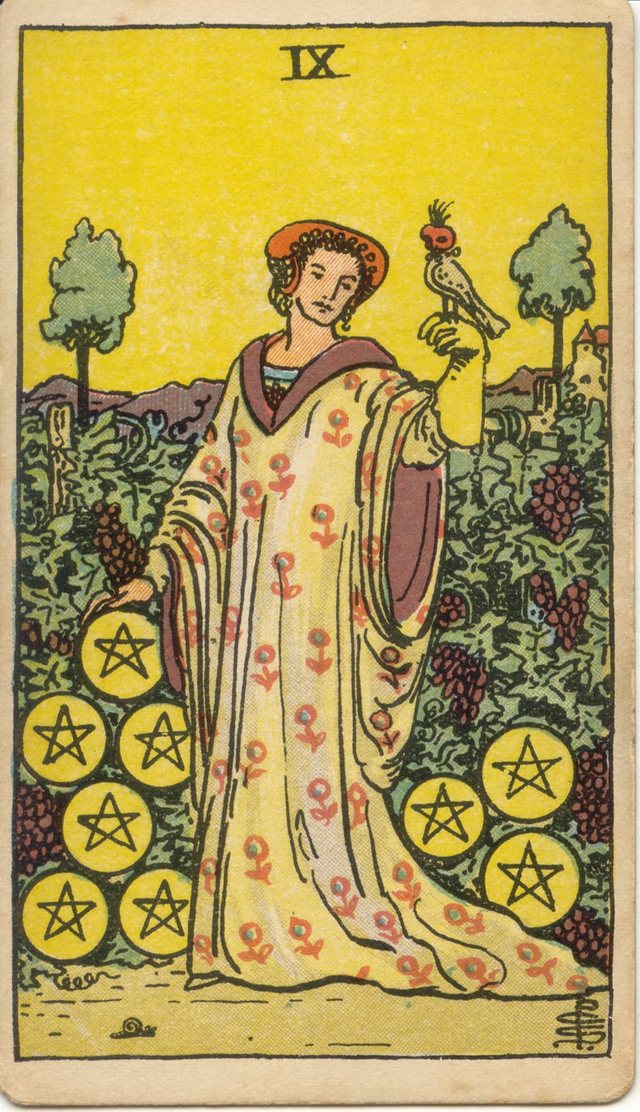
A woman in a long yellow robe patterned with red flowers stands alone in a vineyard heavy with purple grapes. A hooded falcon perches on her gloved left hand, and her right rests lightly on a stack of pentacles. Behind her, under a bright yellow sky, a manor house with a red roof stands beyond the vines, and a tiny snail crosses the path at her feet.
This is the card of having enough and knowing it. Waite saw "a wide domain, suggesting plenty in all things", and thought it was possibly her own. The point of the picture is not wealth as display but wealth as ease: a life ordered well enough that its owner can walk in her garden and enjoy it. She is alone, and the card treats that as a strength. Her comfort does not depend on anyone else's approval.
The falcon adds a note of discipline. A hunting bird is trained, hooded and kept calm, and so is she. The card suggests that independence like this is built from long habits of patience and self-control, not luck. It can describe financial self-reliance, but just as often a settled confidence in your own judgement and taste, a home made to your liking, or time finally your own.
Nine of Pentacles reversed
Reversed, the garden walls feel less secure. Readers often see comfort that depends on someone else, a show of success that hides worry, or the sense that independence has come at the cost of connection. It can also describe overwork: building the estate so hard that you never walk in it.
Waite's reversed meanings are blunt: "roguery, deception, voided project, bad faith". Some readers take these as a warning about schemes that promise easy luxury, or about relying on people who are not trustworthy. As always, readers vary in how much weight they give reversals, and the surrounding cards usually decide which shade applies.
In love and relationships
In love, the Nine of Pentacles describes someone who is complete in themselves: content single, or in a relationship by choice rather than need. For couples it can point to a partnership where each person keeps their own interests and space, and is happier for it. It also suits the pleasure of shared good things: a well-kept home, a meal, a garden. Reversed, it may suggest staying in a relationship mainly for the comfort it provides, or fear of losing independence getting in the way of closeness.
In work and purpose
At work the card fits self-employment, a well-earned promotion, financial independence or a role where you set your own standards. It speaks well of long-term discipline and the good taste that comes with experience. It can also be a reminder to enjoy what you have built rather than immediately chasing the next target. Reversed, it suggests overextension, a business that looks healthier than it is, or reliance on a single client or employer.
As advice
Enjoy what you have worked for, without apology. Make room in your days for things that are simply good to live with. Keep the habits that got you here, and protect your independence, but do not let it become a wall.
Yes or no?
Yes The card shows comfort and self-reliance achieved, so it reads as a yes, especially for questions you can settle on your own. How yes-or-no readings work here.
Questions to sit with
- What have I built that I have not stopped to enjoy?
- Where does my sense of security truly come from?
- What discipline has served me well, and where could I relax it?
Symbolism in the card
The woman in the flowered robe
She wears a long yellow robe covered in small red flowers, some of which look strikingly like the Venus symbol, with a dark red cap. Yellow and Venus both suggest warmth, pleasure and refinement, enjoyed in a settled, unhurried way.
The hooded falcon
A falcon with a red hood sits on her gloved left hand. Falconry was a pastime of the wealthy and needed long training; the hooded bird is often read as instinct brought under control, power that waits calmly until it is needed.
The grapes and vines
Heavy bunches of purple grapes hang on vines all around her and spill into the foreground. Grapes are an old image of abundance and ripened effort: fruit that takes years of tending before the harvest.
The pentacles
Six pentacles are stacked on the left of the card, at her right hand, and three more sit on the right, low among the vines. Her hand rests on the stack rather than gripping it; the wealth is part of her surroundings, not something she clutches.
The manor house
A house with a red roof and pale walls stands among the trees on the right. It is the estate Waite describes, a sign of settled, permanent comfort beyond the garden.
The yellow sky and trees
A bright yellow sky fills the top of the card, with two leafy trees and low purple hills on the horizon. Smith uses yellow skies for her most contented scenes, and the trees suggest growth that has had time to mature.
The snail
A tiny snail crawls across the ground at the lower left. It is easy to miss and often read as a sign of slowness and self-containment: something that carries its home with it.
“A woman, with a bird upon her wrist, stands amidst a great abundance of grapevines in the garden of a manorial house. It is a wide domain, suggesting plenty in all things.”
Numbers, elements and astrology
Nine
Nine stands just short of completion: the fullness of a suit's energy, sometimes as fulfilment and sometimes as its burden.
Earth: the suit of Pentacles
Earth is the body, money, work, home and the slow growth of material things.
By Golden Dawn tradition each numbered card from two to ten rules ten degrees of the zodiac (a decan): the Nine of Pentacles is Venus in the second decan of Virgo. They are a symbolic system, not astronomy. How we checked them.
A little history
The Tarot de Marseille's Nine of Coins shows nine coins arranged among stylised flowers, with no figure. The Golden Dawn named it the Lord of Material Gain. Smith's woman in the vineyard is her own design. The flowers on her robe that resemble the astrological sign of Venus are often pointed out, though Waite does not mention them. Waite's divinatory meanings for the card, "prudence, safety, success, accomplishment, certitude, discernment", stress good judgement as much as prosperity.