Three of Pentacles
Upright collaboration · craftsmanship · skill recognised · building on a plan · teamwork
Reversed poor teamwork · shoddy work · skills overlooked · misaligned plans
- Arcana
- Minor · pip card
- Number
- Three
- Element
- 🜃 Earth
- Astrology
- ♂ Mars in ♑ Capricorn
- Golden Dawn title
- Lord of Material Works
- Yes or no
- Yes
Three of Pentacles upright
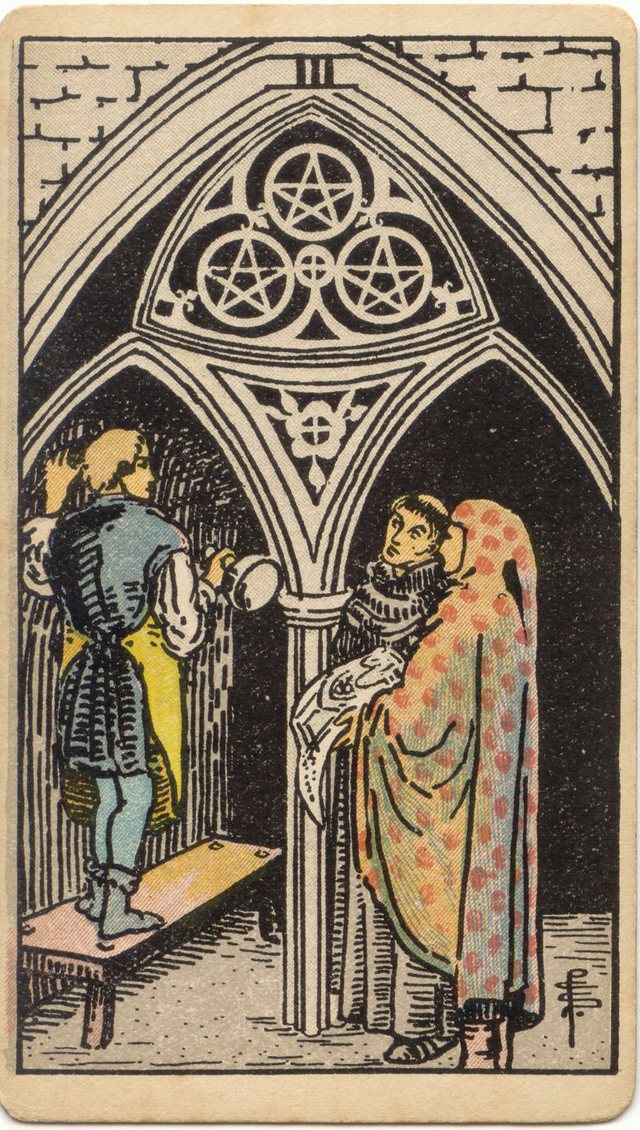
Inside a dim stone church, a craftsman stands on a low pink bench beneath a pointed Gothic arch, tool in hand, his face turned towards two people standing by the column. One is a monk in a dark habit; the other is wrapped in a hooded cloak covered in orange spots, and between them they hold out a sheet with a drawing on it. Above them, three pentacles are carved into a trefoil in the stone of the arch.
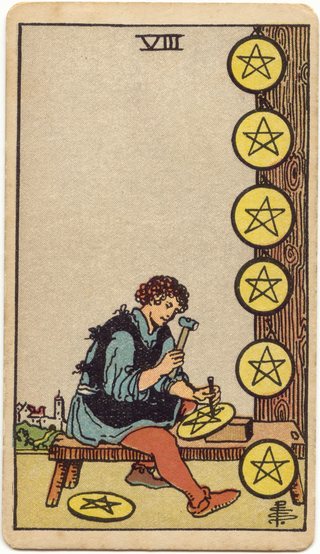
This is the card of good work done in company. Three kinds of contribution meet here: the person who can actually do the job, the person who commissioned it and knows what it is for, and the plans that let them agree. Waite saw the craftsman as the apprentice of the Eight of Pentacles grown into a master, "now at work in earnest". The card speaks to the moment when your skill is good enough to be asked for and taken seriously.
It also says something about humility on both sides. The craftsman turns to listen; the patrons bring the drawing to him and wait for his view of it. Nobody in the scene could build the arch alone. The carving above shows what that kind of cooperation leaves behind: work that outlasts the people who made it.
Three of Pentacles reversed
When the card is upside down, the conversation breaks down. The builder ignores the brief, or the client keeps changing it, or nobody can agree on what the drawing actually shows. It can describe a team where effort is duplicated or wasted, a project done hastily to a low standard, or real skill going unnoticed by the people who should value it.
Some readers take the reversal more personally, as a reluctance to learn from others or a reluctance to ask for help. Waite's reversed keywords, "mediocrity, in work and otherwise, puerility, pettiness, weakness", lean towards work that falls short. Whether you read reversals or not, the card at its lowest points to a gap between intention and execution that only honest communication will close.
In love and relationships
In love, the Three of Pentacles describes a relationship treated as a shared project: planning a home, working through a problem together, or combining two sets of skills into a life that works. It values competence and respect as forms of affection. It can also point to meeting someone through work, study or a group effort. Reversed, it may suggest that one partner is doing all the building while the other simply supervises, or that the two of you are working from different plans without saying so.
In work and purpose
At work this is a strong card for collaboration, apprenticeships, client projects and roles where expertise is finally recognised. It favours clear briefs, regular check-ins and respect for each person's part. If you are the specialist, it suggests your skill is ready to be shown; if you are leading, it asks whether you are listening to the people who do the actual work. Reversed, it points to poor coordination, unclear specifications or quality slipping under pressure.
As advice
Bring your skill to the table and let others bring theirs. Agree on the plan before you pick up the tools, and check back with it as you go. Ask for input from people who see the work differently; the result will be better than anything you could build alone.
Yes or no?
Yes The card shows skilled work going well with the right people involved, so it leans yes, especially for anything done together. How yes-or-no readings work here.
Questions to sit with
- Whose skill or perspective would make my current project better?
- Where am I trying to build alone something that needs other hands?
- Is my work being seen by the people it is meant for, and if not, how could I show it?
Symbolism in the card
The craftsman on the bench
A young man in a dark tunic with a yellow apron stands on a low pink bench, holding a tool, his face turned towards the visitors. His raised position marks him as the one with the skill; his turned head shows he is listening, not just working.
The monk
A man in a dark habit with a heavy grey cowl stands at the centre. He represents the church that commissioned the work: the purpose behind the craft, and the institution that will keep it.
The figure in the spotted cloak
Beside the monk, someone in a long hooded cloak patterned with orange spots stands close behind the plan. Often read as the patron or architect, this figure brings the plan: the idea that the craftsman's hands will make real.
The drawing
A pale sheet bearing a design is held out at the monk's side, between him and the cloaked figure, towards the craftsman. It marks the card as one of shared plans: skill without a brief wanders, and a brief without skill stays on paper.
The Gothic arch
Two pointed arches rise from a slender column, set against a brick wall, with darkness beyond. The church setting gives the work a sense of permanence and of serving something larger than the people doing it.
The carved pentacles
Three pentacles sit in a trefoil carved high in the arch, with a small cross-like flower boss below. They are the only pentacles on the card and they are part of the building itself: value made solid in stone.
“A sculptor at his work in a monastery. Compare the design which illustrates the Eight of Pentacles. The apprentice or amateur therein has received his reward and is now at work in earnest.”
Numbers, elements and astrology
Three
Three is the first number that makes a shape: two things meet and produce a third. It is the number of growth, collaboration and first results.
Earth: the suit of Pentacles
Earth is the body, money, work, home and the slow growth of material things.
By Golden Dawn tradition each numbered card from two to ten rules ten degrees of the zodiac (a decan): the Three of Pentacles is Mars in the second decan of Capricorn. They are a symbolic system, not astronomy. How we checked them.
A little history
On the Tarot de Marseille the Three of Coins is a simple arrangement of three coins among stylised foliage, with no figures. The Golden Dawn named it the Lord of Material Works, a title that fits the building scene Smith later drew. Smith's church interior, with its explicit link to the craftsman of the Eight, is her own invention, and Waite's text invites the reader to compare the two cards. Waite's divinatory meanings, which mix skilled trade with nobility and renown, draw on earlier cartomancy.