Major Arcana · I
The Magician
Upright willpower · skill · focus · resourcefulness · making it happen
Reversed manipulation · scattered talent · trickery · untapped potential
- Arcana
- Major
- Number
- I
- Astrology
- ☿ Mercury
- Hebrew letter
- Beth ב
- Yes or no
- Yes
The Magician upright
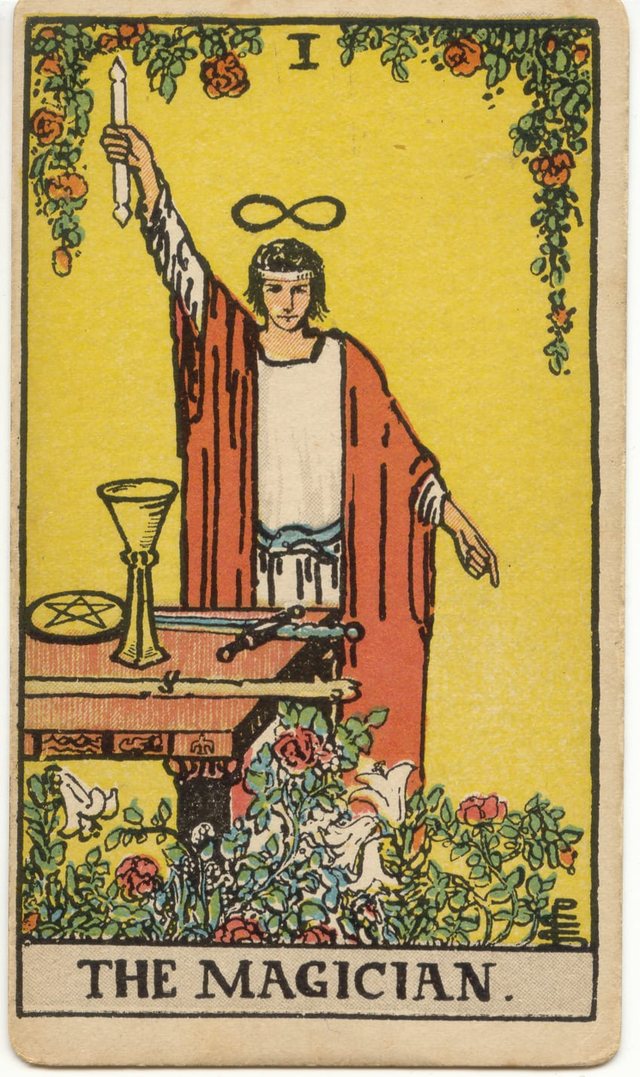
A young man in a red cloak over a white tunic stands behind a table, one arm raised with a white wand, the other pointing at the ground. A figure of eight lies on its side above his head. On the table are a cup, a sword, a coin marked with a star and a second wand: the emblems of the four suits. Roses and white lilies grow at his feet, and more roses hang overhead, all against a flat yellow sky.
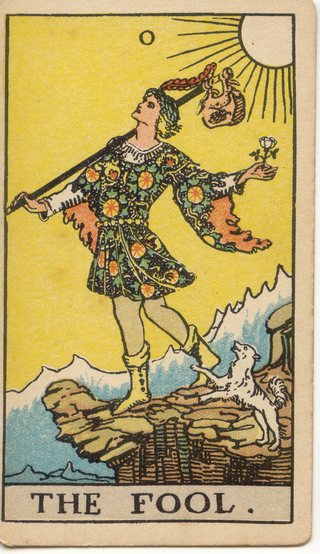
Where the Fool has nothing but possibility, the Magician has tools and knows how to use them. The card is about concentration: gathering scattered energy into a single point and putting it to work. His gesture joins the two halves of the picture, the raised wand drawing something down and the pointing hand placing it in the world. In a reading it often says that you already have what you need, in skills, contacts and materials, and the question is whether you will commit to using them.
The card's older names, the Juggler and the Mountebank, are a useful warning. The same skill that makes something real can also put on a show. The Magician is quick, persuasive and articulate, and he can describe a person who knows exactly how to present things. Whether that is craft or sleight of hand depends on intention, which is why the card asks for integrity as well as confidence.
The Magician reversed
Turned upside down, the Magician's talents point sideways. The card can point to manipulation, someone using charm or cleverness to get their way, or to your own temptation to bluff. It can also describe plans that never leave the table: ability without follow-through, or energy split across too many projects at once.
A gentler reading sees untapped potential. The tools are all laid out, but you are not reaching for them, perhaps because you doubt your right to. Readers who take reversals as blocked energy tend to read it this way, as a nudge to stop rehearsing and begin. The first attempt does not need to be impressive, only real.
In love and relationships
In love the Magician describes active pursuit: making the first move, saying clearly what you want, or a partner who is charming and good with words. It can also mean using those skills to repair something, finding the sentence that actually reaches the other person. The card's shadow is performance. If someone seems a little too polished, or you catch yourself presenting an edited version of who you are, the Magician suggests looking behind the act. Reversed, it can warn of mixed signals or manipulation.
In work and purpose
At work this is a strong card for launching, pitching and building. It suits makers, founders and anyone about to turn a plan into something real. It points to the resources already on your table: the skills you have, the people you know, the budget you have rather than the one you wish for. It also favours negotiation and clear communication. Reversed, it can warn of a colleague who overpromises, or of your own habit of preparing endlessly instead of finishing the thing.
As advice
Choose one aim and put everything you have behind it. Take stock of the tools already in your hands and use them now, rather than waiting for better ones. Say plainly what you intend, and make sure the confidence you show is backed by honest work.
Yes or no?
Yes The Magician favours initiative and the skill to carry it through, so it reads as yes if you are ready to act. How yes-or-no readings work here.
Questions to sit with
- What resources do I already have that I am not using?
- Where am I scattering my energy instead of focusing it?
- Am I acting with integrity here, or just putting on a convincing show?
Symbolism in the card
The raised wand and pointing hand
His right arm lifts a white wand, pointed at both ends, while his left hand points to the earth. Waite reads the gesture as grace 'drawn from things above and derived to things below': the familiar 'as above, so below', an idea brought down into practice.
The figure of eight
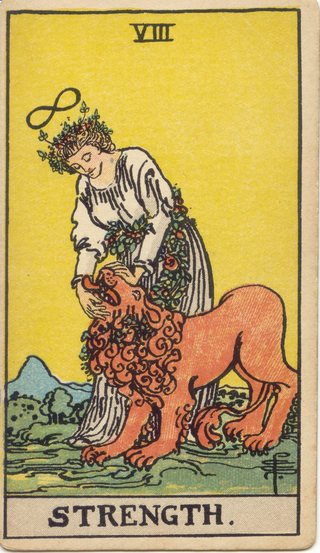
A horizontal figure eight floats over his head like a halo. It is the sign of infinity and of energy that does not run out; Waite calls it 'the sign of life, like an endless cord'. The same sign appears over the woman on Strength.
The four suit emblems
A cup, a sword, a coin engraved with a pentagram and a wand lie on the table. They are the emblems of the four suits and of the classical elements, water, air, earth and fire. The whole of the Minor Arcana is within his reach.
Pentagram in tarotStaff and wand in tarotCups and chalices in tarotSwords in tarot
The red cloak and white tunic
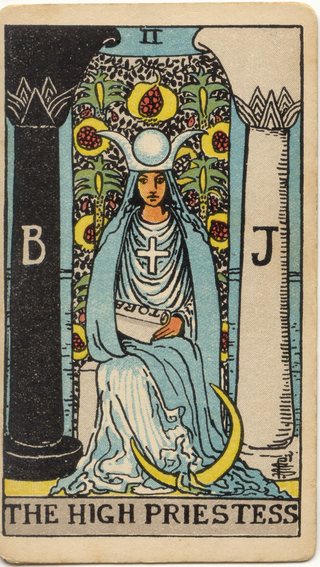
He wears a red cloak over a white tunic. Red is desire, energy and action; white is purity of intention. Together they suggest a strong will kept honest. The High Priestess, who follows him, is dressed in cool blue.
The sash
A blue sash is wrapped around his waist. Waite describes the Magician's girdle as a serpent devouring its own tail, an emblem of eternity, but in Smith's drawing no serpent is clearly shown and the sash reads as plain cloth.
The roses and lilies
Red roses and white lilies grow in front of the table, and a garland of roses hangs from the top of the card. Roses stand for desire, lilies for purity. Waite says these wild flowers are 'changed into garden flowers', aspiration cultivated by effort.
Red roses in tarotWhite lilies in tarotGardens and flowers in tarot
The yellow sky
The background is a plain, bright yellow, the colour of daylight and of the conscious mind. Nothing is hidden behind the Magician: he works in full view, which is part of what separates skill from trickery.
“On the table in front of the Magician are the symbols of the four Tarot suits, signifying the elements of natural life, which lie like counters before the adept, and he adapts them as he wills.”
Numbers, elements and astrology
Number 1: One
One is the single point, the first stroke: initiative, will and the seed of something. Aces and the Magician share it.
These are the traditional attributions of the Hermetic Order of the Golden Dawn (1888), which Waite and Smith followed: each trump is matched to a Hebrew letter and to an element, planet or zodiac sign. They are a symbolic system, not astronomy. How we checked them.
A little history
In early Italian sources the card is Il Bagatto or Bagatella, and in the Tarot de Marseille it is Le Bateleur: a street conjuror at a table of cups, dice and coins, holding a small wand more like a juggler's stick than a magic rod. The hand-painted Visconti-Sforza deck also shows a man seated at a table. Nineteenth-century French occultists, Éliphas Lévi above all, recast him as a magus, and the Golden Dawn built on that reading. Smith kept the table but laid the four suit emblems on it, added the infinity sign and the garden, and turned the trickster into a figure of will.