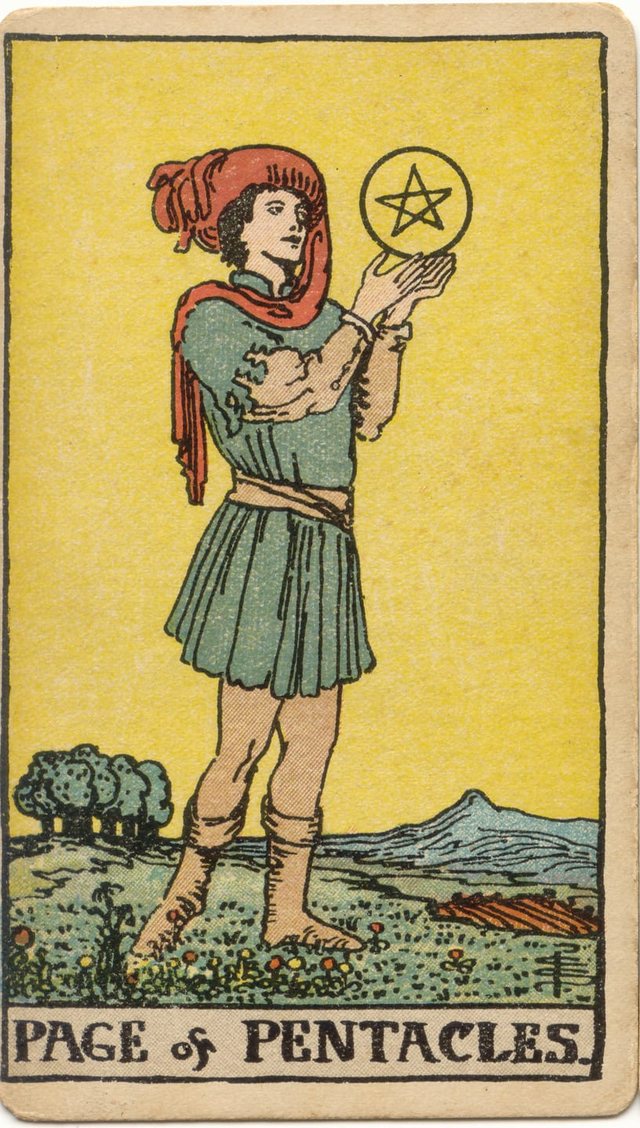
Page of Pentacles
Upright study · curiosity · a practical new start · diligence · good news about work
Reversed procrastination · lack of focus · unrealistic plans · careless spending
- Arcana
- Minor · court card
- Number
- Page
- Element
- 🜃 Earth
- Sub-element
- Earth of Earth
- Yes or no
- Yes
Page of Pentacles upright
A young man stands in a flowering meadow, holding a single pentacle just above his raised hands and gazing at it with complete attention. He wears a green tunic and a red hat with a long red scarf trailing down his back. Behind him the land opens out under a yellow sky: a small grove of trees on the left, a ploughed brown field and a blue mountain on the right.
The Pages are the students of the tarot, and this one is the most serious of them. Waite described him "looking intently at the pentacle" and moving slowly, "insensible of that which is about him". He is not dreaming about what the coin could buy; he is studying it, trying to understand what it is and what can be done with it. That makes him the card of apprenticeship, of reading the manual, of a first job or course of study taken on with care.
As a person, the Page of Pentacles might be someone young or new to a field who is steady, curious and reliable, or the part of yourself willing to start at the beginning. As an approach to a situation, the card suggests learning before acting, and treating a modest opportunity as worth real effort. The ploughed field behind him hints at what comes next: the slow work of turning study into something that grows.
Page of Pentacles reversed
Reversed, the coin drifts out of focus. Readers often see a student who has lost interest, a plan that stays in the planning stage, or procrastination dressed up as research. It can also describe someone so absorbed in details that they miss the larger picture, or so impatient for results that they skip the learning entirely.
Waite's reversed meanings, "prodigality, dissipation, liberality, luxury; unfavourable news", turn the Page's carefulness inside out: money and effort spent loosely. Some readers simply read the reversal as a delay in practical news or plans, or as a lesson that will need repeating before it sticks.
In love and relationships
In love, the Page of Pentacles describes a slow, sincere approach: someone who shows interest through reliability and small practical gestures rather than grand declarations. It can mark the early stage of a relationship where you are still learning about each other, or a partner who is steady but a little shy. Reversed, it may suggest hesitation that never turns into action, or a person more focused on their own plans than on the relationship.
In work and purpose
At work the card fits internships, training, starting a course, learning a new tool or receiving an offer connected to study or a first job. It favours careful groundwork, note-taking and asking questions. It can also point to a practical idea, perhaps a small business or side project, that deserves proper research. If you are mentoring someone, it can describe a promising newcomer worth investing in. Reversed, it suggests procrastination, poor follow-through or plans that need a more realistic footing.
As advice
Treat this as a time to learn. Study the thing in front of you properly, ask the basic questions and do not be embarrassed to start small. Make a simple plan and take the first practical step today, then keep showing up.
Yes or no?
Yes The Page brings a practical opportunity and the patience to use it, so it reads as a yes, though the results will take time. How yes-or-no readings work here.
Questions to sit with
- What am I curious enough about to study properly?
- Which small, practical step could I take today towards a larger goal?
- Where am I gathering information to avoid starting?
Symbolism in the card
The raised pentacle
He holds a single pentacle just above his upturned hands, almost floating, at eye level. Waite stresses how intently he looks at it: the coin is an object of study, something to understand before it is used.
The red hat and scarf
A loose red hat sits on his head, with a long red scarf falling over his shoulder and down his back. Red brings a note of energy and desire to an otherwise calm figure: his patience is not passivity.
The green tunic
His short green tunic is belted at the waist, with lighter sleeves and brown boots. Green is the colour of growing things and of earth in its living form, fitting a suit tied to the land.
The flowering meadow
He stands on a grassy slope dotted with small red and yellow flowers. The ground is fertile and fresh, a place where things can begin.
The ploughed field
On the right, a brown field lies in neat furrows. It suggests ground already prepared for planting: learning that is about to turn into work.
The trees and mountain
A small grove of round trees stands on the left and a blue mountain rises on the right horizon. The trees suggest steady growth; the distant mountain, a goal still far off.
The yellow sky
The background is a clear, bright yellow, as on several of Smith's more optimistic cards. It gives the scene a sense of clarity and good prospects.
“A youthful figure, looking intently at the pentacle which hovers over his raised hands. He moves slowly, insensible of that which is about him.”
Numbers, elements and astrology
Page
Pages are students and messengers: curiosity, news, the beginner's first approach to the suit.
Earth: the suit of Pentacles
Earth is the body, money, work, home and the slow growth of material things.
In the Golden Dawn system each court card is an element within its suit's element. Pages and Queens are agreed; Knights and Kings are Fire or Air depending on whether you follow the Golden Dawn's names or later practice. They are a symbolic system, not astronomy. How we checked them.
A little history
In Italian decks the lowest court card was the Fante, a page or servant, and in the Tarot de Marseille it is the Valet de Deniers, often shown standing with one coin held up and another on the ground. The Golden Dawn replaced the Pages with Princesses, but Waite restored the older title. Smith's version keeps the single standing figure with a coin and places him in an open landscape. Waite's text also preserves an older divinatory reading of the Page as "news, messages and the bringer thereof".