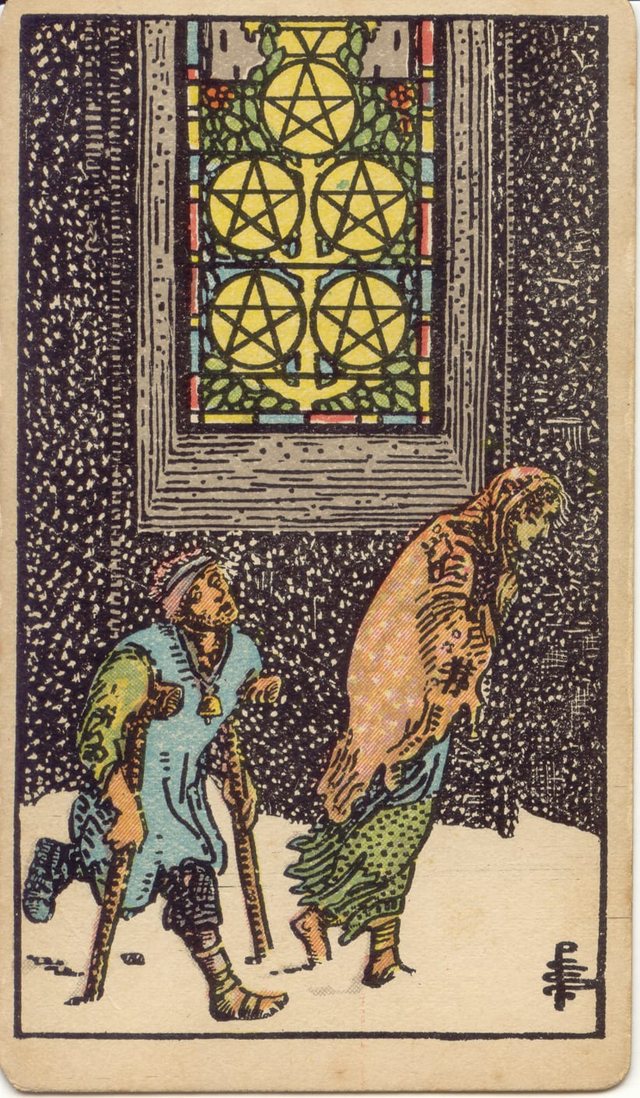
Five of Pentacles
Upright hardship · feeling excluded · worry · isolation · struggle
Reversed recovery · accepting help · the worst passing · finding shelter
- Arcana
- Minor · pip card
- Number
- Five
- Element
- 🜃 Earth
- Astrology
- ☿ Mercury in ♉ Taurus
- Golden Dawn title
- Lord of Material Trouble
- Yes or no
- No
Five of Pentacles upright
Two people struggle through falling snow. A man on crutches, his head bandaged and a bell hanging at his neck, looks up as he limps along; beside him a woman, barefoot, wraps a ragged pink shawl around herself and bows her head against the cold. Behind them, set into a dark wall, a lit stained-glass window shows five pentacles among green branches. Neither of them seems to see it.
This is the suit's hardest card. It speaks of times when the basics feel threatened: money tight, health strained, a home or a role lost, or a sense of being on the outside of a community that seems warm and closed. The suffering in the picture is physical and social at once. They are cold, but they are also passing by a building where others are inside.
The window is the card's turning point. It is lit, it is close, and the pair are walking right beneath it. Many readers see in it the help that exists but has not yet been asked for: a friend, a service, a community that would open its door. The card does not blame anyone for their hardship. It asks gently whether shame or exhaustion is keeping you from looking up.
Five of Pentacles reversed
In the reversed position the snow begins to ease, and readers often take it as the worst of a difficult period passing, the decision to accept help, or a return to shelter after a time outside. It can mark the moment someone finally asks for support or is welcomed back into a group they felt excluded from.
It can also describe hardship that is becoming chronic, or isolation that has lasted so long it feels normal. Waite's reversed meanings, "disorder, chaos, ruin, discord, profligacy", are harsher still, and readers who use reversals differ on whether this card improves or worsens upside down. Context is the guide; many modern readers lean towards recovery.
In love and relationships
In love, the Five of Pentacles can describe two people going through hard times together, still side by side even when everything else is scarce. That is worth noticing: Waite records that some cartomancers read this as a card of lovers and loyal partners. It can also show loneliness within a relationship, or feeling shut out of love altogether. Reversed, it suggests warmth returning, an end to a lonely stretch, or reaching out after a period of withdrawal.
In work and purpose
At work the card fits job loss, a lean period for a business, being passed over or feeling excluded from the inner circle. It is a card about stress around security rather than a statement about your worth. It can be a prompt to look for the resources you have not used yet: a mentor, a professional network, a support scheme. Reversed, it may point to recovery, a new opening after a hard season, or a team that finally lets you in.
As advice
Look up. There may be warmth and help closer than you think, and asking for it is not a failure. Stay close to the people who are walking through this with you. Take care of the basics first, and let others help you carry what is too heavy to carry alone.
Yes or no?
No The card describes hardship and exclusion, so it reads as a no for now, though help may be nearer than expected. How yes-or-no readings work here.
Questions to sit with
- Where am I walking past help because I do not feel entitled to ask for it?
- Who is beside me in this difficult stretch, and have I told them I see them?
- What would it take for me to knock on the door?
Symbolism in the card
The lit window
A tall stained-glass window glows yellow in the dark wall, showing five pentacles set among green leafy branches with small red flowers. It suggests shelter, charity and spiritual help: warmth that is present and visible, though the figures pass beneath it.
The man on crutches
A man in a blue tunic limps on two wooden crutches, his head bandaged and one leg wrapped. He looks up and ahead. He is the image of bodily hardship, but his raised head keeps some hope in the card.
The bell
A small bell hangs from a cord around the man's neck. It is often read as the bell lepers and outcasts were once made to carry, marking him as someone others avoid. The detail is small but it turns poverty into exclusion.
The woman in the shawl
A barefoot woman, bent forward, clutches a ragged pink and orange shawl around her head and shoulders over a green skirt. She walks with her face turned down and away from the window, the picture of exhaustion and shame.
The falling snow
White flecks fill the dark background and the ground is covered in snow. Winter is the season of scarcity, when what you have stored matters most; here it emphasises how exposed the two figures are.
The dark wall
The window is set into a heavy dark wall with no visible door. It suggests a world that seems closed to them, though the light inside says otherwise.
“Two mendicants in a snow-storm pass a lighted casement. Divinatory Meanings: The card foretells material trouble above all, whether in the form illustrated—that is, destitution—or otherwise.”
Numbers, elements and astrology
Five
Five breaks the square. It brings disruption, conflict and loss, the necessary instability that keeps a story moving. Most tarot fives are hard cards.
Earth: the suit of Pentacles
Earth is the body, money, work, home and the slow growth of material things.
By Golden Dawn tradition each numbered card from two to ten rules ten degrees of the zodiac (a decan): the Five of Pentacles is Mercury in the first decan of Taurus. They are a symbolic system, not astronomy. How we checked them.
A little history
In the Tarot de Marseille the Five of Coins is four coins in the corners with a fifth in the centre, decorated with foliage. The Golden Dawn named it the Lord of Material Trouble. Smith's snowbound scene of two beggars beneath a church window is her own design. Waite notes the curious split in earlier divinatory tradition, which read the card either as destitution or as love and affinity, and remarks that "these alternatives cannot be harmonized".