
Robes and colours in tarot
Clothing carries meaning in the deck through its colours, which follow loose traditions from Christian art and the Golden Dawn. Red is passion, action and desire; white is purity and spirit; blue is intuition, water and the inner life; yellow is intellect and the sun; grey is neutrality or wisdom; black is mourning, mystery or the unknown. The Magician wears red over white, the High Priestess flowing blue, the Hermit grey. The Fool's tunic is patterned with flowers, and one of the Hierophant's acolytes wears a robe sprigged with roses. Read colour as an emphasis, not a code.
Cards that show robes and colours
-
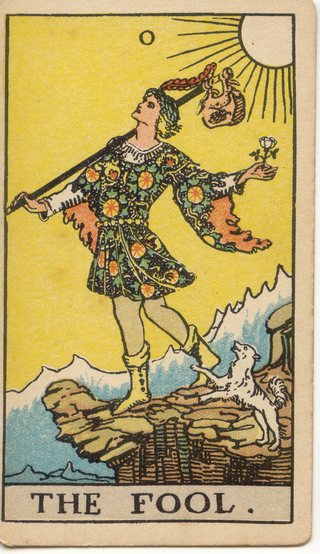 The Fool
: The flowered tunic
His dark tunic is covered in round orange-and-green motifs, like flowers or small wheels, and lined in orange-red at the sleeves. The rich clothes mark him as no beggar: Waite calls him 'a prince of the other world on his travels through this one'.
-
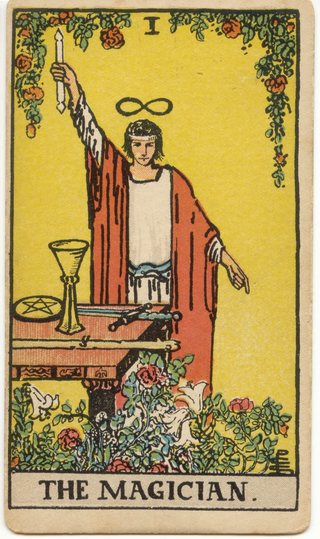 The Magician
: The red cloak and white tunic
He wears a red cloak over a white tunic. Red is desire, energy and action; white is purity of intention. Together they suggest a strong will kept honest. The High Priestess, who follows him, is dressed in cool blue.
-
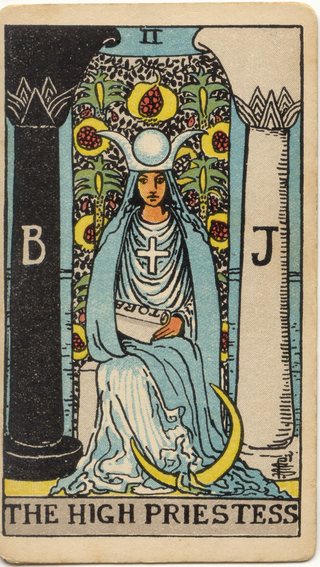 The High Priestess
: The flowing blue robe
Her pale blue mantle pours down and spreads across the floor in rippling folds, almost like water. Many readers see it as the source of the streams that run through later cards. Blue is the colour of depth, coolness and reflection.
-
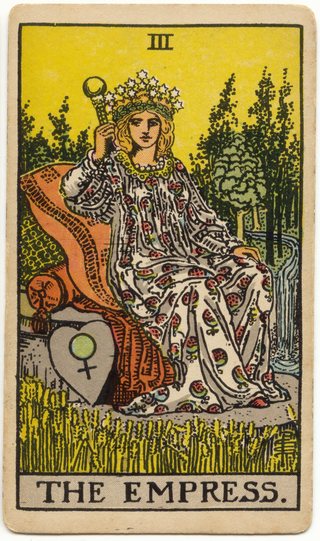 The Empress
: The patterned gown
Her loose white gown is scattered with red fruit, usually read as pomegranates. The fruit's many seeds make it an old emblem of fertility, and it links her with the High Priestess, whose veil carries the same fruit.
-
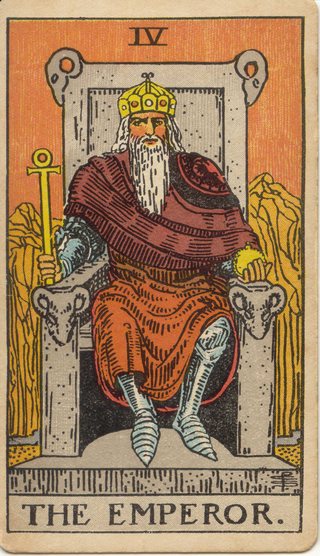 The Emperor
: The crown, robe and beard
A gold crown set with jewels, a deep red robe and a darker cape mark him as sovereign. Red is energy and will. His long white beard gives him age and experience: this is authority earned over time, not inherited yesterday.
-
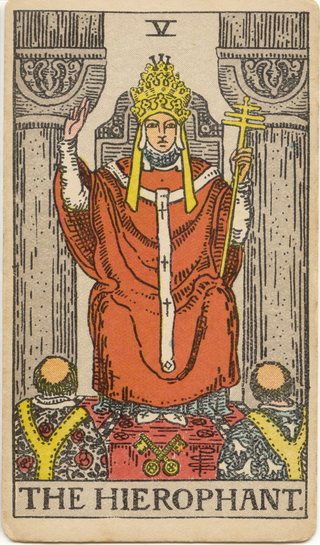 The Hierophant
: The kneeling ministers
Two tonsured men kneel before him with their backs to us, each wearing a yellow Y-shaped stole. One robe is patterned with red roses, the other with white flowers on blue, echoing the roses and lilies of the Magician: desire and purity, both come to be taught.
-
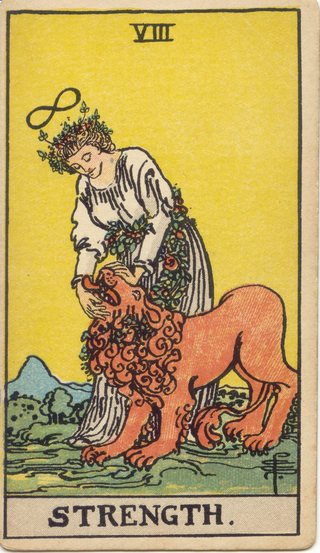 Strength
: The white gown
She wears a plain white gown. White is innocence and clear intention, and Waite connects the card with 'innocentia inviolata': goodness that stays untouched by the beast it handles.
-
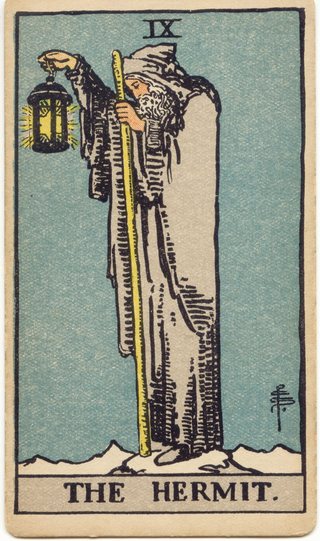 The Hermit
: The grey cloak
He is wrapped from head to foot in a heavy grey hooded cloak. Grey is the colour of age and of neutrality, neither black nor white; the hood suggests a man who has drawn back from the world and turned his attention inward.
-
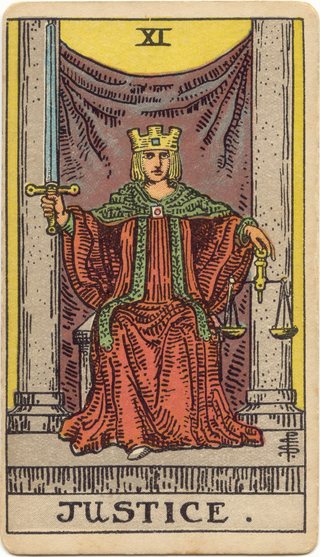 Justice
: The red robe and green cape
Justice wears a full red robe under a green cape fastened with a square clasp. Red is often read as action and will, green as growth and the natural world, so the clothing itself is a kind of balance between doing and allowing.
-
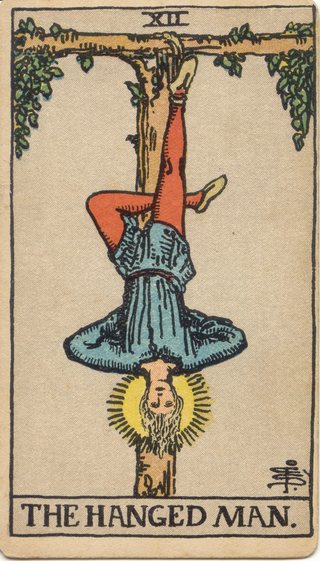 The Hanged Man
: The blue tunic and red hose
A belted blue tunic falls towards his head, with red hose on his legs and pale yellow shoes. Readers often take the red as passion and physical life and the blue as calm and thought, both held still in one body.
-
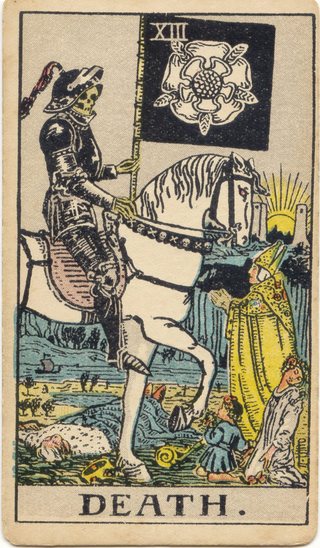 Death
Death: The bishop, maiden and child
A bishop in a gold mitre and vestments faces the rider with hands joined, a kneeling young woman turns her head aside, and a small child looks up with flowers in hand. They read as three responses to change: pleading, avoidance and simple openness.
-
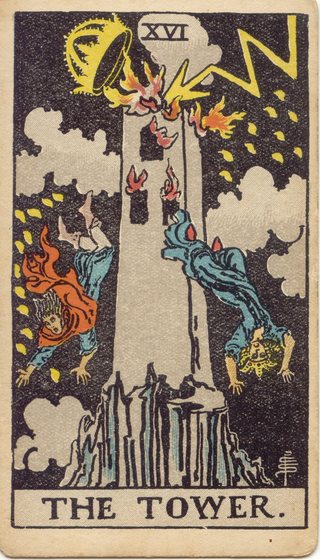 The Tower
: The two falling figures
On the left a bareheaded figure in a red cloak, on the right a crowned one in blue: both fall headfirst, hands out. They have been read as the two halves of a person (pride and reason, or the ruler and the ruled) and by Waite as 'the literal word made void and the other its false interpretation'.
-
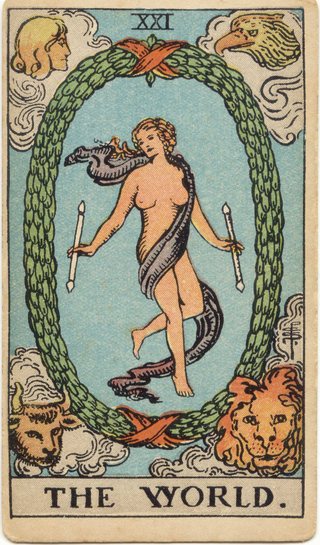 The World
: The violet scarf
A long scarf in violet-grey wraps around her shoulders and body, trailing below. Waite said the wind has girt her with it, 'and this is all her vesture'. It covers just enough to leave her balance and freedom visible.
-
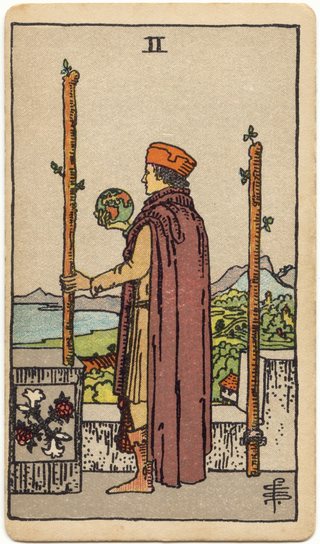 Two of Wands
: The red cap and dark cloak
He wears a red cap and a heavy brownish-purple cloak over a plain tunic. The rich, dark colours give him the air of a merchant or a lord, dressed for authority rather than for travel.
-
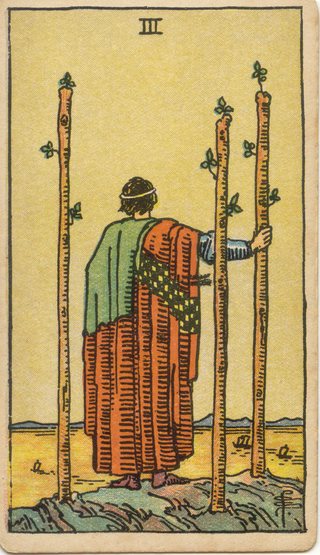 Three of Wands
: The red robe and green cape
A red robe, a green cape over one shoulder, and a band of yellow-and-black check across the back. Red for drive, green for growth: he carries both, dressed for standing still with purpose.
-
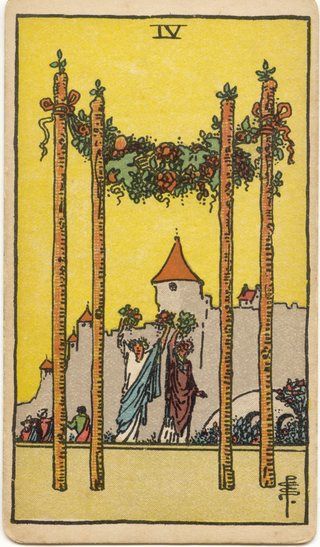 Four of Wands
: The two women with flowers
Two women, one in blue and white and one in deep red, lift bunches of flowers high over their heads. Waite calls them two female figures uplifting nosegays. Their gesture is greeting and thanksgiving.
-
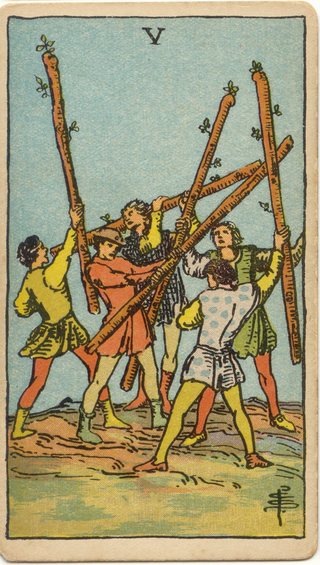 Five of Wands
: The five youths
Five young men in mismatched clothes, each in different colours, face in different directions. They are of an age and none stands above the others: a group of equals with no leader, each pulling his own way.
-
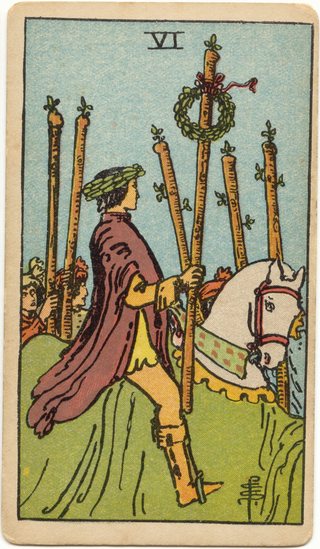 Six of Wands
: The rider's cloak
He wears a red-brown cloak over a yellow tunic, with tall boots. It is festive dress, the clothing of the man of the moment, someone who knows he is being watched.
-
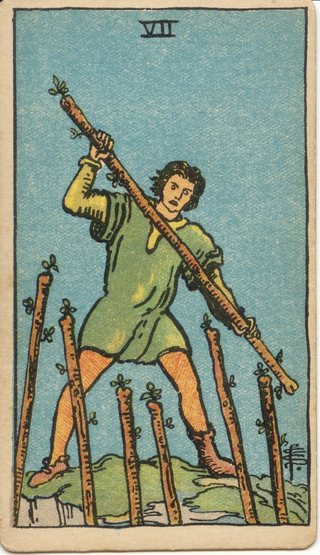 Seven of Wands
: The green tunic
He wears a loose green tunic with yellow sleeves: workaday clothes, not armour. He is no soldier, which makes his stand more about conviction than training.
-
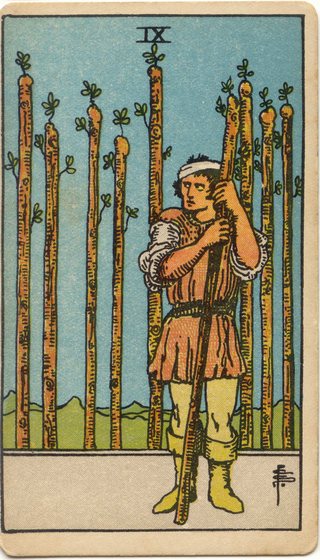 Nine of Wands
: His clothing
A reddish tunic, full white sleeves and pale yellow boots: the plain dress of a watchman rather than a lord. This is endurance at ground level, not command.
-
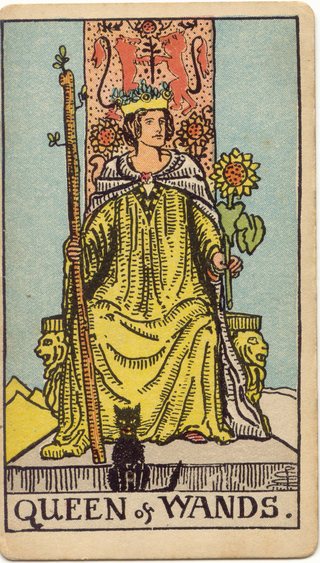 Queen of Wands
: The yellow gown and grey cloak
She wears a deep yellow gown with a pale grey cloak over her shoulders, fastened at the throat. Yellow, the colour of sunlight, runs through the whole Wands court.
-
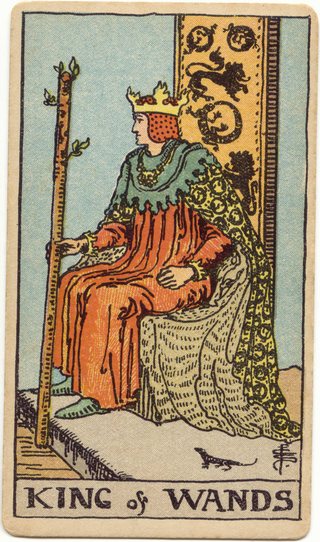 King of Wands
: The salamander cloak
A yellow cloak covered in black salamander patterns falls from his shoulders and pools on the throne. The same pattern clothes the Page and Knight: it marks them as one family of the suit.
-
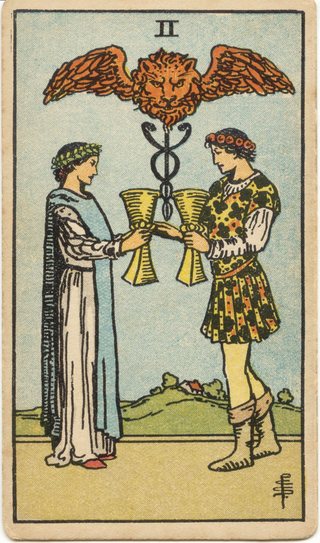 Two of Cups
: The woman's laurel wreath and mantle
She wears a green laurel crown, a white gown and a long pale-blue mantle, with red shoes. Laurel is a sign of honour and achievement, and her blue and white suggest calm and sincerity on her side of the exchange.
-
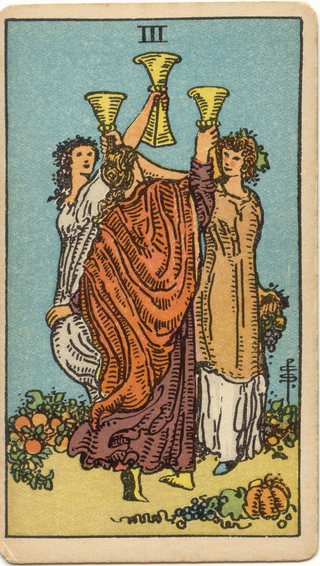 Three of Cups
: The three women
They stand close in a ring, the central one turned away from us. Many readers compare them to the Three Graces of classical art, figures of charm, joy and abundance. Their equality is part of the meaning: no leader, only company.
-
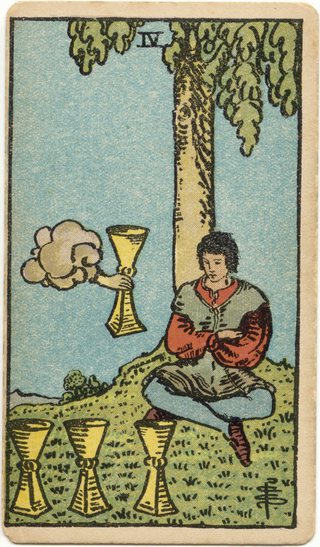 Four of Cups
: The seated young man
He sits cross-legged on a grassy mound, wearing a green jerkin over red sleeves and blue hose. His closed posture and lowered gaze show withdrawal: a person turned inward, either brooding or quietly working something out.
-
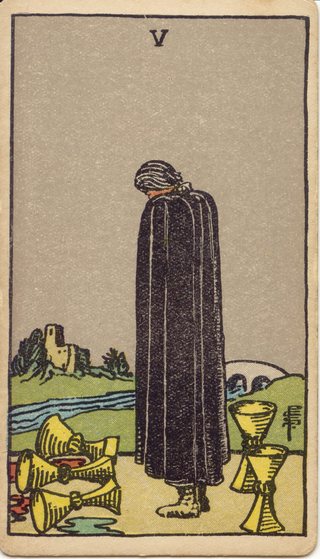 Five of Cups
: The black cloak
The figure is wrapped head to foot in a long black cloak, face hidden and head bowed. Black is the colour of mourning, and the all-covering cloak suggests someone drawing in on themselves to protect a private grief.
-
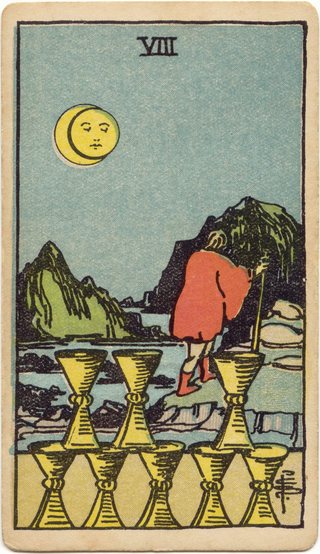 Eight of Cups
: The red-cloaked traveller
A man in a red cloak and red boots walks away from the viewer, leaning on a long staff. Red gives his departure energy and resolve, and the staff marks him as a pilgrim or wanderer.
-
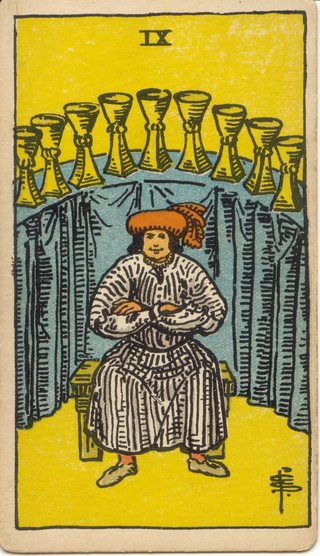 Nine of Cups
: The striped white robe
His long robe is white with dense black stripes, with red stockings beneath. It gives him the look of a comfortable host or merchant, someone at home among good things.
-
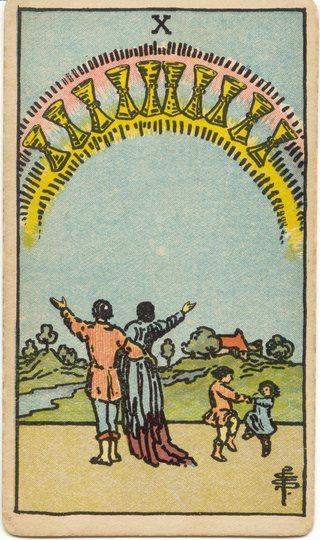 Ten of Cups
: The couple
A man in a short pink tunic and a woman in a long dark gown stand side by side, seen from behind, his arm round her waist. Each raises an arm to the sky: shared wonder, and a partnership facing the same way.
-
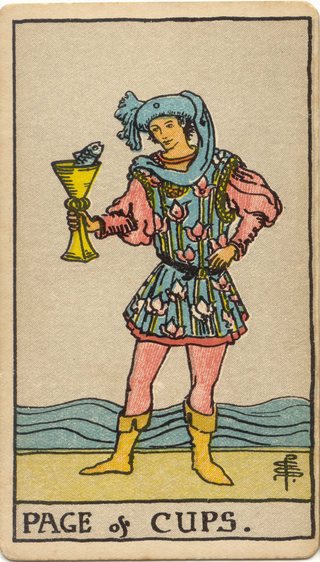 Page of Cups
: The lotus tunic
His blue tunic is printed with pink flowers that resemble lotuses or water-lilies, growing in rows like plants in water. The flowers tie him to the water of his suit and to gentle, unfolding growth.
-
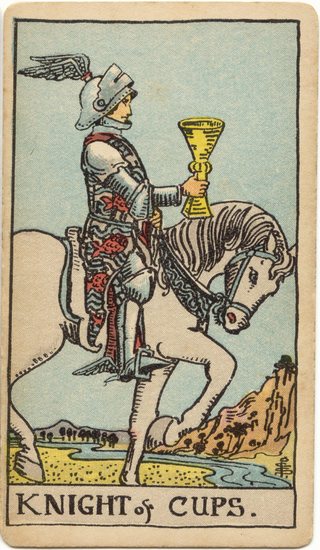 Knight of Cups
: The fish tunic
Over his armour he wears a tunic printed with red fish swimming among blue waves. It marks him clearly as a knight of water, carrying the suit's emotion and imagination on his body.
-
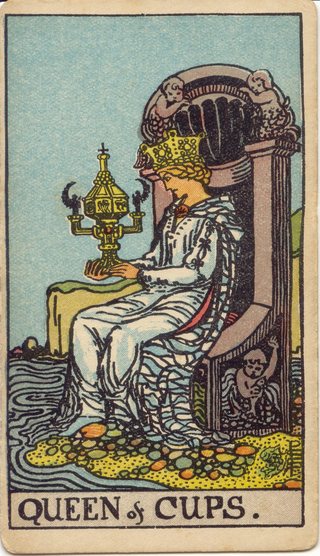 Queen of Cups
: The rippling robes
Her white gown and long mantle are drawn with flowing, wavy lines that look almost like water. Her clothing seems to merge with the sea, showing a person through whom feeling flows.
-
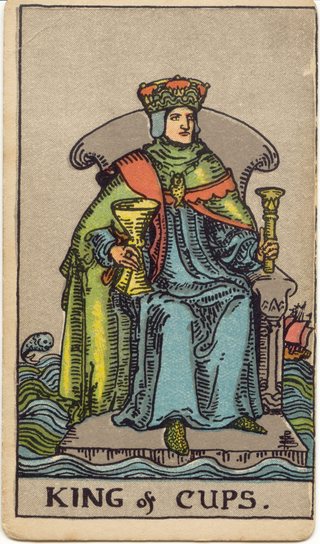 King of Cups
: The robes and cloak
He wears a long blue robe under a green cloak with a red scalloped collar. Blue suggests calm and depth, green growth, and the touch of red the warmth beneath his composure.
-
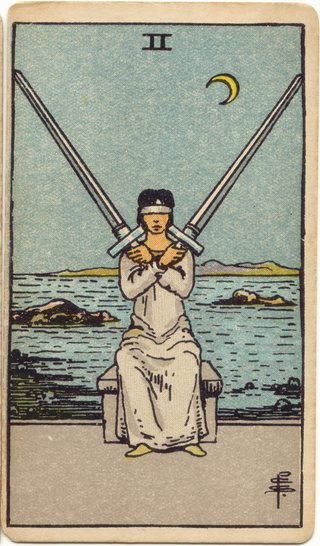 Two of Swords
: The white gown
Her robe is long, plain and pale, with no ornament. White can suggest innocence or neutrality, the stance of someone trying to stay out of a conflict by taking neither side.
-
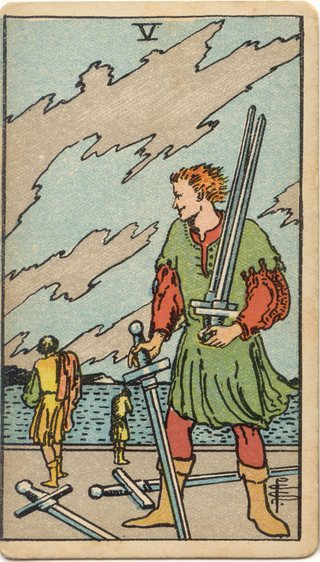 Five of Swords
: The smiling victor
The red-haired young man in green and red looks back at the others with a slight, knowing smile. Waite called him 'disdainful'. He is the picture of self-interest: someone who got what he wanted and is watching the cost walk away.
-
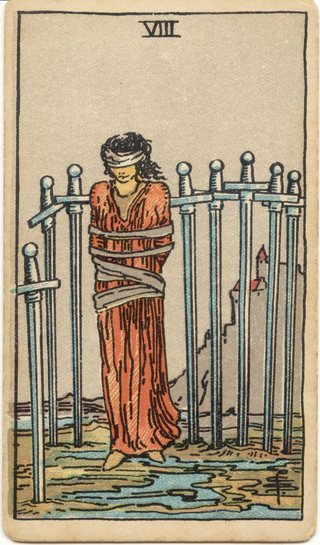 Eight of Swords
: The orange-red robe
Her long robe is warm red-orange against a grey world. Red carries life and passion, and suggests that the energy to break free is still there inside the restriction.
-
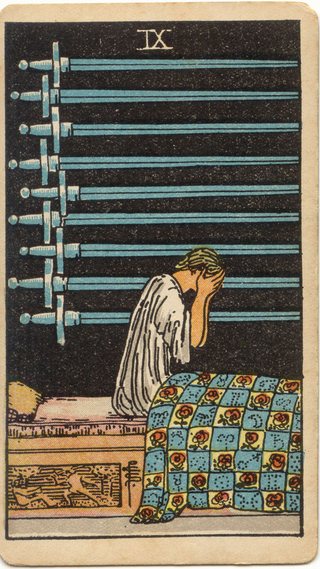 Nine of Swords
: The white nightgown
Her plain white gown makes her look exposed and vulnerable, a person stripped of the defences of the day and left alone with her mind.
-
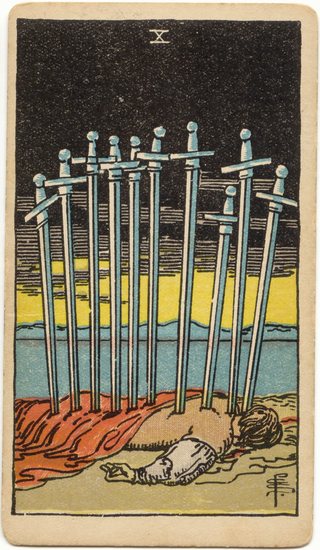 Ten of Swords
: The red cloth
A long red cloak or cloth spreads across the ground on the left. It can be read as blood or as the cloak he wore, and red as passion and life drained out onto the shore.
-
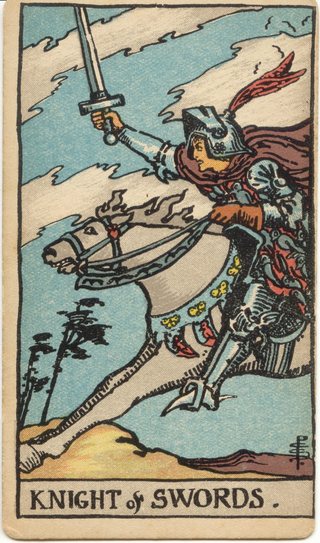 Knight of Swords
: The armour and red cloak
He is completely armoured, with a helmet, a red plume and a long dark red cloak flying back. The armour shows readiness for conflict; the red shows passion and urgency beneath the cool steel of the suit.
-
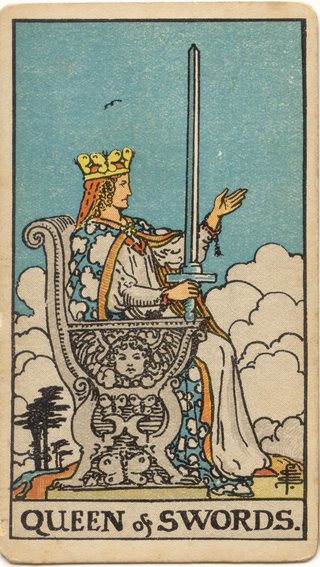 Queen of Swords
: The cloud-patterned cloak
Over a grey gown she wears a blue cloak patterned with white clouds. Clouds belong to air and thought, so she wears her element like a garment.
-
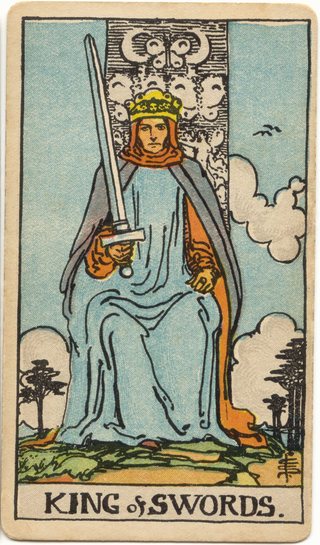 King of Swords
: The crown and hood
He wears a gold crown over an orange hood that frames his face. The crown marks his authority; the close hood gives him the look of a judge or scholar rather than a warrior.
-
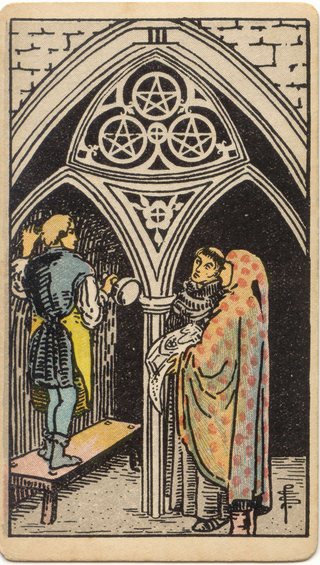 Three of Pentacles
: The monk
A man in a dark habit with a heavy grey cowl stands at the centre. He represents the church that commissioned the work: the purpose behind the craft, and the institution that will keep it.
-
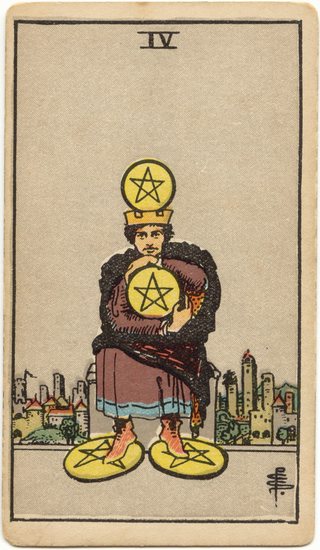 Four of Pentacles
: The black cloak
A heavy black cloak with a dark lining is wrapped around his purple robe like a protective shell. Black and heaviness add to the sense of closure: he is buttoned up, self-contained and defended.
-
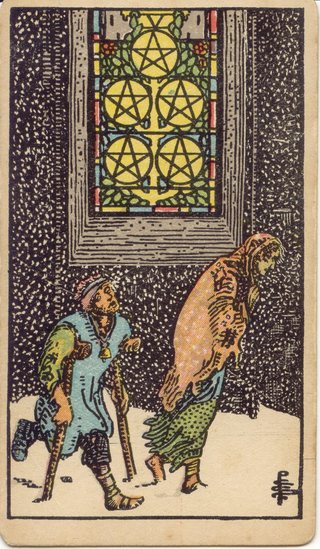 Five of Pentacles
: The woman in the shawl
A barefoot woman, bent forward, clutches a ragged pink and orange shawl around her head and shoulders over a green skirt. She walks with her face turned down and away from the window, the picture of exhaustion and shame.
-
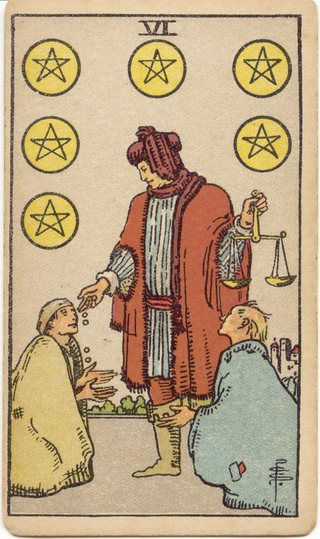 Six of Pentacles
: The merchant
A man in a long red cloak over a striped blue-grey tunic, with a red sash and a wrapped red hat, stands at the centre and looks down at the beggar on the left. Waite calls him a merchant: someone with means, choosing how to share them.
-
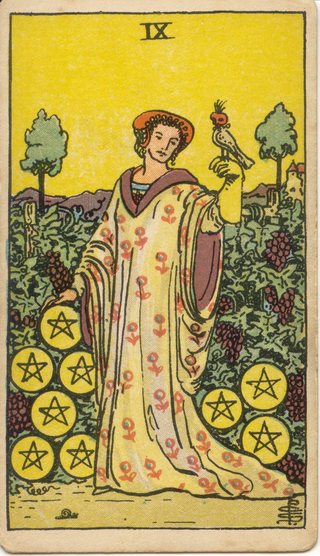 Nine of Pentacles
: The woman in the flowered robe
She wears a long yellow robe covered in small red flowers, some of which look strikingly like the Venus symbol, with a dark red cap. Yellow and Venus both suggest warmth, pleasure and refinement, enjoyed in a settled, unhurried way.
-
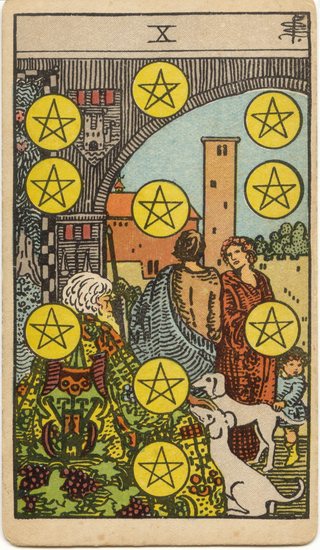 Ten of Pentacles
: The old man
A white-haired, bearded elder sits on the left in a long, richly patterned robe covered in small emblems, with bunches of grapes at his feet. He is the patriarch and the source of the family's wealth, the past generation keeping watch over what it made.
-
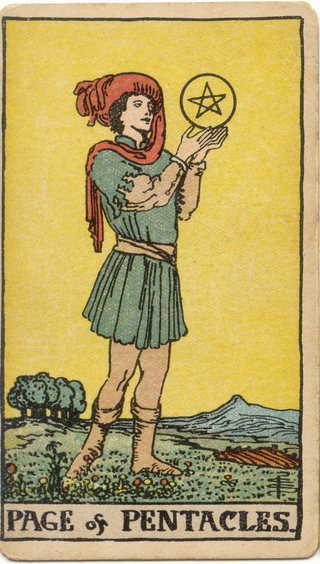 Page of Pentacles
: The red hat and scarf
A loose red hat sits on his head, with a long red scarf falling over his shoulder and down his back. Red brings a note of energy and desire to an otherwise calm figure: his patience is not passivity.
-
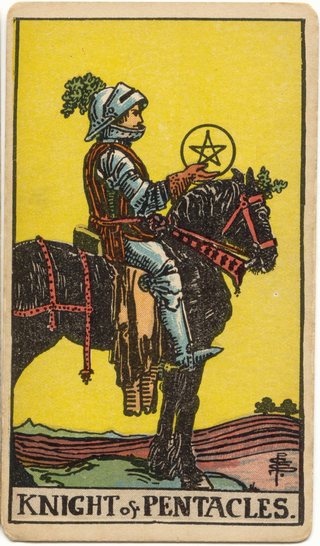 Knight of Pentacles
: The armoured knight
The rider wears full plate armour with a dark red tabard over it. His body is upright and steady, a picture of someone prepared, protected and in no hurry.
-
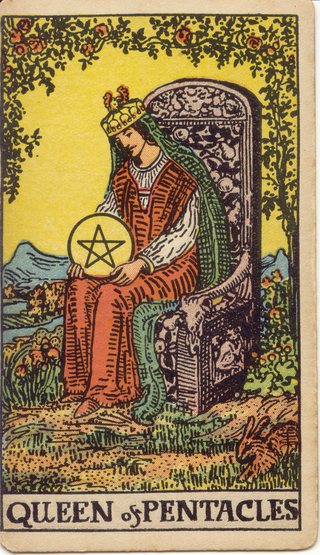 Queen of Pentacles
: The red robe and green veil
She wears a deep red robe over a white undergarment, with a green veil falling from her crown to the ground. Red suggests warmth and vitality, green growth and the earth, the two sides of her practical, life-giving care.
-
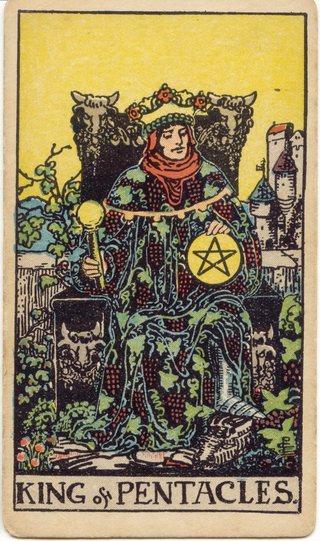 King of Pentacles
: The robe of grapes and vines
His dark robe is covered in bunches of grapes and green vine leaves, which blend into the real vines growing around him. Grapes are a symbol of abundance and harvest; he is almost part of the garden he tends.