Major Arcana · IX
The Hermit
Upright solitude · introspection · inner guidance · wisdom · withdrawal
Reversed isolation · loneliness · avoidance · refusing counsel
- Arcana
- Major
- Number
- IX
- Element
- 🜃 Earth
- Astrology
- ♍ Virgo
- Hebrew letter
- Yod י
- Yes or no
- Maybe
The Hermit upright
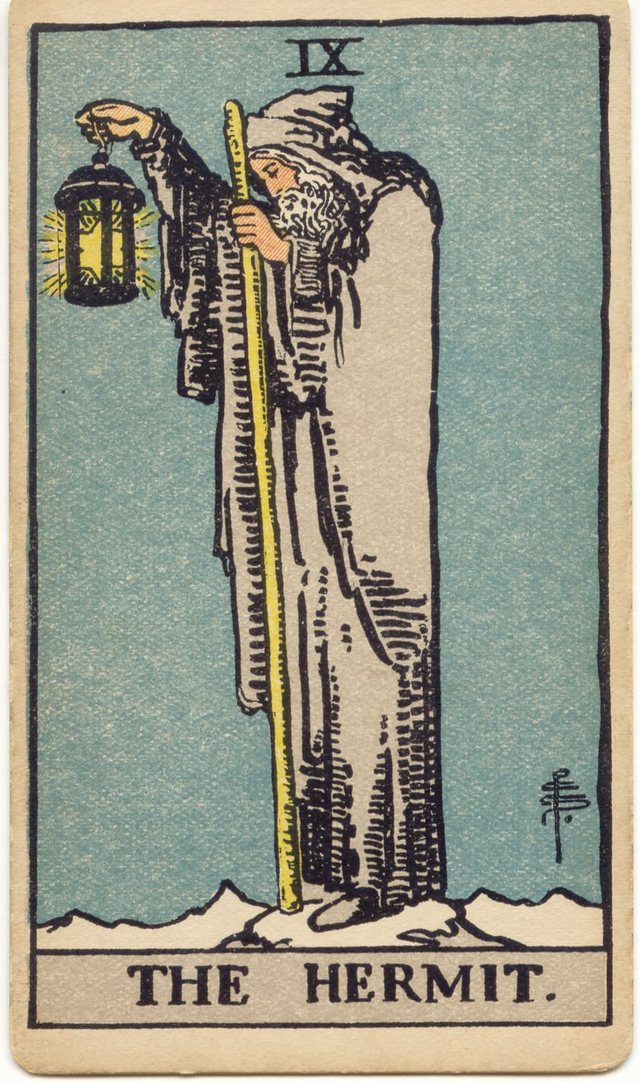
An old man in a long grey hooded cloak stands alone on a snowy height. He leans on a tall yellow staff and holds a lantern out at arm's length, its light glowing yellow. His head is bowed and his eyes are lowered. There is nothing else in the card: no path, no companion, only a plain blue-grey sky around him.
The Hermit is the card of withdrawal for the sake of understanding. He has climbed away from the world, not out of bitterness, but because some things can only be seen in quiet. In a reading it can mean taking time alone, stepping back from a busy situation, studying something in depth, or looking for answers that other people cannot give you. It honours the slow, solitary kind of wisdom that grows out of experience.
Yet he holds his lantern up and out, not close to his chest. Waite was firm that the Hermit is not simply a seeker but someone who has arrived, and that his light is a beacon for those still climbing. So the card has an outward side too: becoming a mentor, sharing what you have learned, or finding a guide who has walked the path before you. Solitude here is a means, not an end.
The Hermit reversed
The shadow side of the Hermit is isolation, and the reversal often shows solitude that has curdled into it: cutting yourself off, refusing help, or hiding from problems and calling it reflection. It can describe loneliness that was never chosen, or a withdrawal that has gone on too long.
Some readers see the opposite: a resistance to solitude, filling every moment with company and distraction so that you never have to sit with your own thoughts. Either way the card asks for balance, enough time alone to hear yourself and enough connection to stay part of the world. A light held up for no one in particular still needs someone to see it.
In love and relationships
In love the Hermit often signals a need for space: time to understand what you want before committing, or a period of being single that is chosen and useful. Within a relationship it can describe a partner who needs solitude, which is not the same as rejection. It can also point to a love that is quiet and deep rather than showy. Reversed, it may show withdrawal that is hurting a relationship, or loneliness that makes it hard to see someone clearly.
In work and purpose
At work the Hermit suits research, writing, specialist knowledge and careful work done away from the crowd. It may suggest stepping back from a project to rethink its direction, taking a sabbatical, or asking an experienced mentor for advice. It can also mark the point when you become the expert others consult. Reversed, it may warn of isolation within a team, a project developed alone for too long, or a refusal to ask for guidance.
As advice
Step back and give yourself quiet. Turn down the noise, think things through on your own terms, and trust the small light you have rather than waiting for full daylight. Once you have found your answer, consider holding it up for someone else.
Yes or no?
Maybe The Hermit asks for more time and reflection before deciding, so it reads as not yet, or only after careful thought. How yes-or-no readings work here.
Questions to sit with
- What question do I need silence to answer?
- Am I withdrawing to reflect, or to avoid something?
- Whose lantern could guide me, and whom could mine guide?
Symbolism in the card
The lantern
He holds out a dark lantern with yellow light streaming from it. Waite writes that 'it is a star which shines in the lantern', though in the drawing the star is hard to make out. Unlike older versions, the lamp is not half hidden in his cloak: his light is offered openly.
The staff
A tall yellow staff in his left hand steadies him on the uneven peak. It is the pilgrim's staff, the support of experience and the authority of age, and it echoes the wands carried by the Fool and the Magician.
The grey cloak
He is wrapped from head to foot in a heavy grey hooded cloak. Grey is the colour of age and of neutrality, neither black nor white; the hood suggests a man who has drawn back from the world and turned his attention inward.
The snowy height
He stands on white, snow-covered ground at the top of the world. Snow and height suggest isolation, clarity and attainment: he has climbed to where he can see far, though it is cold and solitary there. Waite calls it 'an eminence'.
The bowed head
His head is bowed and his eyes lowered, above a long white beard. He is not admiring the view but looking inward. Waite saw in him 'the Ancient of Days', an image of age and lasting wisdom.
The empty sky
The background is a flat, empty blue-grey, with no sun, no town and no road. The emptiness reinforces the solitude: everything he needs to find his way is what he carries.
“His beacon intimates that "where I am, you also may be."”
Numbers, elements and astrology
Number 9: Nine
Nine stands just short of completion: the fullness of a suit's energy, sometimes as fulfilment and sometimes as its burden.
Earth
Earth is the body, money, work, home and the slow growth of material things. The Golden Dawn tied The Hermit to Virgo, a sign of Earth.
These are the traditional attributions of the Hermetic Order of the Golden Dawn (1888), which Waite and Smith followed: each trump is matched to a Hebrew letter and to an element, planet or zodiac sign. They are a symbolic system, not astronomy. How we checked them.
A little history
In the fifteenth-century Visconti-Sforza cards this figure is an old man holding an hourglass, and he is often read as a personification of Time. By the time of the Tarot de Marseille he is L'Hermite, a hooded old man with a staff and a lantern half covered by his cloak. Court de Gébelin, in the eighteenth century, explained him as a wise man in search of truth and justice, a reading Waite explicitly rejected in favour of a card of attainment. Smith keeps the Marseille figure but stands him on a snowy height, with the lantern held clear of the cloak.