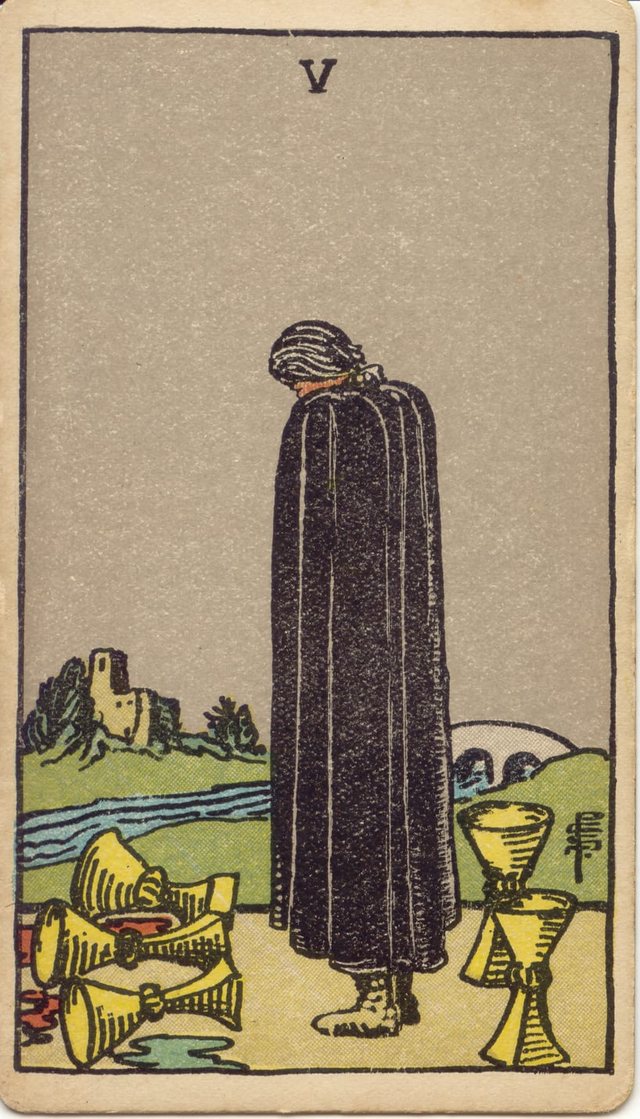
Five of Cups
Upright loss · grief · regret · disappointment · dwelling on what went wrong
Reversed acceptance · moving on · forgiveness · turning towards what remains
- Arcana
- Minor · pip card
- Number
- Five
- Element
- 🜄 Water
- Astrology
- ♂ Mars in ♏ Scorpio
- Golden Dawn title
- Lord of Loss in Pleasure
- Yes or no
- No
Five of Cups upright
A tall figure in a long black cloak stands with head bowed, turned away from us. At their feet on the left, three cups lie knocked over, red and green liquid spilling from them onto the ground. To the right, behind their back and out of their line of sight, two cups still stand upright. Beyond them a river runs across the card; a stone bridge crosses it on the right, and on the far bank a small ruined tower stands among trees under a flat grey sky.
The Five of Cups is the card of mourning. Something has been lost or spoiled: a relationship, a hope, a plan, a version of the future you had been counting on. The card does not hurry this. The figure's cloak covers them almost completely, and grief of this kind does need time and shelter. Waite calls it 'a card of loss, but something remains over'.
That remainder is the card's quiet second message. Two cups are still full, and there is a bridge home across the water. The figure cannot see them yet because they are looking at the spill. Nothing in the image says they should stop grieving; it simply shows that the loss is not the whole of the situation. When the time comes to turn round, there is something there to turn towards.
Five of Cups reversed
Reversed, the card often describes the turn itself: the moment you begin to accept a loss and look at what is left. Readers commonly take it as healing, forgiveness of yourself or someone else, or a willingness to cross the bridge and get on with things.
Some readers see a less settled reversal: grief that has been pushed down rather than worked through, or regret that has hardened into a habit of looking back. Waite's own reversed meanings run in a different direction again, towards 'return', 'ancestry' and 'alliances', which some readers keep as a sign of reconnecting with family or old friends. All of these share one idea: the cloaked figure is starting to face a new way.
In love and relationships
In love the Five of Cups often describes heartbreak or disappointment: a break-up, a betrayal, or a relationship that has not turned out as hoped. It can also show someone so focused on what went wrong in the past that they cannot see the warmth available now. Within a relationship it may point to a hurt that has not been talked through. Reversed, it suggests forgiveness and readiness to love again, or making peace with an old loss.
In work and purpose
At work the card fits a setback that stings: a project that failed, a job lost, a bid that went to someone else, or an effort that was not recognised. Feeling the disappointment is reasonable. The card's caution is against letting one loss become the only story you tell about your working life. Look at what still stands: skills, contacts, the parts that did work. Reversed, it suggests recovering from a setback and learning from it.
As advice
Let yourself grieve what is gone; it mattered. But when you are ready, turn round slowly and count what is still standing. Two full cups are not nothing. The bridge is there whenever you want to cross it, and you do not have to cross it today.
Yes or no?
No The spilled cups put loss and disappointment at the front of the card, so it reads as a no, though not a final one. How yes-or-no readings work here.
Questions to sit with
- What am I still grieving, and have I let myself grieve it fully?
- What remains to me that I have not been looking at?
- What would it take for me to cross the bridge?
Symbolism in the card
The black cloak
The figure is wrapped head to foot in a long black cloak, face hidden and head bowed. Black is the colour of mourning, and the all-covering cloak suggests someone drawing in on themselves to protect a private grief.
The three spilled cups
Three cups lie on their sides on the left, with red and green liquid running from them. They are what has been lost or wasted. Waite's reading is direct: 'three have been taken, but two are left'.
The two standing cups
Two upright cups stand behind the figure on the right, still whole. Because they are out of the figure's sight, they carry the card's hope: what remains is real, only unnoticed.
The river
A blue river runs across the middle of the picture, between the figure and the far bank. Water is the element of Cups, and here it marks the flow of feeling and a separation that must be crossed.
The bridge
A pale stone bridge with arches crosses the river on the right. It offers a way across: towards home, recovery or the next stage, available whenever the figure turns to it.
The ruined tower
On the far bank to the left stands a small crumbling tower among dark trees. Waite calls it a 'keep or holding'. It can be read as the security or home that still exists beyond the loss, weathered but standing.
The grey sky
The sky is a flat, even grey, without sun or cloud. It gives the card its muted, heavy mood and matches the stillness of a person who is not yet ready to move.
“It is a card of loss, but something remains over; three have been taken, but two are left; it is a card of inheritance, patrimony, transmission, but not corresponding to expectations”
Numbers, elements and astrology
Five
Five breaks the square. It brings disruption, conflict and loss, the necessary instability that keeps a story moving. Most tarot fives are hard cards.
Water: the suit of Cups
Water is feeling, intuition, relationships and the imagination.
By Golden Dawn tradition each numbered card from two to ten rules ten degrees of the zodiac (a decan): the Five of Cups is Mars in the first decan of Scorpio. They are a symbolic system, not astronomy. How we checked them.
A little history
The Tarot de Marseille Five of Cups is an unillustrated pattern of five cups among foliage. The Golden Dawn titled it the Lord of Loss in Pleasure, which suits Smith's picture well. Waite's meanings of inheritance and patrimony, and his note that some interpreters read it as 'a card of marriage', probably come from older French cartomantic lists rather than from the image. The mourning figure, the spilled cups and the bridge are Smith's own composition.