Six of Pentacles
Upright generosity · giving and receiving · fair exchange · support · sharing resources
Reversed strings attached · unequal power · debt · giving to be seen
- Arcana
- Minor · pip card
- Number
- Six
- Element
- 🜃 Earth
- Astrology
- ☽ Moon in ♉ Taurus
- Golden Dawn title
- Lord of Material Success
- Yes or no
- Yes
Six of Pentacles upright
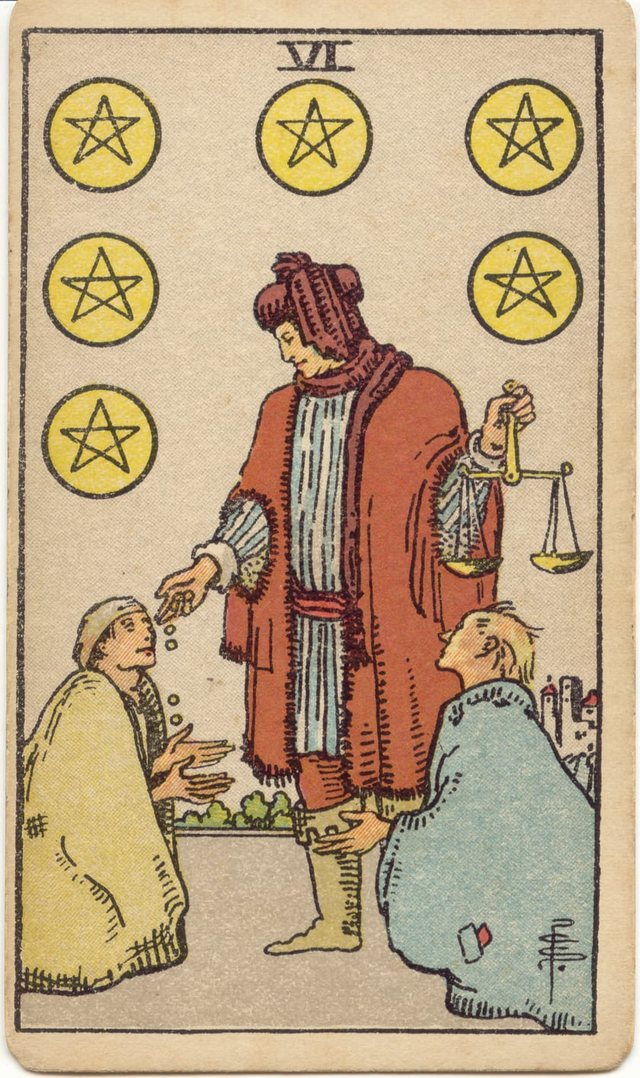
A well-dressed man in a red cloak and turban-like hat stands between two kneeling figures. In his left hand he holds a small pair of scales, perfectly level; with his right he lets a few coins fall into the open hands of a beggar in a patched yellow cloak. A second figure in blue kneels on the other side, looking up and waiting. Six pentacles hang in the pale sky above them.
After the hardship of the Five, the Six shows resources moving again. It is a card about the flow of help: giving when you have enough, receiving when you need to, and the fairness that should govern both. Waite called the figure a merchant and saw the scene as "a testimony to his own success in life, as well as to his goodness of heart". The scales are the important detail. This is generosity that has been thought about, measured and given in proportion.
But the picture is also frank about power. One person stands and two kneel. One decides; the others hope. The card asks you to notice which position you are in and how it feels. Giving can be kind and still create obligation, and receiving can be necessary and still be hard on the pride. A healthy Six is one where everyone can stand up again afterwards.
Six of Pentacles reversed
Reversed, the scales tip. Readers often see generosity with strings attached, help that keeps someone dependent, or charity given mainly so the giver can be seen giving. It can also describe a debt that is becoming a burden, or a person who always gives and never allows themselves to receive.
Waite's reversed keywords, "desire, cupidity, envy, jealousy, illusion", point to resentment around who has what. Readers who do not use reversals may still read these shadows into the card when nearby cards suggest imbalance. The question it raises is whether the exchange in front of you is fair, and who is quietly paying for it.
In love and relationships
In love, the Six of Pentacles is about the give and take that keeps a relationship balanced: time, attention, money and care flowing both ways. It can describe a partner who supports you through a hard stretch, or a season when you are the one holding things together. The card asks whether that support feels mutual over time. Reversed, it may point to one person keeping score, a relationship where gifts replace intimacy, or a power imbalance that neither partner names.
In work and purpose
At work this card fits pay, funding, grants, mentoring and any situation where resources are being shared out. It favours transparent criteria and fair treatment; the scales are a reminder to weigh things properly. You may be the one offering opportunities to others, or the one asking for support, and either is fine. Reversed, it can describe unfair pay, favouritism, or help from a manager or patron that comes with expectations you did not agree to.
As advice
Give where you can, and do it with care rather than for credit. Accept help when you need it without feeling diminished. Pay attention to the balance between you and the people you share with, and make sure everyone can stand on their own feet in the end.
Yes or no?
Yes Resources and goodwill are flowing in the card, so it reads as a yes, especially where help or a fair exchange is involved. How yes-or-no readings work here.
Questions to sit with
- Am I more comfortable giving or receiving, and what does that tell me?
- Is there an exchange in my life that has quietly become unequal?
- Who has helped me recently, and how could I pass that on?
Symbolism in the card
The merchant
A man in a long red cloak over a striped blue-grey tunic, with a red sash and a wrapped red hat, stands at the centre and looks down at the beggar on the left. Waite calls him a merchant: someone with means, choosing how to share them.
The scales
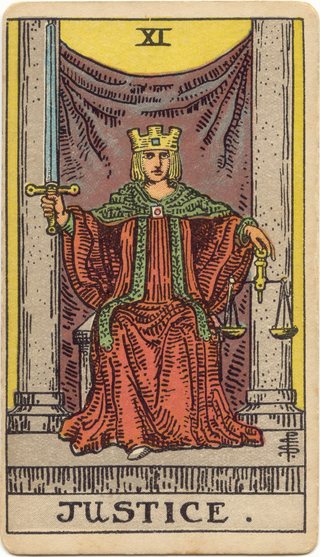
He holds a small pair of balance scales level in his left hand. Scales are the classic emblem of fairness and judgement, the same device carried by Justice, and here they suggest that his giving is measured, deliberate and fair.
The falling coins
A few small coins drop from his right hand into the beggar's cupped palms. They are tiny compared with the six pentacles above, which suggests that what is given is a portion, not the whole of his wealth.
The kneeling figures
Two people kneel at his feet, one in a patched yellow cloak with hands raised to catch the coins, the other in blue on the right, reaching out and looking up. The difference in height spells out the uneven power of giver and receiver.
The six pentacles
Six coins frame the scene from above: three down the left side, two on the right and one at the top centre. They frame the merchant like a halo of good fortune, the wealth from which he gives.
The town in the distance
A small walled town with a tower and green trees appears low on the right horizon. It places the scene on the edge of a settled community, the world of trade the merchant belongs to.
“A person in the guise of a merchant weighs money in a pair of scales and distributes it to the needy and distressed. It is a testimony to his own success in life, as well as to his goodness of heart.”
Numbers, elements and astrology
Six
Six restores harmony after the five's upset: generosity, recovery, sharing and passage onward.
Earth: the suit of Pentacles
Earth is the body, money, work, home and the slow growth of material things.
By Golden Dawn tradition each numbered card from two to ten rules ten degrees of the zodiac (a decan): the Six of Pentacles is Moon in the second decan of Taurus. They are a symbolic system, not astronomy. How we checked them.
A little history
The Tarot de Marseille's Six of Coins shows six coins in two columns divided by flowering stems, with no figures. The Golden Dawn named it the Lord of Material Success. Smith added the merchant, his scales and the two beggars, a scene that reads naturally after her Five of Pentacles. The scales link the card visually to Justice, though Waite does not draw that connection himself in his text.