Six of Cups
Upright nostalgia · childhood memories · innocent kindness · old friends · a simple gift
Reversed stuck in the past · idealised memories · moving forward · outgrowing old patterns
- Arcana
- Minor · pip card
- Number
- Six
- Element
- 🜄 Water
- Astrology
- ☉ Sun in ♏ Scorpio
- Golden Dawn title
- Lord of Pleasure
- Yes or no
- Yes
Six of Cups upright
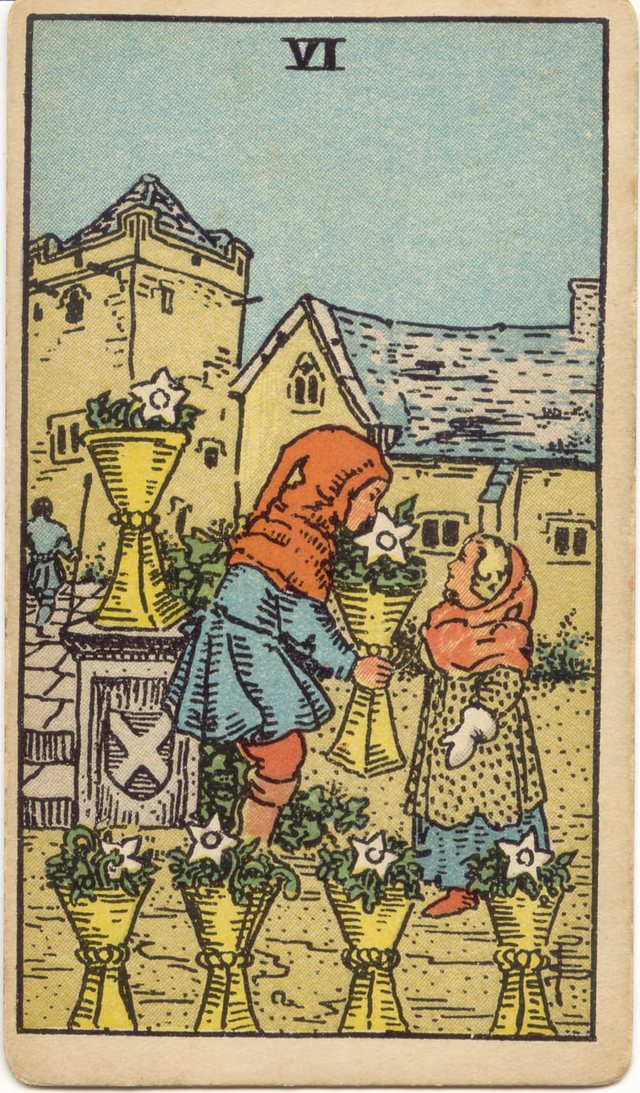
In the courtyard of an old town, a boy in a red hood and blue tunic bends towards a smaller girl and hands her a cup filled with white star-shaped flowers. She wears a red headscarf and a spotted dress, with a white mitten on one hand. Five more cups stand around them, each planted with the same white flowers, one of them raised on a stone pedestal carved with a shield and a diagonal cross. Behind are a square tower, steep roofs and yellow walls, and on the far left a small figure walks away down a lane.
This is the card of the past, and of a particular kind of goodness: unforced, small, childlike. Waite calls it 'A card of the past and of memories', and readers often see in it the pull of childhood, of a home town, of an old friend who turns up again. Its gift is the reminder of what you were like before you learned to be careful.
Memory is not always accurate, and the card is honest about that too. The scene is sheltered, almost too safe, and the walls are old. The Six of Cups asks you to draw sweetness from the past without trying to live there. At its best it describes giving something with no thought of return, the way children sometimes do, and receiving it with the same openness.
Six of Cups reversed
The commonest reading of the reversal is being caught in the past: replaying old times, holding a memory up as the standard nothing in the present can meet, or clinging to a childhood role inside a family. It can also describe a past that was not as kind as nostalgia paints it.
Many readers see a hopeful turn in the reversal as well. Waite's reversed meanings are 'The future, renewal, that which will come to pass presently', and readers who follow him take it as a sign of leaving old patterns behind and looking forward. Whether it reads as stuck or as released usually depends on what you are doing with your memories.
In love and relationships
In love the card can describe a sweet, uncomplicated affection, a relationship with a strong shared history, or someone from the past coming back into view: a childhood sweetheart, an old friend, an ex. It favours tenderness and small gestures over grand passion. It can also ask whether you are comparing a partner to a memory. Reversed, it may point to an attachment to an old relationship that is preventing a new one, or to finally letting it go.
In work and purpose
At work the Six of Cups can point to returning to an earlier interest, reconnecting with a former colleague, or work with children, teaching, heritage or care. It values goodwill and kindness between colleagues. It can also warn against 'the way we have always done it': fondness for an old method is not a reason to keep it. Reversed, it suggests moving on from a past role or reputation and letting new work define you.
As advice
Go back to something you loved before you had to be sensible about it, and see what it still has to teach you. Offer a kindness without expecting anything in return. Then come back to the present: the past can nourish you, but it cannot be lived in.
Yes or no?
Yes The card shows a gift freely offered and warmly received, so it reads as a gentle yes, often linked to something familiar. How yes-or-no readings work here.
Questions to sit with
- What did I love doing as a child that I have let go of?
- Which memory do I keep returning to, and what does it give me?
- Is there someone from my past I would like to reconnect with, and why?
Symbolism in the card
The two children
A taller boy in a red hood bends to hand a cup of flowers to a small girl in a red headscarf. Children carry the card's themes of innocence, simple trust and the memories of early life.
The cup of flowers
The cup he holds out is filled with green leaves and a white five-petalled flower. A cup of flowers rather than wine turns the suit's vessel of feeling into a gift of pure goodwill.
The white star-shaped flowers
All six cups hold the same white flowers with five pointed petals, like small stars. White suggests innocence, and their sameness ties every cup into one remembered scene.
The stone pedestal and shield
On the left one cup stands on a stone block carved with a shield bearing a diagonal cross. It gives the scene a sense of something inherited and established: family, place and tradition.
Crosses in tarotCube and stone in tarotShields and coats of arms in tarot
The old town
Behind the children rise a square stone tower, steep grey roofs and yellow walls. The setting is old and enclosed, a safe and familiar place, the kind of world memory tends to preserve.
The figure walking away
At the far left a small figure in blue walks off down a lane, back to the viewer. It is a minor detail, often read as an adult or guardian leaving, or as time moving on while the children stay in their moment.
The mitten
The girl wears a single white mitten or glove on one hand. Its meaning is not explained by Waite and readers disagree on it; it may simply suggest cold weather and the shelter of the courtyard.
“Another reading reverses this, giving new relations, new knowledge, new environment, and then the children are disporting in an unfamiliar precinct.”
Numbers, elements and astrology
Six
Six restores harmony after the five's upset: generosity, recovery, sharing and passage onward.
Water: the suit of Cups
Water is feeling, intuition, relationships and the imagination.
By Golden Dawn tradition each numbered card from two to ten rules ten degrees of the zodiac (a decan): the Six of Cups is Sun in the second decan of Scorpio. They are a symbolic system, not astronomy. How we checked them.
A little history
The Six of Cups in the Tarot de Marseille shows six cups in two columns among foliage, with no figures. The Golden Dawn called it the Lord of Pleasure. Waite's double reading, either memories of the past or new surroundings and new relations, is typical of the older divinatory lists he drew on, which often gave contradictory meanings for one card. The children in an old courtyard are Smith's own invention for the 1909 deck.