Major Arcana · XI
Justice
Upright fairness · accountability · cause and effect · clear decision · truth
Reversed bias · avoiding responsibility · an unfair outcome · self-deception
- Arcana
- Major
- Number
- XI
- Element
- 🜁 Air
- Astrology
- ♎ Libra
- Hebrew letter
- Lamed ל
- Yes or no
- Maybe
Justice upright
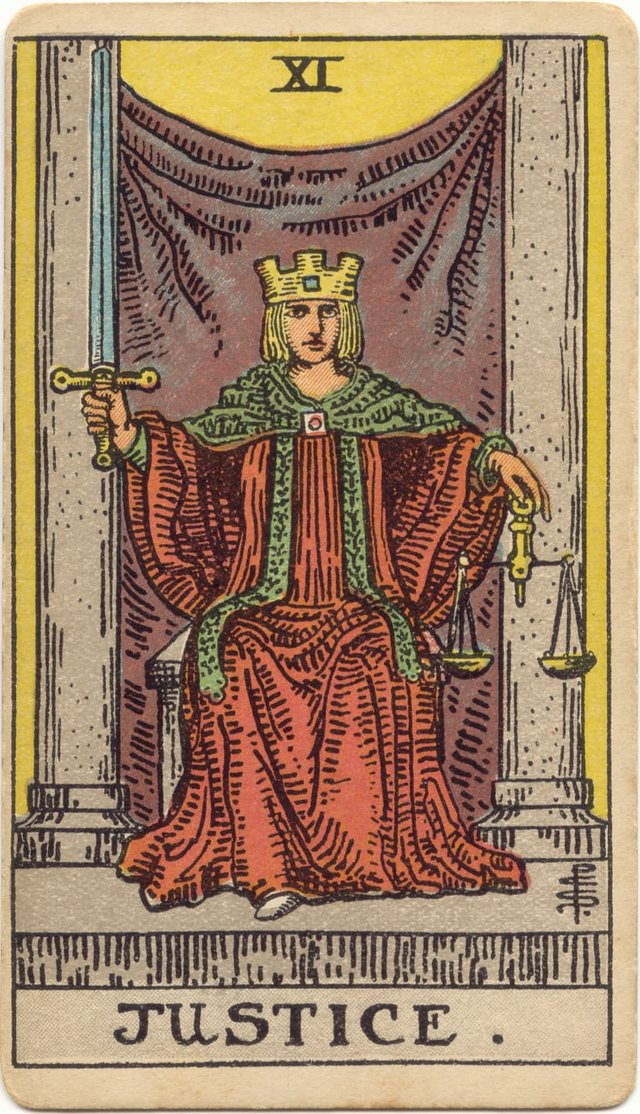
A crowned figure sits squarely between two grey stone pillars, a purple veil hanging behind and a band of yellow showing above it. In one hand a sword points straight up; in the other a pair of scales hangs loose and level. The robe is red, the cape green, and the face looks directly out at you. Nothing in the picture leans or hurries.
Justice is the card of consequences that make sense. What was done leads to what follows, and the card asks you to look at that chain honestly instead of hoping it has been forgotten. In a reading it often marks a decision point: a choice that needs weighing on its merits, a contract or agreement, a conversation in which the facts have to be laid on the table. The sword cuts, the scales weigh, and both are needed. Weighing without ever deciding is just worry; deciding without weighing is just impulse.
The steady gaze matters too. This card is not only about how others treat you. It turns the same scrutiny inward and asks what your own part was. That can be a relief as much as a burden, because once you own your share of a situation you also gain the power to change it.
Justice reversed
Reversed, Justice usually points to something out of balance: a judgement coloured by bias, a decision being dodged, or a refusal to admit your own part in a problem. It can also describe being on the receiving end of something that feels unfair, where the rules seem to apply to some people and not others.
Readers who use reversals gently may read it as a verdict that is still pending, or a lesson that has not yet been taken in. The useful question is usually where the account does not add up. If the scales are tilted, find out whose thumb is on them, and be willing to discover that it might be yours.
In love and relationships
In love, Justice asks whether the relationship is fair to both people: who carries the emotional work, who apologises, whose needs set the pace. It suits honest talks about commitment, money shared in a household, or the terms of a separation handled with care. For someone single, it can describe choosing a partner with your judgement as well as your feelings. Reversed, it tends to show a balance that has quietly tipped, and resentment growing where nobody has said so.
In work and purpose
At work the card fits evaluations, negotiations, contracts and any situation where a decision rests on evidence. It favours clear records, consistent standards and saying what you actually did. If you feel overlooked, it suggests making your case with facts rather than frustration. It also asks how you treat others when you hold the scales: as a manager, a colleague or a client. Reversed, watch for office politics, double standards or a choice being made on the wrong grounds.
As advice
Look at the whole situation as if you were a fair stranger, including your own part in it. Gather the facts, weigh them without flattering yourself or anyone else, then make the decision and stand by it. Fairness is a practice, not a feeling.
Yes or no?
Maybe Justice gives back what has been put in, so the answer depends on whether the situation has been handled honestly and fairly. How yes-or-no readings work here.
Questions to sit with
- What part of this situation am I responsible for, and have I admitted it to myself?
- Which way would I decide if I had nothing to gain or lose?
- Where am I waiting for fairness from others while not offering it myself?
Symbolism in the card
The upright sword
Held in the figure's right hand on the viewer's left, a straight blue blade with a gold hilt points directly upward. A raised sword is the power to decide and to cut through confusion. Pointing up, it suggests a decision made in service of something higher than personal advantage.
The scales
The golden scales hang from the other hand, lowered beside the throne and level. Scales are the oldest emblem of weighing evidence, and on this card they sit beside the sword as its partner: no judgement without weighing first.
The crown
A square, battlemented gold crown with a small square jewel at its centre. It gives Justice the authority of a ruler, but a plain, almost architectural one. The square shape is often read as order and the four-square stability of law.
The two grey pillars
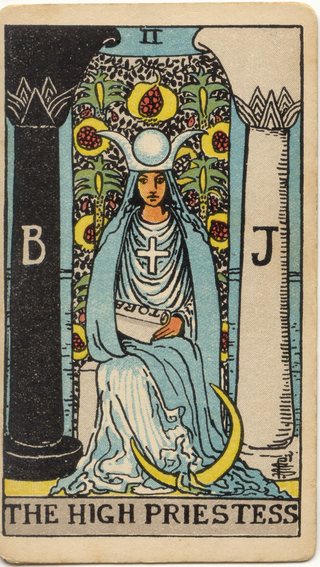
Justice sits between plain stone columns, as the High Priestess does between her black and white ones. Waite drew attention to the parallel and the difference: these pillars mark the threshold of ordinary moral law, not of hidden mysteries.
The purple veil
A dark purple cloth hangs between the pillars, hiding what lies behind. Purple has long been a colour of authority. The veil suggests that Justice deals with what can be seen and judged, while some things remain outside her court.
The yellow sky above the veil
Above the veil and at the edges a flat yellow shows, the same colour Smith used behind several of the more hopeful or spiritual cards. It hints that a wider light surrounds even this sober, enclosed scene.
The red robe and green cape
Justice wears a full red robe under a green cape fastened with a square clasp. Red is often read as action and will, green as growth and the natural world, so the clothing itself is a kind of balance between doing and allowing.
The white shoe
At the hem of the robe, a single white foot or shoe steps forward from under the red cloth. It is a small detail, and readers often take it as a sign that judgement leads to action: the verdict has to be carried out.
The throne
A plain stone seat raised on a step, its arms barely visible under the robe. It is a judge's bench more than a royal throne, solid and without ornament.
“Equity, rightness, probity, executive; triumph of the deserving side in law. Reversed: Law in all its departments, legal complications, bigotry, bias, excessive severity.”
Numbers, elements and astrology
Number 11, reduced to 2 (1 + 1): Two
Two brings a second thing, and with it relationship, choice and balance. Twos are about pairs, partnerships and decisions between options.
Air
Air is thought, speech, truth and conflict: the mind and its sharp edges. The Golden Dawn tied Justice to Libra, a sign of Air.
These are the traditional attributions of the Hermetic Order of the Golden Dawn (1888), which Waite and Smith followed: each trump is matched to a Hebrew letter and to an element, planet or zodiac sign. They are a symbolic system, not astronomy. How we checked them.
A little history
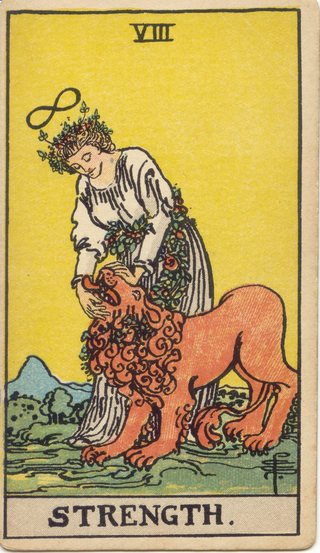
Justice is one of the cardinal virtues, and a crowned woman with sword and scales appears among the hand-painted Visconti-Sforza trumps of fifteenth-century Milan. In the Tarot de Marseille she is La Justice and numbered VIII, with Strength at XI. The Hermetic Order of the Golden Dawn swapped the two so that the sequence would match its astrological scheme, placing Justice with Libra, and Waite followed that order, so the Smith card is numbered XI. Smith kept the traditional sword and scales and seated the figure between grey pillars hung with a veil, a frame that echoes the High Priestess.