Two of Pentacles
Upright balancing priorities · adaptability · juggling · keeping things in motion
Reversed overcommitment · dropped balls · disorganisation · forced cheerfulness
- Arcana
- Minor · pip card
- Number
- Two
- Element
- 🜃 Earth
- Astrology
- ♃ Jupiter in ♑ Capricorn
- Golden Dawn title
- Lord of Harmonious Change
- Yes or no
- Maybe
Two of Pentacles upright
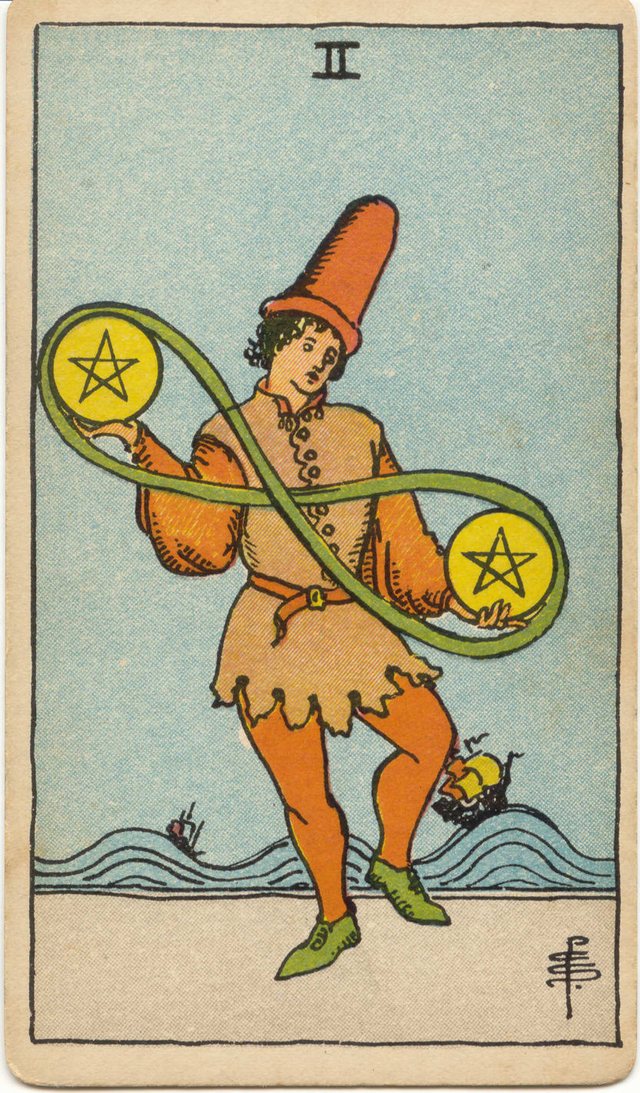
A young man in a towering orange-red hat dances on one foot, a coin in each hand. A green cord loops around both coins in a figure-eight, so that the two are joined however he moves them. Behind him the sea rises in great waves, and two ships, one small and one with yellow sails, ride up and down on the swell.
This is a card about handling more than one thing at once, and doing it with some grace. Two jobs, two bills, a family and a deadline, a plan and its backup: the coins are different but linked, and the dancer keeps them both moving. Nothing is settled. The trick is rhythm rather than control, the way a juggler stays balanced by never quite stopping.
The ships in the background are the honest part of the picture. The world behind him is not calm; it is heaving. The card does not promise that the pressure will ease, only that you can meet it lightly. It also quietly asks how long this is meant to last. A dance is sustainable for an evening. As a permanent way of living, it can tip into exhaustion.
Two of Pentacles reversed
Reversed, the cord tangles. The juggling has gone on too long or taken on one item too many, and something gets dropped: a payment, a promise, sleep. It can describe the stress of saying yes to everything, or a schedule so packed that there is no slack left for the unexpected.
Waite's reversed meanings include "enforced gaiety, simulated enjoyment", which many readers still find apt: the smile you keep on while privately struggling to keep up. As with all reversals, some readers ignore them and read the card's upright meaning with extra caution instead. The usual advice drawn from it is to put one coin down, at least for now.
In love and relationships
In love, the Two of Pentacles often appears when a relationship is competing for time with everything else: shift work, children, study, a long commute. It can also describe playful, flirtatious energy, or a person who is weighing two possibilities. The card asks whether you are dancing together or just passing each other in the corridor. Reversed, it may show one partner carrying the logistics alone, or a relationship that keeps getting postponed until things are less busy, a moment that never quite arrives.
In work and purpose
At work the card fits multitasking, side projects, shifting deadlines and roles that require constant adjustment. You may be good at it; the dancer looks capable. It is still worth checking whether the load is a phase or the new normal, and whether anyone has noticed how much you are carrying. Reversed, it suggests overcommitment, missed details and a need to prioritise rather than keep every plate spinning. A shorter list, done well, beats a long one done badly.
As advice
Keep your footing by keeping your rhythm. Decide which two things genuinely matter right now and let the rest wait. Stay flexible and good-humoured, but notice when the dance has turned into a struggle, and give yourself permission to put something down.
Yes or no?
Maybe The card shows things still in motion and undecided, so the answer depends on what else you are juggling. How yes-or-no readings work here.
Questions to sit with
- What am I juggling right now, and which of these actually needs me today?
- Is my lightness genuine, or am I performing calm?
- What would give me more slack if the waves got higher?
Symbolism in the card
The figure-eight cord
A green band loops around both coins in a sideways figure of eight. Waite called it 'that endless cord which is like the number 8 reversed', and it is usually read as the lemniscate: continuous exchange, two things kept in endless motion.
The two pentacles
Two gold coins marked with pentagrams, held at different heights in each hand. They stand for two demands, resources or options, never quite level, constantly being rebalanced.
The tall hat
An exaggerated orange-red hat, almost a chimney pot, tops the figure. It gives him a slightly comic, entertainer's look, in keeping with Waite's note that gaiety and recreation are the subject of the design.
The dancing step
He stands on his right foot with the left raised and bent, green shoes pointed. Balance here is something done in motion, not achieved by standing still.
The heaving sea
Behind him, the sea rises in high rounded waves well above the horizon line. It shows the instability of his circumstances: the ground of his life is moving even while he dances.
The two ships
A small ship on the left and a larger one with yellow sails on the right ride the swell, the larger tilted sharply on a crest. Ships traditionally stand for ventures and trade; these are being tossed about but still afloat.
“A young man, in the act of dancing, has a pentacle in either hand, and they are joined by that endless cord which is like the number 8 reversed.”
Numbers, elements and astrology
Two
Two brings a second thing, and with it relationship, choice and balance. Twos are about pairs, partnerships and decisions between options.
Earth: the suit of Pentacles
Earth is the body, money, work, home and the slow growth of material things.
By Golden Dawn tradition each numbered card from two to ten rules ten degrees of the zodiac (a decan): the Two of Pentacles is Jupiter in the first decan of Capricorn. They are a symbolic system, not astronomy. How we checked them.
A little history
In the Tarot de Marseille the Two of Coins shows two large coins bound together by a looping, S-shaped ribbon, which on many editions carries the card-maker's name or the deck's date. Smith's green figure-eight cord seems to echo that ribbon, turning a printer's flourish into the subject of the card. The Golden Dawn titled it the Lord of Harmonious Change. Smith gave this pip, like the other Pentacles, a full scene with a human figure, something few earlier decks had done for numbered cards.