Two of Swords
Upright stalemate · a difficult choice · guarded truce · holding steady · avoidance
Reversed information coming out · overwhelm · the truce breaks · forced decision · deception
- Arcana
- Minor · pip card
- Number
- Two
- Element
- 🜁 Air
- Astrology
- ☽ Moon in ♎ Libra
- Golden Dawn title
- Lord of Peace Restored
- Yes or no
- Maybe
Two of Swords upright
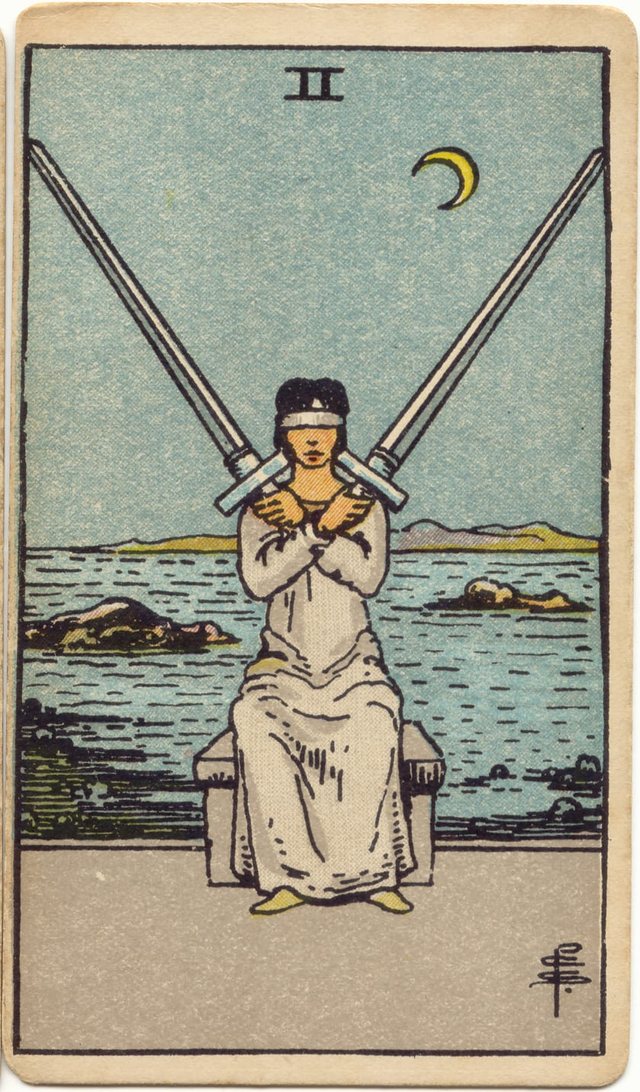
A woman in a long white gown sits on a plain grey stone bench with her back to the water. A white band covers her eyes. Her arms are crossed over her chest, and in each hand she holds a long sword that rests against her shoulder, the two blades rising in a wide V far above her head. Behind her lies a calm sea scattered with dark rocks, a low yellowish shore on the horizon, and a thin crescent moon high in a pale blue sky.
The card describes a deadlock that is at least partly chosen. Two options, two loyalties or two versions of the truth are held at exactly equal weight, and the price of keeping them balanced is not looking too closely at either. Sometimes that is wise. A truce between people who are not ready to agree can keep the peace while tempers cool, and Waite's older meanings include "concord in a state of arms": friendship, but with the weapons still drawn.
More often the card asks how long the pose can be held. Arms crossed over the chest are a defensive gesture as well as a balancing one, and a blindfold you have tied yourself can be taken off. The Two of Swords tends to appear when the information needed to decide is available, but taking it in would mean giving something up. The stillness feels like calm. It may also be the strain of not moving.
Two of Swords reversed
The reversal usually means the balance fails. Facts you were keeping at arm's length arrive anyway, or the pressure of holding still becomes greater than the fear of choosing. That can feel like chaos, but it also ends a paralysis that had gone on too long. Once the choice is made, even badly, there is something real to respond to instead of a stalemate to maintain.
Readers also take the reversal as a sign of being pulled between other people's demands, too many voices to hear your own, or, following Waite, as falsehood and duplicity: a truce that one side never meant. If you read reversals, ask which kind of imbalance fits.
In love and relationships
In love, the Two of Swords often describes a standoff: a disagreement that both of you have agreed not to mention, or a decision between two people, or between staying and leaving, that keeps being postponed. It can also show someone protecting their heart so carefully that nothing reaches it. Taking the blindfold off here means asking what you are afraid to find out. Reversed, the conversation that was being avoided may be happening whether anyone is ready or not.
In work and purpose
At work the card fits a decision stuck in committee, two offers on the table, or colleagues in a polite cold war. It can also describe diplomacy done well, keeping two departments from open conflict while a solution is found. The question is whether the delay is buying time for something or simply avoiding a cost. Gather the facts you have been avoiding, set a date, and decide. Reversed, deadlines or outside pressure may force the choice for you.
As advice
Take the blindfold off. You cannot weigh two options fairly while refusing to look at them. Put the facts in front of you, admit which outcome you are afraid of, and then decide. A truce is useful while it lasts, but it is not a plan.
Yes or no?
Maybe The card shows a question deliberately left unresolved, so the honest answer is not yet, and not until you look at it squarely. How yes-or-no readings work here.
Questions to sit with
- What am I refusing to look at because it would force me to choose?
- Is this stillness giving me peace, or costing me energy to maintain?
- If I had to decide today, which way would I lean, and why?
Symbolism in the card
The blindfold
A plain white band is tied over the woman's eyes. She cannot see the swords she holds or the sea behind her. It reads as a refusal to look as much as an inability, and as an attempt to judge without being swayed by appearances.
The crossed arms and two swords
Her wrists cross over her heart, each hand holding a sword whose blade lies against the opposite shoulder. The pose is both balanced and defensive: the swords guard the heart and also lock her in position, since lowering one would upset the other.
The stone bench
She sits on a low, square grey seat on a bare grey platform. Stone suggests firmness and patience, but also something cold and unmoving, a deliberate stillness set apart from the life of the scene behind.
The sea and rocks
Calm water stretches behind her, broken by low dark rocks. Water belongs to feeling, and she has turned her back on it. The rocks hint at obstacles just under a smooth surface, the things that make a quiet sea hard to cross.
The crescent moon
A slim yellow crescent hangs in the upper right of the blue sky. The moon is the light of intuition and of things only half seen, an apt companion for a choice made in partial darkness.
The white gown
Her robe is long, plain and pale, with no ornament. White can suggest innocence or neutrality, the stance of someone trying to stay out of a conflict by taking neither side.
“The suggestion of harmony and other favourable readings must be considered in a qualified manner, as Swords generally are not symbolical of beneficent forces in human affairs.”
Numbers, elements and astrology
Two
Two brings a second thing, and with it relationship, choice and balance. Twos are about pairs, partnerships and decisions between options.
Air: the suit of Swords
Air is thought, speech, truth and conflict: the mind and its sharp edges.
By Golden Dawn tradition each numbered card from two to ten rules ten degrees of the zodiac (a decan): the Two of Swords is Moon in the first decan of Libra. They are a symbolic system, not astronomy. How we checked them.
A little history
In the Tarot de Marseille the two is a pattern card: two curved blades crossing to form an oval, often with a flower at the centre, and no human figure. The Golden Dawn titled it the Lord of Peace Restored, which helps explain why Waite's meanings mix friendship and concord with the sense of arms still raised. The blindfolded woman by the sea is Smith's own invention for the 1909 deck.