Page of Cups
Upright curiosity · imagination · tender feelings · a surprising message · creative beginnings
Reversed emotional immaturity · escapism · a creative block · moodiness · unwelcome news
- Arcana
- Minor · court card
- Number
- Page
- Element
- 🜄 Water
- Sub-element
- Earth of Water
- Yes or no
- Yes
Page of Cups upright
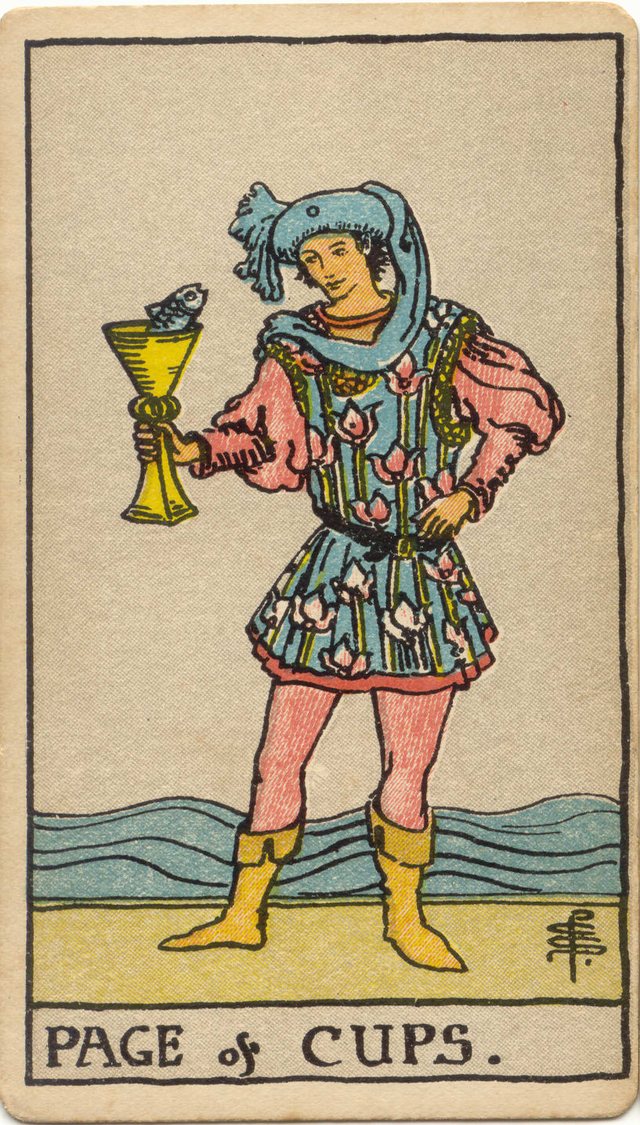
A young man stands on a sandy shore with the sea rolling behind him, one hand on his hip, the other holding out a gold cup. A small fish has poked its head out of the cup and looks up at him, and he looks back at it with a calm, slightly amused expression. He wears a blue turban-like hat with a long scarf, a blue tunic patterned with pink lotus-like flowers, pink sleeves and tights, and yellow boots. The background is plain grey.
As a person, the Page of Cups is someone young in heart, sensitive and imaginative: a student, a child, a dreamy friend, or the part of you that still finds the world surprising. Waite calls the image 'the pictures of the mind taking form', and the fish rising from the cup is exactly that: a feeling or idea that appears unbidden and asks to be noticed.
As an approach to a situation, the Page suggests curiosity rather than strategy. It often turns up with a message: an invitation, an unexpected expression of affection, a creative impulse, a hunch. None of these is fully formed yet. The card's gentle advice is to take the fish seriously without demanding that it already be something grand.
Page of Cups reversed
Reversed, the Page's sensitivity can tip into immaturity: moodiness, taking things too personally, or retreating into daydreams to avoid practical demands. It may describe someone emotionally young for their age, or a creative idea that never gets past the dreaming stage because it is never tested.
Some readers read the reversal as a block: imagination feeling dry, or intuition being ignored. Others see a message that disappoints, arrives late or is misunderstood. Waite's reversed meanings include 'Taste, inclination, attachment, seduction, deception', which hint at feelings being manipulated. As with any court reversal, it may describe another person or a side of yourself.
In love and relationships
In love the Page of Cups suggests tender, shy or playful feelings: a crush, a sweet message, an unexpected confession, or the first stirrings of a new romance. In a relationship it can bring back playfulness and simple affection. It may describe a partner who is sensitive and romantic, sometimes more in love with love than ready for its demands. Reversed, it may point to emotional immaturity, mixed signals or an infatuation that has little substance.
In work and purpose
At work the card favours creative beginnings: a new idea, an artistic project, a first step into a field you feel drawn to. It suits students, apprentices and anyone learning a craft. It can also describe a junior colleague with fresh ideas and little experience. Reversed, it may point to unprofessional moodiness, ideas that stay unfinished, or a creative block that needs patience, play and time rather than brute force.
As advice
Pay attention to the odd idea or feeling that surprised you this week. Write it down, try it out, say it aloud. Approach the situation with curiosity, as though you were seeing it for the first time, and let yourself be a beginner. Not every insight needs to be useful at once.
Yes or no?
Yes The Page brings a gentle, hopeful message, so it reads as a soft yes, especially for creative or emotional questions. How yes-or-no readings work here.
Questions to sit with
- What feeling or idea has surfaced in me recently that I have not taken seriously?
- Where could I approach my life with more curiosity and less judgement?
- What would I make or say if I did not worry about looking foolish?
Symbolism in the card
The fish in the cup
A small grey-blue fish rises from the cup and seems to look at the Page. Waite calls it 'the pictures of the mind taking form': a surprising feeling, intuition or creative idea emerging from the depths.
The gold cup
He holds the cup out in one hand at arm's length, as if presenting it. It is the suit's vessel of feeling, here held with curiosity and lightness rather than reverence.
The lotus tunic
His blue tunic is printed with pink flowers that resemble lotuses or water-lilies, growing in rows like plants in water. The flowers tie him to the water of his suit and to gentle, unfolding growth.
The turban and scarf
A soft blue hat wrapped like a turban, with a long scarf falling over his shoulder, gives him a slightly theatrical, artistic look: a dreamer or a performer rather than a worker.
The sea behind him
Low blue waves roll behind him across the width of the card, with a sandy shore under his feet. The sea is the emotional and imaginative depths from which the fish has come.
The hand on the hip
His free hand rests on his hip, a relaxed and slightly self-possessed pose. It suggests a young person at ease with his own feelings and in no hurry.
“A fair, pleasing, somewhat effeminate page, of studious and intent aspect, contemplates a fish rising from a cup to look at him. It is the pictures of the mind taking form.”
Numbers, elements and astrology
Page
Pages are students and messengers: curiosity, news, the beginner's first approach to the suit.
Water: the suit of Cups
Water is feeling, intuition, relationships and the imagination.
In the Golden Dawn system each court card is an element within its suit's element. Pages and Queens are agreed; Knights and Kings are Fire or Air depending on whether you follow the Golden Dawn's names or later practice. They are a symbolic system, not astronomy. How we checked them.
A little history
The Page descends from the Valet de Coupe of the Tarot de Marseille, a young attendant shown carrying a cup. The Golden Dawn turned the four pages into princesses, but Waite kept the older title of Page. The fish rising from the cup is Smith's addition. Waite also links the Cups courts to people with 'light brown or dull fair hair and grey or blue eyes', a convention from older cartomancy that few modern readers use.