
Cups and chalices in tarot
The cup is the emblem of the suit of Cups and of the element of water: it receives, holds and offers. In Christian art the chalice holds the wine of the Eucharist, and medieval romance made the Grail the cup of Christ. Smith's Ace of Cups draws on this, with a dove bearing a wafer above an overflowing cup. The Magician has a cup on his table among the four tools, and Temperance pours water between two cups. In readings a cup means emotion, love and receptivity. Notice whether it is full, spilled, offered or refused.
Cards that show cups and chalices
-
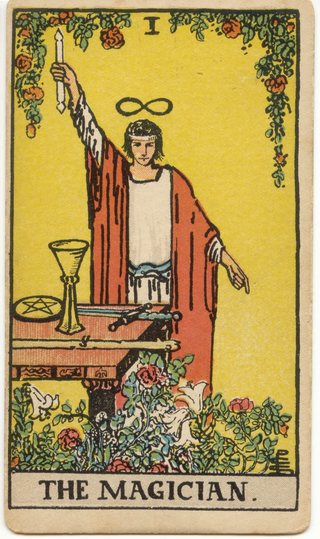 The Magician
: The four suit emblems
A cup, a sword, a coin engraved with a pentagram and a wand lie on the table. They are the emblems of the four suits and of the classical elements, water, air, earth and fire. The whole of the Minor Arcana is within his reach.
-
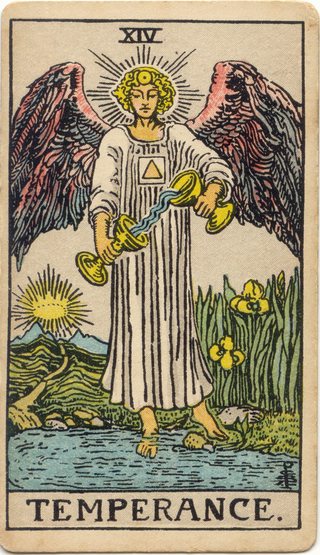 Temperance
: The two cups and flowing water
Water passes from a higher gold cup to a lower one in a long sideways slant, more like a current than a pour. Many readers take it as a hint that this is not ordinary water: Waite called it 'the essences of life'. It is the card's central act of blending.
-
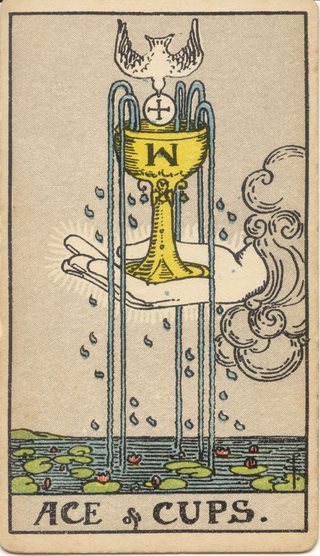 Ace of Cups
: The golden cup
A tall gold chalice with a decorated knop sits on the open palm. Its shape is that of a church chalice, and the suit's cups traditionally stand for the heart, the emotions and what a person is able to receive and hold.
-
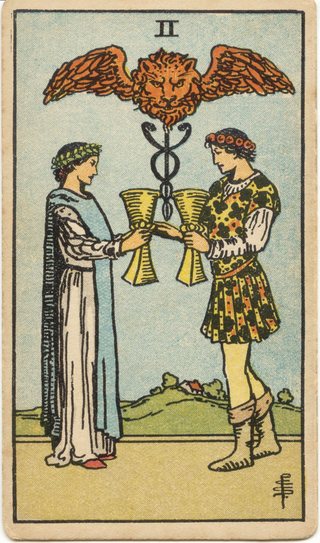 Two of Cups
: The two cups
Each figure holds one gold cup out towards the other, and the man's hand reaches over to touch hers. An exchange of cups is an old image of pledge and toast: two people offering what they feel and accepting what is offered.
-
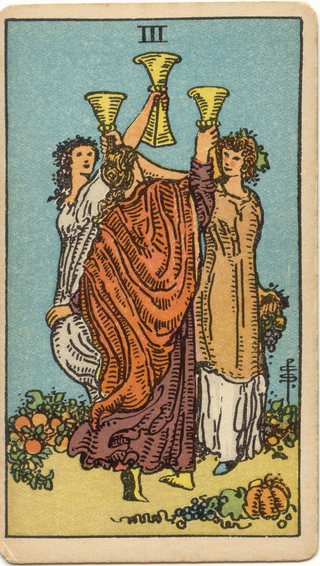 Three of Cups
: The three raised cups
Three gold cups are lifted high above the women's heads, the middle one highest. A raised cup is a toast: shared joy, goodwill and the act of honouring a moment together.
-
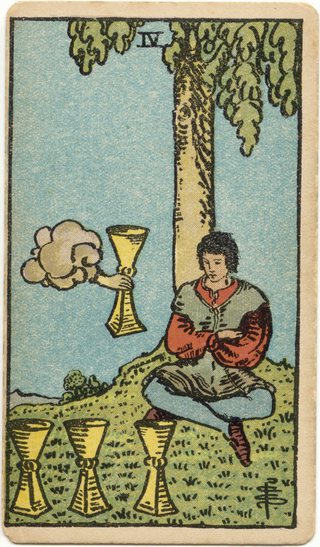 Four of Cups
: The three cups on the grass
Three gold cups stand in a neat row before him. They are what he already has, and his downward stare suggests he has stopped valuing them. Familiar comforts can lose their taste.
-
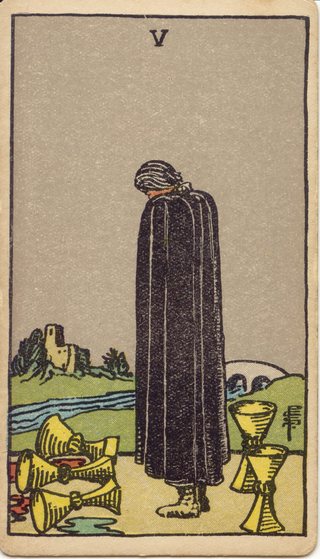 Five of Cups
: The three spilled cups
Three cups lie on their sides on the left, with red and green liquid running from them. They are what has been lost or wasted. Waite's reading is direct: 'three have been taken, but two are left'.
-
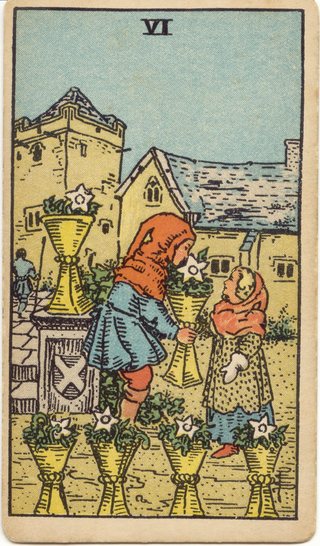 Six of Cups
: The cup of flowers
The cup he holds out is filled with green leaves and a white five-petalled flower. A cup of flowers rather than wine turns the suit's vessel of feeling into a gift of pure goodwill.
-
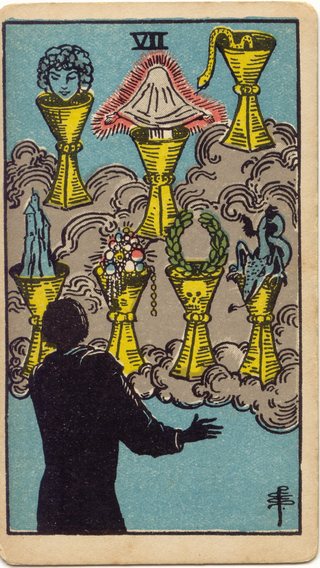 Seven of Cups
: The clouds
All seven cups rest on heavy grey clouds. Clouds are the stuff of dreams and confusion here: the visions hang in the air, unsupported by solid ground.
-
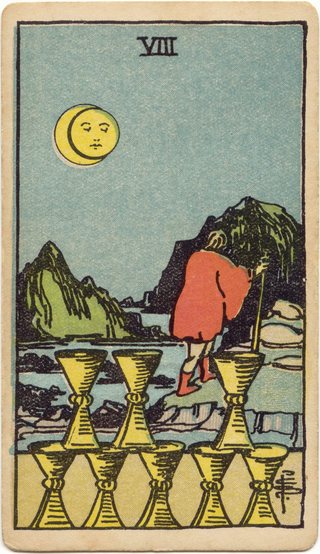 Eight of Cups
: The stacked cups
Eight cups stand neatly in two rows in the foreground, five below and three above. They are intact and orderly: what is being left is not ruined, only no longer enough.
-
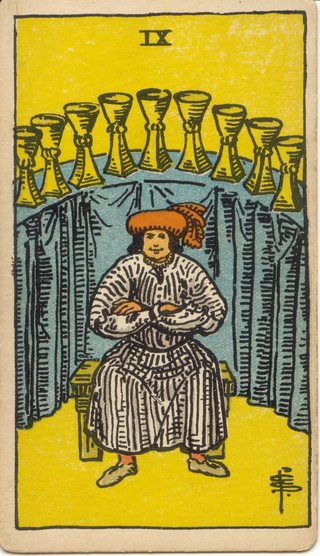 Nine of Cups
: The arc of nine cups
Nine gold cups stand in a curved row along a high counter behind him, like a display. Waite reads them as 'abundant refreshment of wine', suggesting that 'the future is also assured'.
-
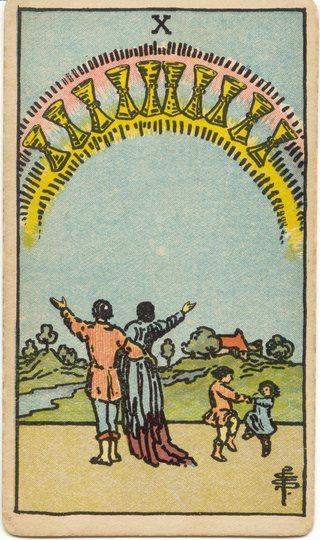 Ten of Cups
: The rainbow of cups
Ten gold cups are set in a broad rainbow of pink, yellow and green bands. The rainbow is an old sign of promise and peace after storm, and setting the cups within it makes the household's happiness feel blessed.
-
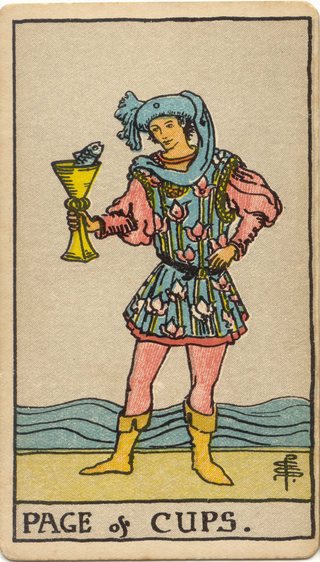 Page of Cups
: The fish in the cup
A small grey-blue fish rises from the cup and seems to look at the Page. Waite calls it 'the pictures of the mind taking form': a surprising feeling, intuition or creative idea emerging from the depths.
-
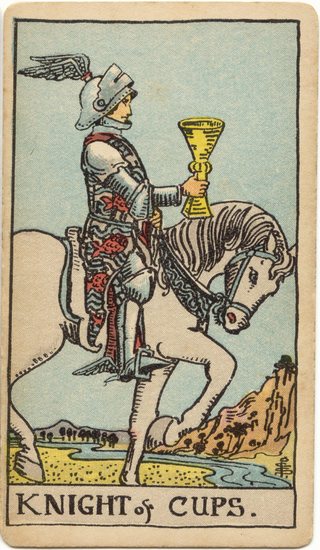 Knight of Cups
: The held-out cup
The Knight holds a gold cup steadily out in front of him at chest height, like a gift being brought. It makes him a bearer of feeling or of an offer: his purpose is to deliver something, not to conquer.
-
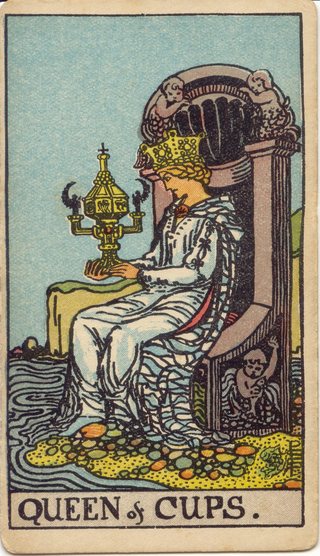 Queen of Cups
: The covered cup
She holds an ornate gold vessel with a lid, crowned by a small cross and flanked by two winged figures for handles. It is the only lidded cup in the suit: feeling held as something sacred, and kept rather than poured out.
-
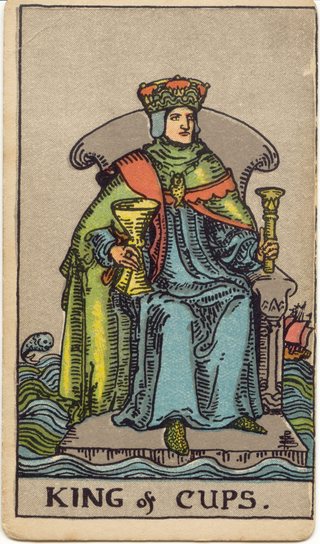 King of Cups
: The cup and sceptre
He holds a large gold cup in his right hand and a short gold sceptre in his left. Cup and sceptre together join feeling with authority: he rules, but through understanding.