Major Arcana · XIX
The Sun
Upright joy · clarity · vitality · success · openness
Reversed dimmed enthusiasm · delayed success · overconfidence · temporary clouds
- Arcana
- Major
- Number
- XIX
- Astrology
- ☉ Sun
- Hebrew letter
- Resh ר
- Yes or no
- Yes
The Sun upright
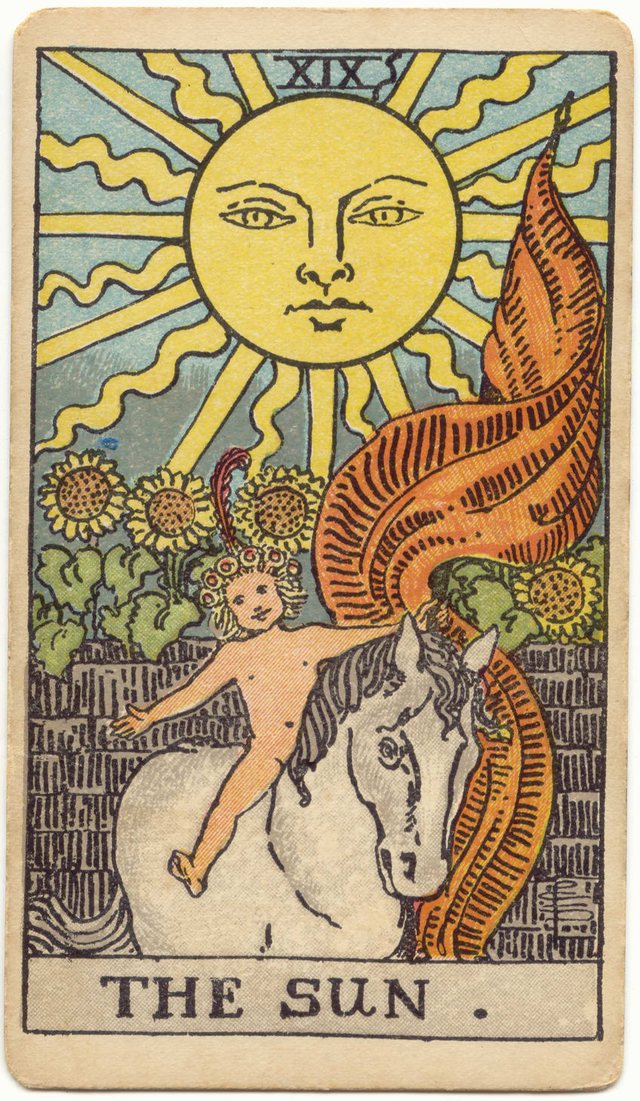
A great sun with a calm human face fills the top of the card, its rays alternating straight and wavy. Below it a row of sunflowers leans over a grey brick wall, and in front of the wall a naked child rides a white horse bareback, arms flung wide. The child wears a wreath of flowers and a red feather. A huge orange-red banner billows alongside, its staff rising out of the picture.
After the uncertain half-light of the Moon, everything is visible. The Sun is the most straightforwardly happy card in the deck: success, energy, high spirits, the pleasure of being alive on a clear day. In a reading it often marks a time when things go well because you are being open and direct, without needing to hide or strategise.
The child is the heart of it. Children do not justify their delight or worry about how it looks. The card asks for the same simplicity: to enjoy what is good without waiting for the catch, and to show yourself as you are. Notice too that the garden is walled and the child has ridden out in front of it. Joy here is not only shelter. It is something carried out into the open, shared and on display.
The Sun reversed
Reversed, the Sun rarely turns dark. Most readers see a lesser version of the upright meaning: happiness that is real but muted, success that takes longer than hoped, or enthusiasm dimmed by tiredness or doubt. Clouds pass in front of the sun, but it is still there.
Some read the reversal as overconfidence, a brightness that has become showing off or a refusal to see problems. Others see an inner child neglected under too much seriousness. The question to ask is what is blocking your warmth just now, who or what has been casting the shade, and whether that block is really as solid as it feels.
In love and relationships
In love, the Sun describes warmth, openness and ease: a relationship where you can be yourself, laugh, and be seen without performing. It suits happy, playful stages, celebrations, and moving forward together with confidence. For someone single, it favours being visible and enjoying meeting people without overthinking. Reversed, it can show a good relationship going through a flat patch, or one partner hiding parts of themselves out of fear of being judged.
In work and purpose
At work the Sun fits recognition, successful launches and work done in plain view. It favours honesty, presenting your work confidently and enjoying what you do. Collaboration tends to go well because people respond to the energy you bring. It also suits creative fields and work with children. Reversed, it can show success arriving more slowly than hoped, or a tendency to oversell, and it suggests keeping your enthusiasm grounded in what you can deliver.
As advice
Step into the light. Be open about what you want, enjoy what is going well, and let others see your work and your warmth. You do not need to earn simple happiness by worrying first, and sharing it usually makes it larger rather than smaller.
Yes or no?
Yes The Sun is the clearest yes in the deck: open, warm and favourable. How yes-or-no readings work here.
Questions to sit with
- What makes me feel most fully alive, and how much of it is in my life now?
- Where am I hiding something about myself that could be shown?
- What would I do today if I trusted things to go well?
Symbolism in the card
The sun with a face
A large yellow disc with calm human features fills the upper half of the card. Its rays alternate straight and wavy, a pattern Waite noted on older cards. A face in the sun gives it presence: a light that sees as well as shines.
The naked child
A small, fair-haired child with arms spread wide sits on the horse without saddle or reins. Nakedness here means innocence and nothing to hide. Waite saw the child as 'simplicity and innocence in the sense of wisdom'.
The wreath and red feather
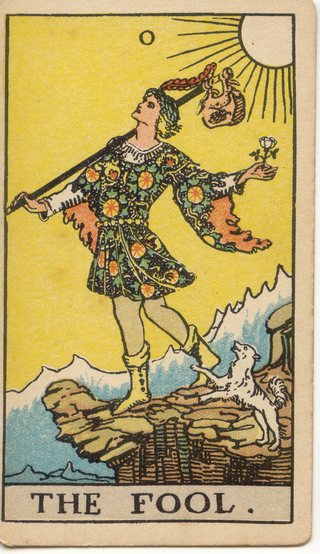
The child wears a garland of small flowers with a single red feather standing up from it, the same kind of feather that the Fool wears. It links the beginning of the Major Arcana with its sunniest card: innocence returning with experience behind it.
The white horse
A grey-white horse walks forward with its head lowered, carrying the child calmly without bridle or saddle. Horses traditionally represent strength and energy; here that strength is gentle and willing, needing no control.
The orange-red banner
A long banner billows beside the child, its staff rising off the top of the picture. Waite called it a red standard. A banner announces something openly, and its colour carries the vitality and action of the scene.
The sunflowers
A row of sunflowers grows above the wall, their heads turned towards the viewer and the child rather than up at the sun. Sunflowers follow the light; here they seem to face the life below it.
The grey wall
A grey brick wall runs across the card behind the horse. Waite described 'the walled garden of the sensitive life'. The child has come out from the garden into the open, so the wall marks safety left behind as well as shelter.
“The naked child mounted on a white horse and displaying a red standard has been mentioned already as the better symbolism connected with this card.”
Numbers, elements and astrology
Number 19, reduced to 10 (1 + 9): Ten
Ten completes one cycle and begins the next (1 + 0 = 1). Tens show a suit carried to its end, for better or worse.
These are the traditional attributions of the Hermetic Order of the Golden Dawn (1888), which Waite and Smith followed: each trump is matched to a Hebrew letter and to an element, planet or zodiac sign. They are a symbolic system, not astronomy. How we checked them.
A little history
The Sun appears among the early Italian trumps; the Visconti-Sforza card shows a winged child holding up a red sun's head. The Tarot de Marseille shows two children, nearly naked, standing before a wall beneath a sun with a face that sheds drops. Waite says that Éliphas Lévi mentioned an alternative with a naked child on a white horse bearing a standard, and that is the version Smith drew, with the sunflowers added. The Golden Dawn assigned the card to the Sun itself.