Ten of Pentacles
Upright legacy · family · long-term security · belonging · tradition
Reversed family conflict · disputes over inheritance · instability · breaking with tradition
- Arcana
- Minor · pip card
- Number
- Ten
- Element
- 🜃 Earth
- Astrology
- ☿ Mercury in ♍ Virgo
- Golden Dawn title
- Lord of Wealth
- Yes or no
- Yes
Ten of Pentacles upright
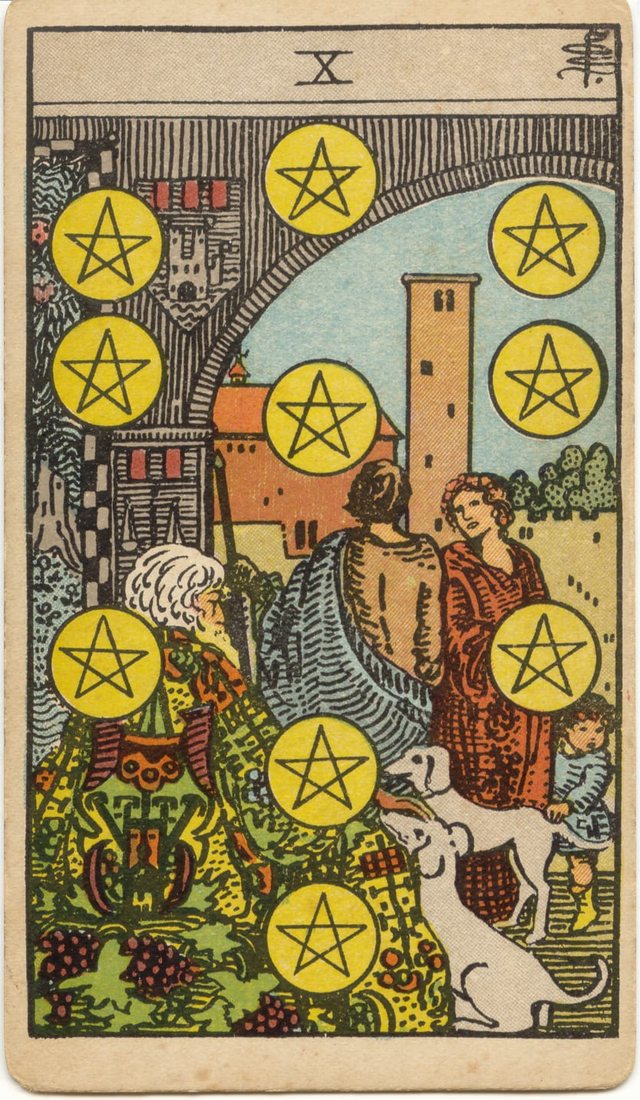
Under a stone archway an old man with white hair sits in a richly patterned robe, two white dogs nuzzling at his hand. Beyond him, a younger man in a blue cloak with his back to us and a woman in red stand talking, and a small child clings to her skirt while reaching for a dog. A tall tower and red-roofed buildings fill the courtyard behind. Ten pentacles float over the whole scene, laid out in a pattern that runs from the top of the card to the bottom.
The Ten is the end of the suit's story: wealth that has outlasted one lifetime. Waite listed "family matters, archives, extraction, the abode of a family", and the picture shows three generations in one place. It is about the structures that hold a family or a community together over time: a home, a name, shared habits, the things people pass on and are given.
The odd thing about the scene is how little anyone looks at anyone else. The old man is turned away; the couple are absorbed in each other; only the child and the dogs connect the generations. Some readers find that touching, others a quiet warning. Inheritance, of any kind, is not only about what is passed on, but about whether people actually meet across the years.
Ten of Pentacles reversed
Reversed, the family home develops cracks. Readers often see disputes over money or property, the weight of family expectations, or traditions that have become a burden. It can also describe the instability of a household under financial pressure, or a decision to break with what you inherited and build something different.
Waite's reversed meanings include "chance, fatality, loss, robbery, games of hazard", a sense of fortunes put at risk. Readers who work with reversals often look here for the difference between losing a legacy and freely choosing to leave one behind. The surrounding cards usually show which it is, and the difference matters.
In love and relationships
In love, the Ten of Pentacles describes commitment with deep roots: a long marriage, combining households, building a home that others will grow up in. It can also mean being welcomed into a partner's family, with all the history that comes with it. For someone single, it may highlight what kind of lasting life they want to build. Reversed, it may point to family pressure on a relationship, disagreements about money or home, or a partnership that looks settled from outside but lacks warmth within.
In work and purpose
At work the card fits family businesses, long-established institutions, succession planning and careers built over decades. It favours thinking long-term: what will this work look like in twenty years, and who will carry it on? It can also describe a workplace that feels like a family, for better or worse. Reversed, it may suggest conflict over control or succession, an organisation clinging to tradition, or the wish to leave an inherited path.
As advice
Think beyond your own lifetime. Look after what was handed to you, and consider what you will hand on in turn, whether that is property, knowledge, kindness or a way of doing things. Make time for the people across the generations; the inheritance means little without them.
Yes or no?
Yes The card describes lasting stability and belonging, so it reads as a steady yes for anything built to endure. How yes-or-no readings work here.
Questions to sit with
- What have I inherited, in values as well as things, and do I want to keep it?
- What would I like to pass on to the people who come after me?
- Am I truly present with my family, or just sharing the same courtyard?
Symbolism in the card
The old man
A white-haired, bearded elder sits on the left in a long, richly patterned robe covered in small emblems, with bunches of grapes at his feet. He is the patriarch and the source of the family's wealth, the past generation keeping watch over what it made.
The two white dogs
Two pale dogs come to the old man, one nosing his hand. Dogs traditionally stand for loyalty and faithfulness; here they also link the generations, since the child's hand reaches for one of them.
The couple
A man in a blue cloak, seen from behind and holding a staff or spear, stands facing a woman in a red dress who looks back over her shoulder. They are the present generation, busy with their own lives in the middle of the household.
The child
A small child in blue holds on to the woman and stretches a hand towards a dog. Waite notes that the child 'looks curiously' at the scene: the next generation, still taking it all in.
The archway and coats of arms
The foreground is framed by a stone arch, with heraldic shields on the left pillar, one showing a castle. Heraldry is the visible sign of a family's name and lineage, and the arch is the threshold of the estate.
Houses and cities in tarotTowers and castles in tarotShields and coats of arms in tarot
The tower and courtyard
Through the arch a tall square tower rises above red-roofed buildings and trees under a blue sky. The family's home is solid, established and walled in.
Towers and castles in tarotHouses and cities in tarotTrees in tarot
The arrangement of ten pentacles
The ten coins are laid out over the scene in the pattern of the Kabbalistic Tree of Life, three columns from top to bottom. It links material inheritance to a much older map of the whole of creation.
“A man and woman beneath an archway which gives entrance to a house and domain. They are accompanied by a child, who looks curiously at two dogs accosting an ancient personage seated in the foreground.”
Numbers, elements and astrology
Ten
Ten completes one cycle and begins the next (1 + 0 = 1). Tens show a suit carried to its end, for better or worse.
Earth: the suit of Pentacles
Earth is the body, money, work, home and the slow growth of material things.
By Golden Dawn tradition each numbered card from two to ten rules ten degrees of the zodiac (a decan): the Ten of Pentacles is Mercury in the third decan of Virgo. They are a symbolic system, not astronomy. How we checked them.
A little history
In the Tarot de Marseille the Ten of Coins is an ornamental arrangement of ten coins with foliage, without figures. The Golden Dawn named it the Lord of Wealth. Smith's three-generation family scene is her own design, and the placing of the coins in the Tree of Life pattern reflects the Golden Dawn's Kabbalistic system, in which the ten numbered cards of each suit correspond to the ten sephiroth. Waite's meanings, "gain, riches; family matters", follow the earlier cartomantic sense of the card as household wealth.