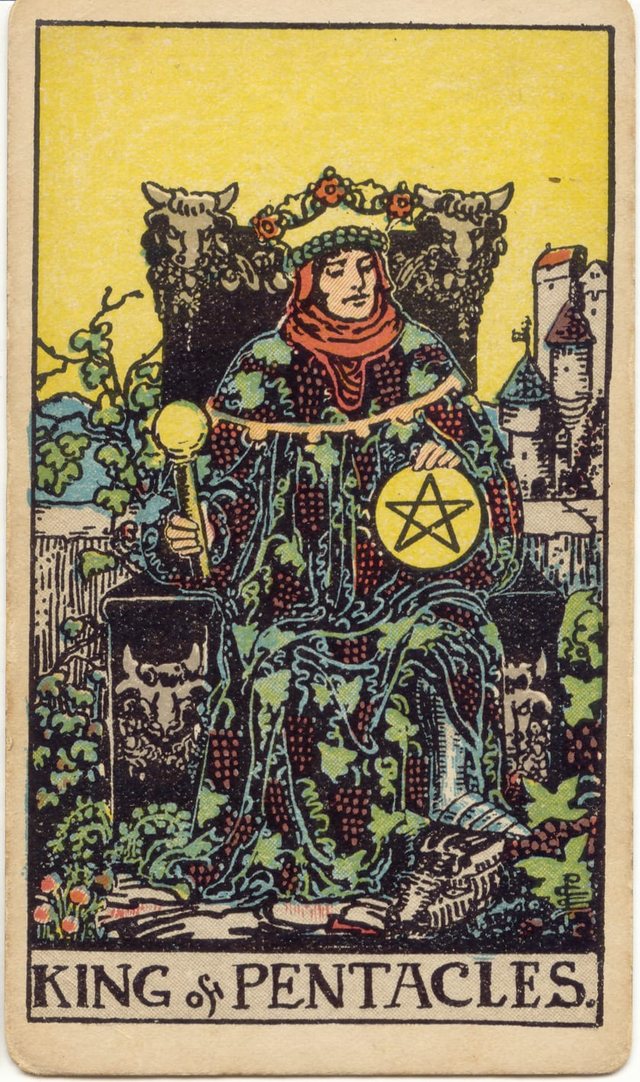
King of Pentacles
Upright material success · stability · leadership · generosity · discipline
Reversed greed · rigidity · stubbornness · success at any cost
- Arcana
- Minor · court card
- Number
- King
- Element
- 🜃 Earth
- Sub-element
- Fire or Air of Earth (varies)
- Yes or no
- Yes
King of Pentacles upright
A king sits on a dark throne carved with bulls' heads, a large pentacle resting under one hand and a sceptre topped with a golden orb in the other. His robe is so thickly patterned with grapes and vine leaves that he seems to be growing out of the garden around him. A wreath of red flowers sits on his head, a castle rises behind the wall to the right, and beneath the hem of his robe an armoured foot is just visible.
The King of Pentacles is the suit at full maturity: someone who has turned effort into lasting results and now holds them with ease. Waite listed "valour, realizing intelligence, business and normal intellectual aptitude" among his meanings. This is the businessperson who built something real, the expert whose judgement can be trusted, the head of a household who provides without fuss. His power is not dramatic. It is the quiet authority of having done the work.
As a person, he may be generous, practical and loyal, perhaps a little set in his ways. As an approach to a situation, the card suggests patience, sound decisions and a long view. The armour under the vines is a telling detail: the comfort here was won by struggle, and the King has not forgotten it. His wealth is meant to be used, shared and passed on.
King of Pentacles reversed
Upside down, the picture inverts: the King's grip on the material world becomes its grip on him. Readers often see greed, an obsession with status or possessions, or a stubborn refusal to adapt. It can also describe someone whose success has made them controlling, or a leader who measures everything, including people, in terms of profit.
Waite's reversed keywords, "vice, weakness, ugliness, perversity, corruption, peril", are among his harshest. Some readers take the reversal more gently, as poor money habits or a plan that lacks discipline. As always, how much weight to give a reversal depends on the reader and the rest of the spread.
In love and relationships
In love, the King of Pentacles describes a partner who is dependable, generous and committed: someone who expresses love by building a secure life together. It suits long-term relationships, shared homes and partners who make plans for the future. It can also describe your own steadiness as a partner. Reversed, it may point to a relationship where money or status matters more than closeness, or to a partner who is controlling, possessive or too focused on work to be present.
In work and purpose
At work the card fits leadership, entrepreneurship, senior roles and long-term stewardship of a business or organisation. It favours reliable decisions, steady growth and a reputation built on results. It can describe a mentor or a boss who supports others' success. If you are moving into a senior role, the card suggests leading by example and keeping your promises. Reversed, it suggests rigidity, a leader resistant to new ideas, or ambition that has become ruthless and short-sighted.
As advice
Act like someone who has built things and intends to build more. Make decisions with the long view, keep your commitments and use your resources well. Be generous with what you have gained. Stay open to change, so that your stability does not become stiffness.
Yes or no?
Yes The King represents solid achievement and good judgement, so he reads as a confident yes for practical matters. How yes-or-no readings work here.
Questions to sit with
- What have I built through patience, and how do I want to use it?
- Where has my need for security made me resistant to change?
- How do I measure success, and does that measure leave room for people?
Symbolism in the card
The bulls' heads
Carved bulls' heads crown both top corners of the throne and appear again on its arm. Waite noted them as 'a recurrent symbol on the throne'. The bull is the sign of Taurus, an earth sign, and stands for strength, patience and fertility.
The robe of grapes and vines
His dark robe is covered in bunches of grapes and green vine leaves, which blend into the real vines growing around him. Grapes are a symbol of abundance and harvest; he is almost part of the garden he tends.
The pentacle
A large pentacle rests on his knee under his left hand. He does not grasp or display it, he simply holds it, comfortable with what he has.
The orb sceptre
In his right hand he holds a sceptre topped with a golden orb. Orb and sceptre are traditional signs of worldly rule: authority over the material world.
The flower wreath
Instead of a heavy crown he wears a wreath with red flowers over a red hood. It suggests a ruler whose power is linked to growth and the land rather than to conquest.
The armoured foot
Beneath the hem of his robe, an armoured foot rests on a carved stone block. It is a reminder that his peace and prosperity were won by effort, and that he can still defend them.
The castle
A castle with pointed towers rises on the right behind a low wall. It represents his domain: a secure, established place that he has built and governs.
The yellow sky
The background is a bright yellow sky above the wall, the castle and the greenery. Smith uses yellow skies for her most assured scenes, and here it matches the King's settled, unhurried confidence.
“The bull's head should be noted as a recurrent symbol on the throne. The sign of this suit is represented throughout as engraved or blazoned with the pentagram”
Numbers, elements and astrology
King
Kings direct the suit outwardly: authority, responsibility and the mature use of its power.
Earth: the suit of Pentacles
Earth is the body, money, work, home and the slow growth of material things.
In the Golden Dawn system each court card is an element within its suit's element. Pages and Queens are agreed; Knights and Kings are Fire or Air depending on whether you follow the Golden Dawn's names or later practice. They are a symbolic system, not astronomy. How we checked them.
A little history
Kings head the court cards in the earliest Italian tarots, including the Visconti-Sforza, and in the Tarot de Marseille, where the Roy de Deniers is shown seated holding a coin. In the Golden Dawn system the suit of Pentacles belongs to earth, and its courts were renamed; Waite returned to the traditional King. Smith's King, robed in vines with bulls on his throne, is her own rich elaboration of that seated figure. Waite also uses this card to explain why he kept the name Pentacles rather than coins.