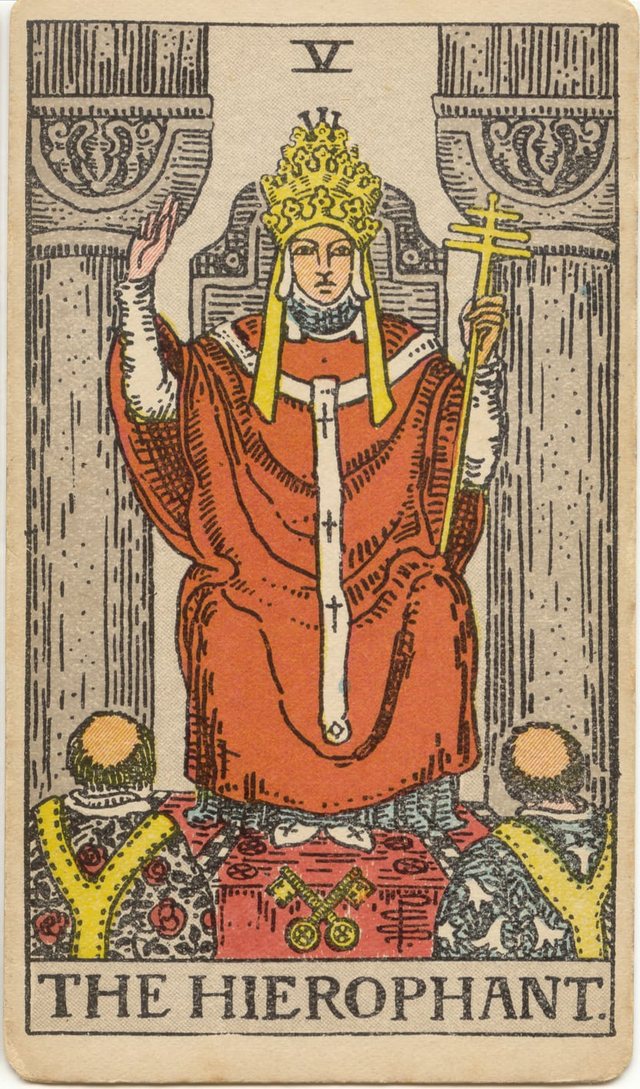
Major Arcana · V
The Hierophant
Upright tradition · teaching · institutions · shared values · mentorship
Reversed rebellion · dogma · questioning authority · an unconventional path
- Arcana
- Major
- Number
- V
- Element
- 🜃 Earth
- Astrology
- ♉ Taurus
- Hebrew letter
- Vav ו
- Yes or no
- Yes
The Hierophant upright
A priestly figure in a red robe and a golden triple crown sits between two grey stone pillars. His right hand is raised in blessing and his left holds a long staff topped with a triple cross. A white stole marked with small crosses hangs down the front of his robe. At his feet lie two crossed golden keys, and two tonsured men kneel before him, one robe patterned with red roses, the other with white flowers on blue.
The Hierophant is the card of the established way: teachings handed down, institutions that hold knowledge, ceremonies that mark the turning points of a life. The title comes from Greek and means one who shows sacred things. In a reading he often stands for education, a teacher or mentor, a formal commitment, or simply a community that shares your values. He is the part of life that does not need to be invented from scratch, because others have walked the road before.
That is both strength and limit. Tradition carries wisdom no single person could gather, and the card can come as a relief: you do not have to work everything out alone. But the two figures kneel, and the keys are in his keeping. The Hierophant also asks whether you follow a path because it fits you or because it is expected, and whether the institution in front of you deserves the trust it asks for.
The Hierophant reversed
Reversed, the Hierophant turns towards personal conviction and dissent. It can describe breaking with a family custom, leaving a church, a school of thought or a profession's accepted method, or simply questioning rules that no longer make sense. That can be healthy and overdue.
It can also point to the shadow side of institutions: dogma, hypocrisy, an authority that demands obedience without earning it. Some readers see the reversal as a caution against rebellion for its own sake. Rejecting a tradition is not the same as understanding it, and the card asks you to know which you are doing.
In love and relationships
In love the Hierophant favours commitment in its traditional forms: making things official, meeting each other's families, sharing values and rituals. It can describe a relationship in which both people want the same kind of life, or raise the question of whether you do. It can also point to advice from someone older or more experienced. Reversed, it suggests a relationship that does not fit the usual mould, or tension between what you want and what family or community expect.
In work and purpose
At work the card points to established organisations, formal training, qualifications, mentorship and doing things by the book. It suits teaching, academic and religious work, and any field with a long tradition of practice. It may be the moment to learn from someone experienced, or to work within a system rather than around it. Reversed, it can describe frustration with procedure, a mentor whose advice no longer fits, or the pull towards a less conventional career.
As advice
Look for the wisdom that already exists. Find a teacher, a community or a practice that has stood the test of time, and learn its ways properly before you try to change them. Respect structure where it helps you, and stay honest about where it does not.
Yes or no?
Yes The Hierophant supports conventional, well-trodden choices, so it reads as yes when the question follows an established path. How yes-or-no readings work here.
Questions to sit with
- Which of my beliefs did I choose, and which did I simply inherit?
- Who could teach me what I am trying to learn alone?
- Where am I conforming, and where am I genuinely belonging?
Symbolism in the card
The triple crown
His tall gold crown rises in three tiers, like a papal tiara. The tiers are often read as three worlds or levels of being, and the crown marks him as the highest authority of an organised faith.
The raised hand
His right hand is lifted in a gesture of blessing. Waite describes it as the sign 'distinguishing between the manifest and concealed part of doctrine': the Hierophant teaches openly, but not everything is said aloud.
The triple cross
In his left hand is a long golden staff ending in three crossbars. The triple cross is a papal emblem; here it suggests an authority that claims to reach over spiritual, intellectual and bodily life alike.
The crossed keys
Two golden keys lie crossed on the dais at his feet. They recall the keys given to Saint Peter, the power to bind and loose, open and close. Waite, agreeing with an earlier writer, calls the Hierophant 'the power of the keys'.
The grey pillars
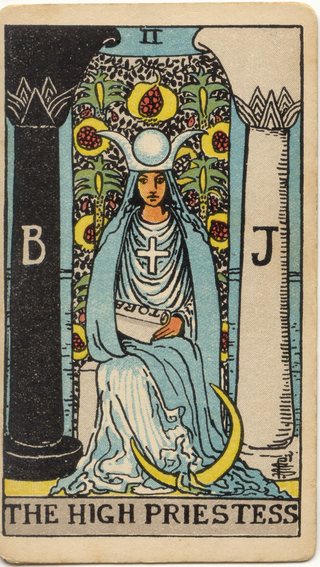
He sits between two matching grey pillars with carved capitals. Unlike the black and white pillars of the High Priestess, these are alike: his temple is public, ordered and outwardly united. Waite stresses that they are not the pillars of her temple.
The kneeling ministers
Two tonsured men kneel before him with their backs to us, each wearing a yellow Y-shaped stole. One robe is patterned with red roses, the other with white flowers on blue, echoing the roses and lilies of the Magician: desire and purity, both come to be taught.
The red robe and white stole
His red outer robe is the colour of authority and active power. A long white stole marked with small crosses runs down its centre, and a blue-grey garment shows at his throat and hem, a hint of inner learning beneath the public office.
“He is the ruling power of external religion, as the High Priestess is the prevailing genius of the esoteric, withdrawn power.”
Numbers, elements and astrology
Number 5: Five
Five breaks the square. It brings disruption, conflict and loss, the necessary instability that keeps a story moving. Most tarot fives are hard cards.
Earth
Earth is the body, money, work, home and the slow growth of material things. The Golden Dawn tied The Hierophant to Taurus, a sign of Earth.
These are the traditional attributions of the Hermetic Order of the Golden Dawn (1888), which Waite and Smith followed: each trump is matched to a Hebrew letter and to an element, planet or zodiac sign. They are a symbolic system, not astronomy. How we checked them.
A little history
In the Italian decks and the Tarot de Marseille this card is the Pope, Le Pape: an enthroned pontiff in a triple crown blessing two smaller tonsured figures. Some later French patterns avoided the religious subject altogether; the Besançon tarot, for example, replaced the Pope and Popess with Jupiter and Juno. In the eighteenth century Court de Gébelin recast the card as a high priest, and the occult tradition adopted the Greek title Hierophant, the name of the priest who revealed sacred things at the mysteries of Eleusis. Smith keeps the old composition, with the kneeling pair in patterned robes and crossed keys at the pontiff's feet.