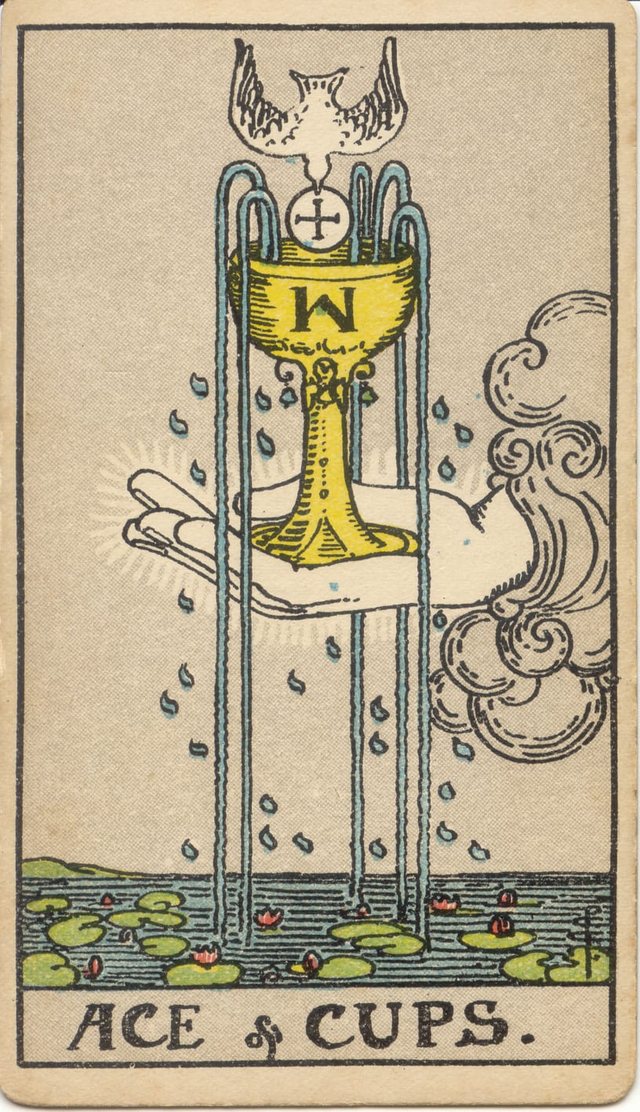
Ace of Cups
Upright an open heart · new love or friendship · emotional renewal · generosity · creative feeling
Reversed feelings held back · emotional emptiness · love poured out unwisely · a blocked spring
- Arcana
- Minor · ace
- Number
- Ace
- Element
- 🜄 Water
- Golden Dawn title
- Root of the Powers of Water
- Yes or no
- Yes
Ace of Cups upright
A hand comes out of a cloud on the right and holds a golden cup on its flat palm, with a faint halo of light around it. Streams of water arch out of the cup and fall into a still pond scattered with water-lilies. Above it a white dove dives head down, carrying a round wafer marked with a cross, as if to drop it into the cup. Loose drops of water hang in the grey air on every side.
Each ace in the Smith deck is a gift handed down rather than something earned, and this one is the gift of feeling. The Ace of Cups describes the start of an emotional current: falling for someone, a friendship that suddenly matters, a surge of tenderness towards a child or a parent, or simply the return of joy after a dry season. It is the suit of water at its source, before it has been shaped by any particular relationship.
The cup overflows, and that is worth noticing. The card does not ask you to measure out what you feel or keep it in reserve. It suggests that love and kindness are renewed by being given, the way a spring keeps running because the water keeps leaving it. If you have felt numb or guarded, the card points to an opening. It says nothing about what the feeling will become, only that it is real and present now.
Ace of Cups reversed
Upside down, the cup spills downward instead of brimming over, and many readers take the reversal as feeling that is held in or has run dry. You may be going through the motions with people you care about, or keeping a new attraction quiet because naming it feels risky. Sometimes it describes a period of emotional tiredness after giving a great deal.
Other readers see the reversal as love poured into the wrong place: generosity towards someone who does not return it, or a need for affection that makes you accept less than you want. Readers who do not use reversals simply treat this as the Ace with its flow obstructed. In either reading the question is where the water has gone and what would let it run again.
In love and relationships
In love the Ace of Cups is one of the warmest cards a reading can turn up. For someone single it can describe a new attraction or a fresh openness to meeting people after a long time closed off. In a relationship it suggests renewed tenderness: a conversation that brings you closer, or simply noticing again why you chose each other. Reversed, it asks whether one of you is holding back feeling, or giving it out of habit rather than warmth.
In work and purpose
At work the card points to work that you feel something about: a project that moves you, a team with real goodwill, or a creative idea that arrives with emotional force behind it. It suits caring professions, the arts and anything built on relationships with people. It can also describe the simple pleasure of being appreciated by colleagues. Reversed, it may describe burnout in a role that asks for constant emotional labour, or a passion project that has quietly lost its pull.
As advice
Let yourself feel what you feel, and let some of it show. Offer warmth where it is wanted without counting the cost too closely. If you are empty, do not force it: go back to the people, places or work that refill you, and let the water rise on its own.
Yes or no?
Yes An overflowing cup is about as clear a sign of welcome and goodwill as the deck offers, so it reads as yes. How yes-or-no readings work here.
Questions to sit with
- Where in my life am I being offered affection that I have not let myself receive?
- What am I feeling right now that I have not yet said to anyone?
- What refills me when I have given too much?
Symbolism in the card
The hand from the cloud
A pale hand emerges from a curling grey cloud on the right, palm up, with fine rays of light around it. As on all four Smith aces, it marks the card as a gift from beyond the person: the feeling arrives rather than being manufactured.
The golden cup
A tall gold chalice with a decorated knop sits on the open palm. Its shape is that of a church chalice, and the suit's cups traditionally stand for the heart, the emotions and what a person is able to receive and hold.
The letter on the cup
The bowl carries a large letter that reads as an upside-down M or a W. Its meaning is not explained by Waite. Some readers take it as a W for Waite, others as an inverted M for Mary or for water; none of these is certain.
The dove and the wafer
A white dove plunges downward holding a round wafer marked with an equal-armed cross. Waite calls it 'a cross-marked Host'. Dove and Host are Christian images of the Holy Spirit and the Eucharist, and together they give the cup the look of the Grail: love as something sacred.
The five streams
Waite's text speaks of four streams, but Smith drew five arching from the cup. Readers often link the five to the senses, or to the four elements with a fifth, spirit. The mismatch is a reminder that artist and author did not always agree.
The falling drops
Small teardrop shapes hang in the air on all sides, which Waite calls 'the dew of water'. They resemble the yod-shaped drops on the Tower and the Moon, and many readers take them as grace descending, not only overflow.
The pond and water-lilies
At the bottom a calm blue pond is covered with green pads and small red-pink lilies. The streams land in still water: feeling that has somewhere to settle, and growth rooted in the emotional depths.
Water, rivers and pools in tarotGardens and flowers in tarot
“The waters are beneath, and thereon are water-lilies; the hand issues from the cloud, holding in its palm the cup, from which four streams are pouring”
Numbers, elements and astrology
One
One is the single point, the first stroke: initiative, will and the seed of something. Aces and the Magician share it.
Water: the suit of Cups
Water is feeling, intuition, relationships and the imagination.
By Golden Dawn tradition the Aces are the roots of their elements and stand outside the zodiac. They are a symbolic system, not astronomy. How we checked them.
A little history
Cups come from the Italian suit of coppe, the same suit that became hearts in French playing cards, a link Waite himself mentions. The Tarot de Marseille ace usually shows a single large, ornate cup with no hand, a vessel often compared to a small building. The Golden Dawn called it the Root of the Powers of Water. Smith's version gives it the hand and cloud and adds the dove and wafer, which most commentators connect with Waite's interest in the Grail legend: his study The Hidden Church of the Holy Graal was published in 1909, the same year as the deck.