King of Wands
Upright vision · leadership · boldness · enterprise · honesty
Reversed impulsiveness · arrogance · harsh standards · severity
- Arcana
- Minor · court card
- Number
- King
- Element
- 🜂 Fire
- Sub-element
- Fire or Air of Fire (varies)
- Yes or no
- Yes
King of Wands upright
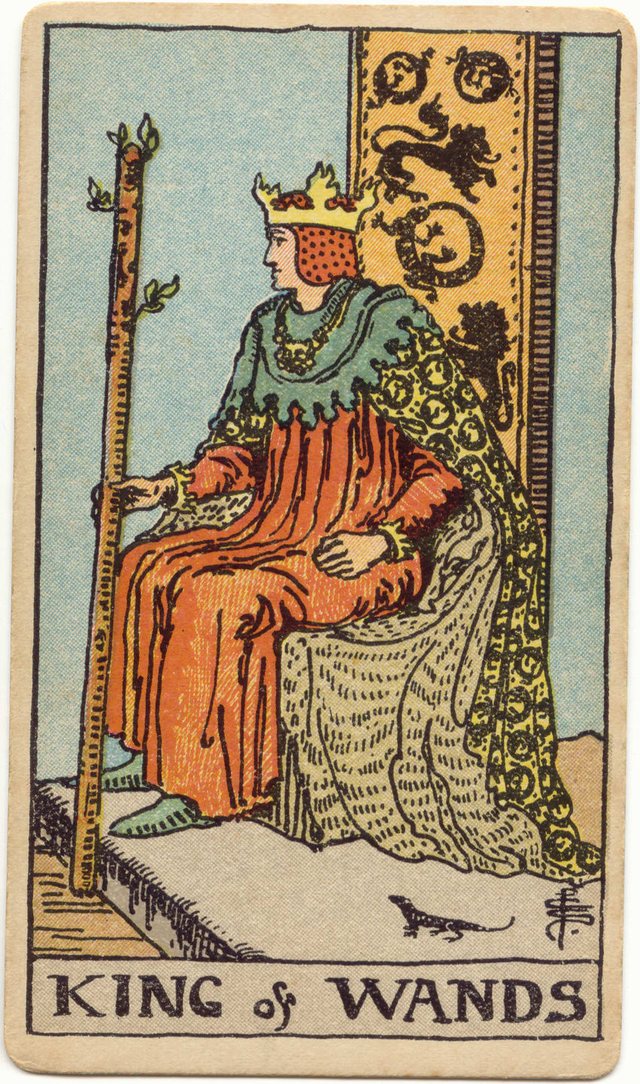
The King sits in profile, facing left, holding a tall leafy wand upright beside him. A gold crown with flame-like points sits over a red cap. He wears an orange-red robe, a green cape with a scalloped edge, and a yellow cloak patterned with black salamanders that spills over the throne. The high back of the throne shows black lions and salamanders curled into rings, and on the dais by his feet a small live salamander crawls.
The King is the suit's fire at its most mature: vision joined to the experience and authority to carry it through. Waite describes the type as ardent, animated, impassioned and noble, and his divinatory note says the card always signifies honesty. As a person he might be a founder, a leader people want to follow, a mentor who sees your potential before you do. As an approach to a situation, he asks you to take charge with long sight and a steady hand.
Notice that he is not leaping into action like his Knight. He sits with his wand planted, looking out of the card toward something only he can see. His fire has learned to wait. He knows where he is going and has the patience to get there, and his energy is spent on purpose rather than on impulse.
King of Wands reversed
When the King is reversed, his fire becomes force without patience: impulsive decisions, a domineering manner, impossibly high standards imposed on everyone else. He may expect others to share his vision and grow irritated when they do not. Sometimes the fire has simply gone out of him, and what remains is the habit of command without the enthusiasm that once justified it.
Waite's reversal is surprisingly mild: good, but severe; austere, yet tolerant. Many readers take that as a leader who has grown hard rather than bad, or whose vision has run ahead of the people around him. The reversed King asks whether you are leading people or merely driving them.
In love and relationships
In love the King of Wands is a generous, passionate partner who likes to take the lead, plan adventures and look after the people he cares about. He can describe someone like that in your life, or the confident side of yourself. He needs a partner with fire of their own. Reversed, he may show a controlling or easily bored partner, or someone whose ego leaves little room for yours.
In work and purpose
At work this is the card of the visionary leader: the entrepreneur, the director who sets the course and inspires others to follow. It encourages strategic thinking, ownership and leadership with integrity, and it suits starting or steering an enterprise. Reversed, it may describe a boss who is all vision and no listening, or your own impatience with people who move more slowly than you would like, even when their caution is sound.
As advice
Lead from where you sit. Hold the long view, decide what you stand for, and let your conduct set the tone for others. Bold energy is strongest when it is steady: be the one who keeps the fire going, not the one who keeps lighting new ones.
Yes or no?
Yes The King of Wands is a card of confident leadership, and reads as a yes when you are willing to take charge. How yes-or-no readings work here.
Questions to sit with
- What vision am I willing to take responsibility for?
- Do people follow me because they are inspired, or because they are pushed?
- Where has my fire learned patience, and where has it not?
Symbolism in the card
The live salamander
A small black salamander crawls on the dais beside the throne. It is the only living one in the Wands court; elsewhere they are patterns on cloth. Here the King's element seems to be present in the room with him.
The throne back
The tall back of the throne is decorated with black lions and with salamanders curled into rings. Waite says the King connects with the symbol of the lion emblazoned there: courage, rule and the fire of Leo.
The crown and red cap
His gold crown has flame-like points and sits over a red cap. Waite calls this a cap of maintenance, worn beneath the crown by all four Kings: a mark of dignity and office.
The leafy wand
He holds a tall wand upright, its top sprouting leaves. Waite says the King uplifts a flowering wand: authority that is still alive and growing, not a dead sceptre.
The salamander cloak
A yellow cloak covered in black salamander patterns falls from his shoulders and pools on the throne. The same pattern clothes the Page and Knight: it marks them as one family of the suit.
The profile view
He faces left in strict profile, looking out of the card rather than at us. The pose gives him a far-seeing quality, as though his attention rests on a horizon the rest of us cannot see.
“The physical and emotional nature to which this card is attributed is dark, ardent, lithe, animated, impassioned, noble.”
Numbers, elements and astrology
King
Kings direct the suit outwardly: authority, responsibility and the mature use of its power.
Fire: the suit of Wands
Fire is will, energy, desire and creativity: the drive that starts things.
In the Golden Dawn system each court card is an element within its suit's element. Pages and Queens are agreed; Knights and Kings are Fire or Air depending on whether you follow the Golden Dawn's names or later practice. They are a symbolic system, not astronomy. How we checked them.
A little history
Kings head the court in the fifteenth-century Italian tarots and in the Tarot de Marseille. Smith's King, in profile among lions and salamanders, draws on the Golden Dawn's pairing of Wands with fire, the element that Renaissance lore gave to the salamander. Waite's own text is inconsistent about him: the card description calls the Wands King dark, while a later section of the same book says the Wands court cards represent very fair people with yellow or auburn hair.