Ace of Wands
Upright new energy · inspiration · a creative start · the will to act
Reversed false start · scattered energy · delay · creative block
- Arcana
- Minor · ace
- Number
- Ace
- Element
- 🜂 Fire
- Golden Dawn title
- Root of the Powers of Fire
- Yes or no
- Yes
Ace of Wands upright
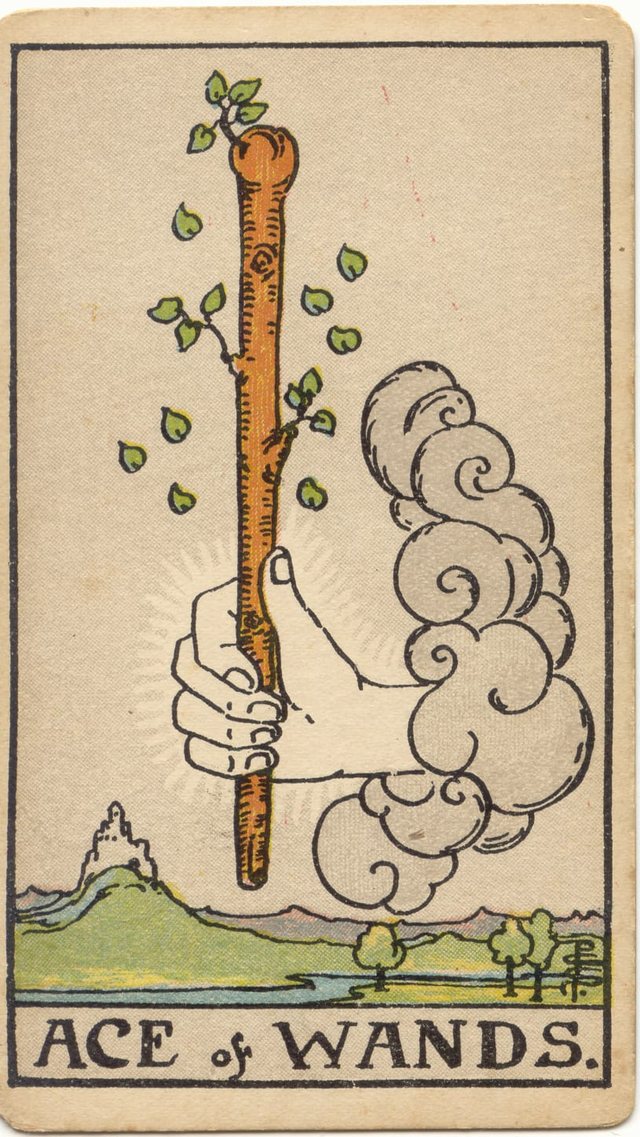
A hand reaches out of a grey cloud on the right and grips a thick, knotted wand. It is not a polished sceptre but a living branch: green shoots sprout from its sides and loose leaves drift down around it. A faint halo of rays surrounds the hand. Far below, a castle sits on a green hill, a river winds through the valley and a few round trees stand on the far bank.
Aces are the purest form of their suit, and Wands is the suit of fire: drive, appetite, creative heat, the urge to make something happen. The Ace of Wands is that urge before it has a shape. It often turns up when an idea has just arrived, when a project is asking to be started, or when someone feels a surge of energy they have not yet pointed anywhere. Notice that the branch is offered rather than earned. The hand comes out of the cloud as if passing it over.
What the card does not supply is the follow-through. A spark is easy to admire and easy to waste, and the castle on the hill is a long walk away. Read it as permission and as a question at once: if this energy is real, what is the first concrete thing you will do with it?
Ace of Wands reversed
Upside down, the Ace of Wands often describes energy that is present but not catching. You may have the idea and lack the push, or start several things and finish none. Sometimes the spark is real but something outside smothers it early: no time, a discouraging response, the wrong moment.
Readers who do not use reversals simply read the upright meaning with more caution about timing. Those who do tend to treat the reversal as a prompt to check the motive behind the urge. Is this a genuine desire, or restlessness looking for any outlet? A false start is not a failure; it is information about where your energy actually wants to go.
In love and relationships
The Ace of Wands brings heat into love: a sudden attraction, a flirtation that feels electric, or a renewed spark in a long relationship after a dull stretch. It is about desire and enthusiasm more than commitment, so it says little about where things lead. For someone single, it can describe the moment of feeling interested and outward-facing again after a quiet period. Reversed, the spark may be one-sided, or an attraction may be cooling simply because no one is tending it.
In work and purpose
At work this is the card of the new initiative: a pitch, a side project, a business idea, a role that suddenly excites you. In its early stages it favours action over planning; the energy is best used while it is hot. It can also mark a return of motivation after a long flat period. The risk is the familiar one of starting strongly and running out of fuel, so pair the excitement with one small, specific next step and a date to take it.
As advice
Act on the idea while it still has heat in it. You do not need the whole plan, only the first move: write it down, make the call, sketch the thing. Then notice whether your energy grows or fades once it meets reality. That tells you whether the spark was worth following.
Yes or no?
Yes A clear, energetic beginning, the Ace of Wands is one of the most straightforward yes cards in the deck. How yes-or-no readings work here.
Questions to sit with
- What idea keeps returning to me, and what is the smallest way I could act on it this week?
- Where is my energy going at the moment, and is that where I want it to go?
- What am I waiting for permission to begin?
Symbolism in the card
The hand from the cloud
A pale hand, drawn in outline rather than coloured, emerges from a billowing grey cloud on the right. The same device opens all four suits in the Smith deck: the gift arrives from outside, as if given rather than made.
The living wand
The wand is a rough, knotted branch of orange-brown wood, thick as a club, with green shoots growing from it. Waite stressed that the wands of this suit are always in leaf: this is the suit of growth and animation, not dead timber.
The falling leaves
Loose green leaves float down on both sides of the wand. Their teardrop shape echoes the falling drops on the Tower and the Moon, and many readers take them the same way, as sparks of spirit. Most simply, they show growth so vigorous it overflows.
The rays around the hand
Fine lines radiate from the hand like a faint halo, easy to miss on the old print. They mark the moment as charged: something more than an ordinary branch is being handed over.
The castle on the hill
On the left a pale castle crowns a green hill. It is small and distant, a goal on the horizon: the place this energy might eventually build, if it is carried that far.
The river and trees
A blue river winds across the valley floor, with a few round trees on the far side. Water and growing things in the background soften the card: the fire of this suit is fertile, not destructive.
“A hand issuing from a cloud grasps a stout wand or club. Divinatory Meanings: Creation, invention, enterprise, the powers which result in these; principle, beginning, source”
Numbers, elements and astrology
One
One is the single point, the first stroke: initiative, will and the seed of something. Aces and the Magician share it.
Fire: the suit of Wands
Fire is will, energy, desire and creativity: the drive that starts things.
By Golden Dawn tradition the Aces are the roots of their elements and stand outside the zodiac. They are a symbolic system, not astronomy. How we checked them.
A little history
In the Italian tarots this suit is bastoni, batons or cudgels, and in the Tarot de Marseille the ace is a great club held by a hand reaching in from the side of the card. Smith kept that essential gesture but set it above a wide landscape and made the club unmistakably alive, sprouting and shedding leaves. The Golden Dawn, to which both Waite and Smith had belonged, called this card the Root of the Powers of Fire, and the Order's pairing of Wands with fire is the one most English-language readers now use.