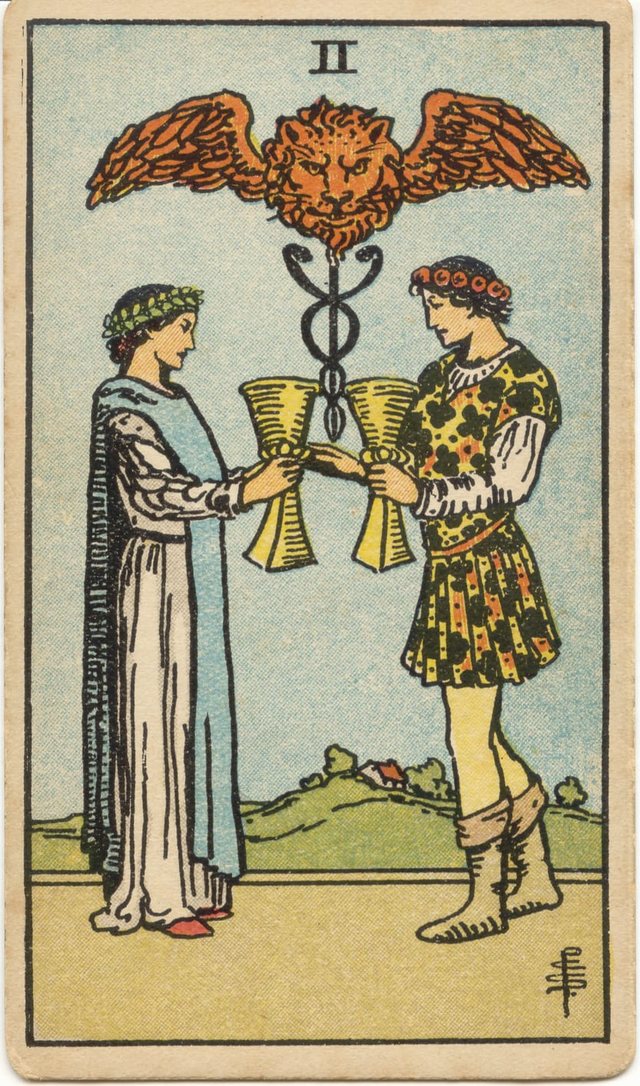
Two of Cups
Upright mutual attraction · partnership · a promise exchanged · reconciliation · equal footing
Reversed imbalance in a bond · a falling-out · broken trust · love on one side only
- Arcana
- Minor · pip card
- Number
- Two
- Element
- 🜄 Water
- Astrology
- ♀ Venus in ♋ Cancer
- Golden Dawn title
- Lord of Love
- Yes or no
- Yes
Two of Cups upright
A young man and a young woman face each other on level ground, each holding a gold cup towards the other. She wears a laurel wreath, a white gown and a long blue mantle; he wears a wreath of red flowers and a short patterned tunic, and he reaches across to touch her cup. Between the two cups rises a caduceus, the staff of Hermes with its twin serpents, and above it hovers a red lion's head with great spread wings. Behind them are green hills and a red-roofed house.
This is the card of two people choosing each other. Its traditional meanings run from romantic love to close friendship, business partnership and the making-up of a quarrel, but the core is always the same: a relationship in which each person gives and receives, and both are seen. Nobody is kneeling. They stand on the same level ground, and the exchange is the point.
The emblem above them deepens the picture. The caduceus, with its two serpents wound round one staff, is a sign of opposites held in balance, and the winged lion suggests passion lifted into something nobler. Taken together, they say that a good bond is not only pleasant; it can change both people, and the energy between them becomes something greater than either brings alone.
Two of Cups reversed
Reversed, the card usually points to a bond that has lost its balance. One person may be giving more than the other, or a misunderstanding has opened a distance neither has addressed. It can describe the end of a partnership, a quarrel between friends, or attraction that is not returned.
Some readers read the reversal more inwardly, as a relationship with yourself that needs repair before you can meet anyone else as an equal. Others treat it as a temporary strain rather than a break. What it asks is practical: what has gone unsaid, and is there still goodwill on both sides to say it?
In love and relationships
Few cards speak so directly of mutual attraction. For someone single, the Two of Cups can describe meeting a person with whom conversation feels unusually easy, or a friendship that starts to turn into something more. In an existing relationship it points to recommitment: a promise, an honest conversation, or a sense of being on the same side again after a difficult stretch. Reversed, it may show that one partner is drifting, or that a disagreement needs facing before resentment hardens.
In work and purpose
At work the card favours collaboration between two people: a good business partner, a mentor who truly listens, a client relationship built on trust, or a negotiation in which both sides come away satisfied. It suggests that the right alliance matters more than going it alone just now. Reversed, it may point to friction with a colleague, a partnership where the terms have become lopsided, or a deal that looked mutual on paper but is not in practice.
As advice
Meet the other person halfway, and make sure they are coming halfway too. Say clearly what you are offering and ask plainly what you hope for in return. A bond between equals is worth tending; one built on one person's effort is worth looking at honestly.
Yes or no?
Yes The card shows agreement between two willing people, so it reads as yes, especially where another person's consent is involved. How yes-or-no readings work here.
Questions to sit with
- In this relationship, am I giving and receiving in something like equal measure?
- What promise, spoken or unspoken, am I making to this person?
- Where do I need to make peace, and am I willing to take the first step?
Symbolism in the card
The two cups
Each figure holds one gold cup out towards the other, and the man's hand reaches over to touch hers. An exchange of cups is an old image of pledge and toast: two people offering what they feel and accepting what is offered.
The caduceus
A black staff with two intertwined serpents rises between the cups. It is the wand of Hermes, messenger of the gods, and in modern times it is also widely used as a sign of medicine. Here it suggests communication and the reconciling of two different natures.
The winged lion's head
Above the caduceus floats a fierce red-orange lion's head between broad brown wings. The lion is passion and strength; its wings lift it upward. Waite says only that it is a variant of a sign on a few old cards and leaves its meaning unexplained.
The woman's laurel wreath and mantle
She wears a green laurel crown, a white gown and a long pale-blue mantle, with red shoes. Laurel is a sign of honour and achievement, and her blue and white suggest calm and sincerity on her side of the exchange.
The man's garland and tunic
He wears a garland of red flowers and a short yellow tunic covered with dark green and black shapes, with white sleeves and turned-down boots. The flowers and warm colours give his side of the meeting its ardour.
The house on the hill
Behind the couple a small red-roofed house sits among green hills. It sets the meeting in an ordinary, lived-in world and hints at the home and shared life a bond like this might lead to.
“A youth and maiden are pledging one another, and above their cups rises the Caduceus of Hermes, between the great wings of which there appears a lion's head.”
Numbers, elements and astrology
Two
Two brings a second thing, and with it relationship, choice and balance. Twos are about pairs, partnerships and decisions between options.
Water: the suit of Cups
Water is feeling, intuition, relationships and the imagination.
By Golden Dawn tradition each numbered card from two to ten rules ten degrees of the zodiac (a decan): the Two of Cups is Venus in the first decan of Cancer. They are a symbolic system, not astronomy. How we checked them.
A little history
In the Tarot de Marseille the Two of Cups is a pattern card: two cups below a decorative flourish, with no people. Waite notes that his winged lion's head and caduceus are 'a variant of a sign which is found in a few old examples of this card', though he does not say which. The Golden Dawn titled the card the Lord of Love, and Waite's divinatory list (love, friendship, union, concord) follows that line closely. The couple pledging each other is Smith's invention for the 1909 deck.