Major Arcana · XVII
The Star
Upright hope · renewal · calm · healing · openness
Reversed discouragement · lost faith · disconnection · self-doubt
- Arcana
- Major
- Number
- XVII
- Element
- 🜁 Air
- Astrology
- ♒ Aquarius
- Hebrew letter
- Tzaddi צ
- Yes or no
- Yes
The Star upright
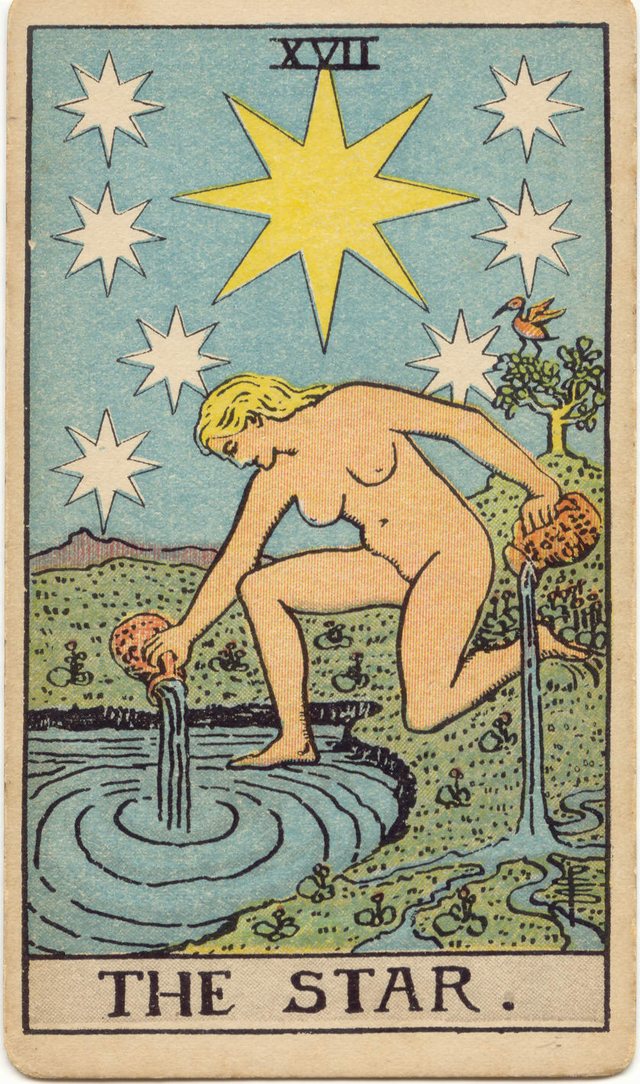
Under a pale blue sky, a naked woman kneels at the edge of a pool, her left knee on the grass and her right foot resting on the water. She pours from two red-brown jugs at once: one stream falls into the pool, the other spills onto the land and runs off in little channels. Above her blazes a large yellow star with eight points, ringed by seven smaller white ones. On a hill to the right a reddish bird has landed in a small tree.
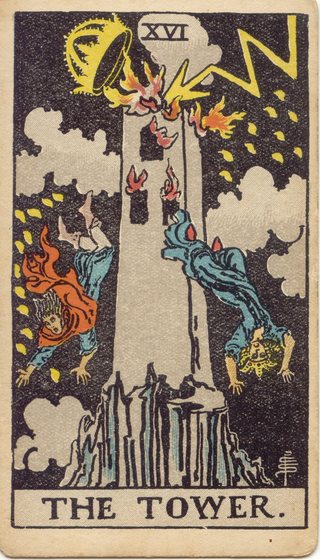
After the Tower, this is a picture in which nothing is happening to anyone. The storm has passed and the sky has cleared. The Star stands for hope, but a particular kind: not excitement or a lucky break, but the steady sense that things can be well again. The woman has nothing to protect and nothing to hide, and she is giving freely, to the water and to the earth alike.
In a reading it often appears at the stage of recovery, when the worst is over and you can begin to trust again: in other people, in your own judgement, in the idea of a future. It also speaks of generosity and openness, and of being guided by something distant and bright rather than by the immediate mess around you.
The Star reversed
Reversed, the Star suggests that hope is hard to find just now. You may feel disconnected from what used to inspire you, or tired in a way that makes the future look flat. Sometimes the reversal points to giving so much to others that nothing is left over for yourself.
Readers who soften reversals often see it as hope that is present but not yet felt, like stars hidden behind cloud. The card's own remedy is modest: small acts of care, a little rest, reconnecting with one thing that used to matter. It asks you to look up again, not to force optimism.
In love and relationships
In love, the Star brings healing and gentle openness. It suits a relationship recovering from a difficult period, two people learning to be honest without defending themselves, or a new connection that feels easy and sincere. For someone single, it can describe being ready to love again after a hard ending. Reversed, it may show someone holding back out of disappointment, or idealising a partner so much that the real person is out of view.
In work and purpose
At work the Star favours a renewed sense of purpose: a project that matters to you, a creative idea, a role where you feel useful rather than merely busy. It often follows a difficult period such as a redundancy or a failed venture, and suggests rebuilding steadily rather than rushing. It suits work that serves others or that has a long horizon. Reversed, it can show burnout or loss of motivation, and the need to reconnect with why you started.
As advice
Let yourself hope again, quietly and without needing proof. Take care of what has been worn down, give what you can without emptying yourself, and keep your eyes on something distant and worth steering by. Recovery does not need to be dramatic to be real.
Yes or no?
Yes The Star is one of the most hopeful cards in the deck and reads as a gentle, encouraging yes. How yes-or-no readings work here.
Questions to sit with
- What still gives me hope, even now?
- Where can I be more open and less guarded?
- What would it look like to give to myself as freely as I give to others?
Symbolism in the card
The great yellow star
A large eight-pointed star, filled with yellow, dominates the sky. Waite linked it to the 'flaming star' of Masonic symbolism. It is a fixed point to steer by: not the full light of day but a guiding light in the dark.
The seven smaller stars
Seven white eight-pointed stars surround the large one, four on the left and three on the right. They are often linked to the seven classical planets or to the Pleiades. Together the eight stars fill the sky with steady points of light.
The kneeling woman
She is entirely naked, with long fair hair, bent forward over the water. Nakedness here is not exposure but openness: nothing hidden, nothing defended. Waite saw her as 'Truth unveiled'.
The two jugs
She pours from two round earthenware jugs at once. One empties into the pool, the other onto the grass, where the water runs away in small streams. The gift goes both to the inner world of feeling and to the practical ground of life.
One knee on land, one foot on water
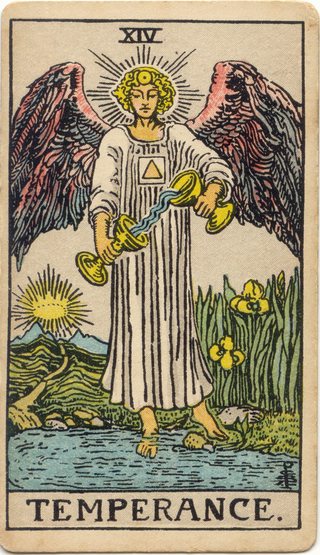
Her left knee rests on the earth and her right foot touches the surface of the pool. Like the angel of Temperance, she belongs to both worlds, practical and emotional, and moves easily between them.
The bird in the tree
On a small tree on the hill to the right sits a reddish bird with spread wings. It is often identified as an ibis, sacred to the Egyptian god Thoth, though Smith's drawing is too small to be sure. Birds carry the idea of messages and of the spirit.
The landscape and distant mountain
Behind her the ground rises gently, dotted with small plants, and a low purple mountain sits on the far horizon. The land is green and open, a peaceful contrast with the black sky of the Tower before it.
“The female figure in the foreground is entirely naked. Her left knee is on the land and her right foot upon the water. She pours Water of Life from two great ewers, irrigating sea and land.”
Numbers, elements and astrology
Number 17, reduced to 8 (1 + 7): Eight
Eight is movement and mastery: effort repeated until it becomes skill, and the momentum to leave what no longer serves.
Air
Air is thought, speech, truth and conflict: the mind and its sharp edges. The Golden Dawn tied The Star to Aquarius, a sign of Air.
These are the traditional attributions of the Hermetic Order of the Golden Dawn (1888), which Waite and Smith followed: each trump is matched to a Hebrew letter and to an element, planet or zodiac sign. They are a symbolic system, not astronomy. How we checked them.
A little history
In the fifteenth-century Visconti-Sforza cards the Star is a woman in a gown holding up a star. The Tarot de Marseille established the familiar scene: a naked woman pouring from two jugs under a large star and seven smaller ones, with a bird in a tree. Waite notes that in some later cards a butterfly on a rose replaced the bird. The Golden Dawn attributed the card to Aquarius. Smith kept the Marseille composition closely, down to the bird in the tree.