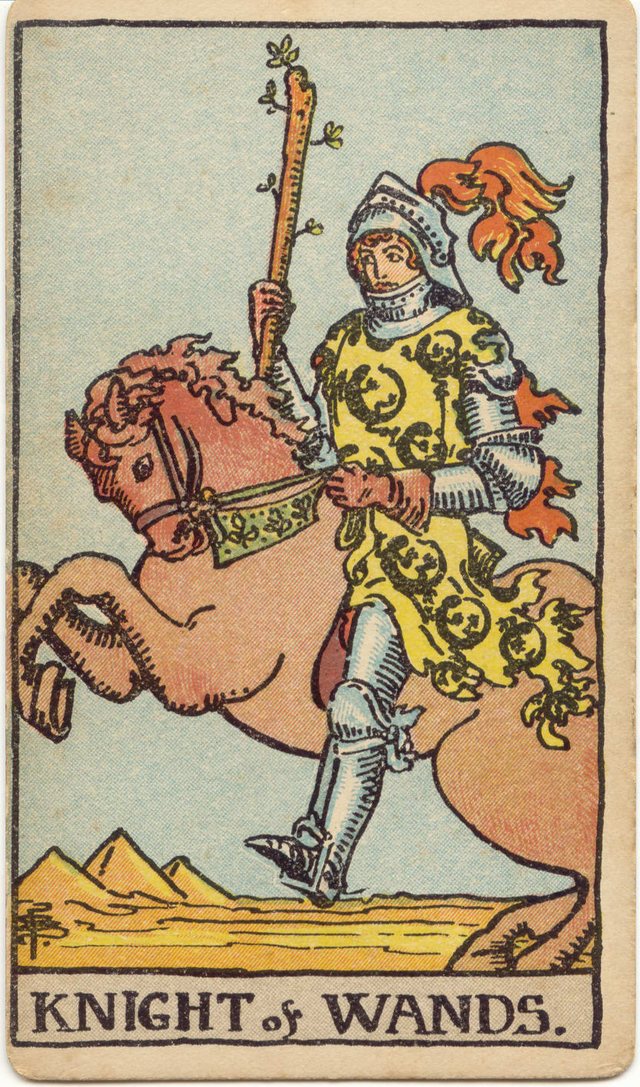
Knight of Wands
Upright bold action · adventure · passion · a sudden move · charisma
Reversed recklessness · impatience · hot temper · plans that break off
- Arcana
- Minor · court card
- Number
- Knight
- Element
- 🜂 Fire
- Sub-element
- Fire or Air of Fire (varies)
- Yes or no
- Yes
Knight of Wands upright
A knight in silver armour sits on a horse that rears back, its front legs high in the air. He holds a short leafy wand upright in one hand and the reins in the other. Orange plumes stream from his helmet and from his arms like flames, and his yellow tunic is patterned with black salamanders. Behind horse and rider, three pyramids rise from the sand.
Waite saw him as if on a journey, armed but not on a warlike errand. The motion of the horse, he wrote, is the key to the rider's character: precipitate, eager, apt to do things in haste. That is the Knight of Wands. As a person, he is energetic, charismatic, adventurous and restless, quick to start and quick to leave. As an approach to a situation, he is pure action: the move made now, the trip booked on impulse, the decision taken before doubt can catch up.
That energy is a gift when something needs momentum, courage or a fresh start. It is a risk when it outruns judgement. Waite's meanings for him are about departure, absence and change of residence, and the card often marks someone on their way somewhere else. Read it as encouragement to act boldly, together with a question: is the horse leading the rider?
Knight of Wands reversed
Reversed, the Knight's fire either burns out of control or will not light. Plans are rushed and come apart, tempers flare, journeys are put off or abandoned. As a person he can be the one who starts things and walks away, or who confuses intensity with commitment.
Waite gives rupture, division, interruption and discord. Some readers also see frustrated energy: the urge to act blocked by circumstances, building into irritation, or restlessness with nowhere to go. The reversal asks you to aim before you charge, and to notice whether you are moving toward something or just away from where you are.
In love and relationships
In love the Knight of Wands is passionate, exciting and not especially patient. He can describe a whirlwind romance, a partner who brings adventure, or a sudden attraction to someone who is only passing through. Whether it lasts depends on whether there is more to it than heat. Reversed, he may show a lover who runs hot and cold, someone wary of commitment, or a relationship in which arguments flare up fast.
In work and purpose
At work this Knight fits bold moves: launching quickly, taking a chance on a new venture, changing jobs or relocating. He thrives in a crisis or a start-up and chafes at routine. The card encourages initiative but warns against impatience with detail. Reversed, it may describe projects abandoned halfway, friction caused by haste, or a promising start stalled because nobody planned the middle. If you work with someone like this, give them the launch and find someone else to handle the follow-through.
As advice
Act, and act with conviction: this is a moment for momentum rather than more thought. But take one breath to check the direction before you spur the horse. Courage and haste look alike from the outside; only one of them takes you where you meant to go.
Yes or no?
Yes The Knight of Wands is a card of action and movement, and reads as a yes, though perhaps a hasty one. How yes-or-no readings work here.
Questions to sit with
- Am I moving toward something, or running from where I am?
- What would I do now if I trusted my own energy?
- Where would a little patience make my boldness more effective?
Symbolism in the card
The rearing horse
The horse rears high, front legs lifted, its mane drawn in curling tufts like flames. Waite wrote that the motion of the horse is a key to the character of its rider: hasty, eager and impossible to hold still.
The flame plumes
Long orange plumes stream from his helmet and from his elbows and back, drawn like flickering fire. He trails flames wherever he goes, and leaves a little heat behind in every place he passes through.
The salamander tunic
Over his armour he wears a yellow tunic patterned with black salamanders curled into rings. In Renaissance lore the salamander was the creature of fire, and the pattern marks him as the suit's man of action.
The short wand
He holds a short leafy wand upright, more like a baton than a lance. Waite notes that he is armed with a short wand and not on a warlike errand: this is energy, not aggression.
The armour
Plate armour covers his arms and legs and a close helmet frames his face. He is equipped for danger and for distance, ready to ride into the unknown.
The pyramids
Three pyramids stand in the sandy distance. Waite describes him passing mounds or pyramids: far horizons, travel, the lure of places a long way from home.
“The motion of the horse is a key to the character of its rider, and suggests the precipitate mood, or things connected therewith.”
Numbers, elements and astrology
Knight
Knights are the suit in motion: action, pursuit and sometimes excess, the energy as a quest.
Fire: the suit of Wands
Fire is will, energy, desire and creativity: the drive that starts things.
In the Golden Dawn system each court card is an element within its suit's element. Pages and Queens are agreed; Knights and Kings are Fire or Air depending on whether you follow the Golden Dawn's names or later practice. They are a symbolic system, not astronomy. How we checked them.
A little history
The mounted knight, cavallo in Italian and cavalier in French, is found among the court cards of the fifteenth-century Italian tarots and of the Tarot de Marseille. The Golden Dawn later rearranged and renamed its court cards, which makes direct comparison between systems confusing; Waite kept the traditional King, Queen, Knight and Page. Smith sets this Knight in the same pyramid landscape as his Page, and gives him flames and salamanders that tie him to the suit's element.