Major Arcana · XXI
The World
Upright completion · wholeness · achievement · integration · belonging
Reversed unfinished business · lack of closure · delays · shortcuts
- Arcana
- Major
- Number
- XXI
- Astrology
- ♄ Saturn
- Hebrew letter
- Tav ת
- Yes or no
- Yes
The World upright
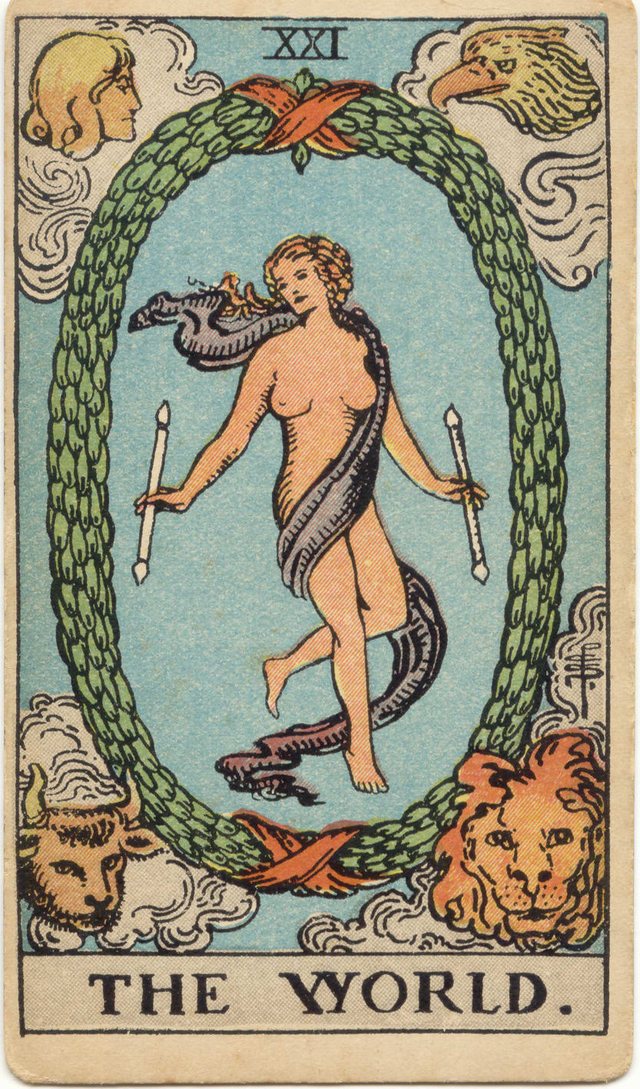
Inside a tall oval wreath of green leaves, tied at top and bottom with red ribbons, a woman seems to dance in the air against a blue sky. A long violet scarf winds around her body, she holds a white wand in each hand, and one leg is bent behind the other. In the four corners, framed in cloud, are the heads of a man, an eagle, a bull and a lion.
This is the last numbered card of the Major Arcana, and it describes arrival. Something has been finished and finished properly: a long project, a stage of education, a healing, a cycle of life. The dancer is not straining. Everything that the earlier cards held in tension seems, for the moment, to move together. The four creatures at the corners, representing the four elements and the four directions, frame her like witnesses.
Completion here is not a full stop. The wreath is open in the middle, and the dancer is in motion. In the tradition the journey loops back to the Fool, who steps off again with everything the World has taught. Many readers take the card as an invitation to recognise what you have achieved before rushing to the next goal, and to feel at home, for once, in your own life.
The World reversed
Something nearly finished but not quite: that is the most common reading of the World reversed. A final step is missing, a loose end keeps you from moving on, or you are trying to skip to the next stage without closing this one. It can feel like being stuck at ninety per cent, close enough to see the end but unable to reach it.
Some readers see the reversal as a lack of closure after a long effort, or as success that feels hollow because something essential was left out. The question is what still needs completing, and whether you have given yourself permission to recognise how far you have come.
In love and relationships
In love, the World describes a relationship that feels whole: two people who know each other well, a commitment marked, a long shared road reaching a meaningful milestone. It can also mean a sense of completion within yourself, which makes you a better partner. For someone single, it suggests feeling content and ready rather than looking for someone to fill a gap. Reversed, it may show a relationship stuck short of the next step, or an old relationship without proper closure.
In work and purpose
At work the World fits the successful end of a major project, a qualification earned, a goal reached, or work with an international reach. It favours celebrating achievements properly, documenting what was learnt and planning the next cycle with that knowledge. Reversed, it can show a project dragging on past its natural end, a promotion just out of reach, or a temptation to cut corners in the final stage. It suggests finishing thoroughly before you start the next thing.
As advice
Finish what you started, and finish it well. Take time to notice what you have achieved and who you have become in the process. Then move freely into what comes next, carrying the whole journey with you, and let the next beginning be as unhurried as this ending.
Yes or no?
Yes The World is a card of completion and success, so it reads as a clear yes. How yes-or-no readings work here.
Questions to sit with
- What have I completed that I have not yet allowed myself to celebrate?
- What loose end still needs tying before I can move on?
- Where do I feel most at home and most myself?
Symbolism in the card
The dancing figure
A woman floats mid-step in the centre of the wreath, her body turned slightly, one leg crossed behind the other. Waite describes her as 'in the act of dancing'. The crossed legs echo the Hanged Man, the same figure now free and in motion.
The violet scarf
A long scarf in violet-grey wraps around her shoulders and body, trailing below. Waite said the wind has girt her with it, 'and this is all her vesture'. It covers just enough to leave her balance and freedom visible.
The two wands
She holds a slim white wand in each hand, each with small knobbed ends. Where the Magician raises a single wand, she carries two. Readers often see them as balance between opposite forces, both held lightly.
The oval wreath
A tall green wreath of leaves encircles her, like a laurel crown. Laurel has long marked victory and achievement. The oval shape suggests a doorway or an opening as well as a frame.
The red ribbons
At top and bottom the wreath is bound by red ribbons that cross in a figure-of-eight shape. Many readers connect this loop with the lemniscate of the Magician and Strength: the endless cycle that ends here and begins again.
The four living creatures
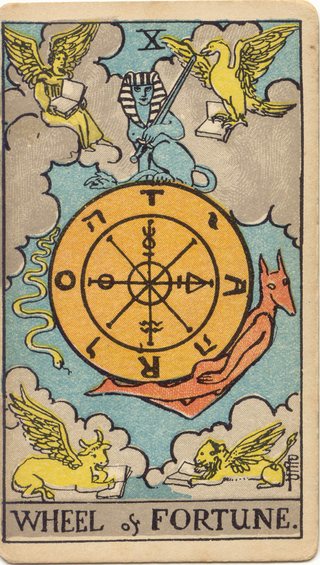
A man's head (top left), an eagle (top right), a bull (bottom left) and a lion (bottom right) appear in clouds at the corners. They come from Ezekiel and Revelation and later became the symbols of the four Evangelists. The same creatures surround the Wheel of Fortune.
The four living creatures in tarotEagle in tarotBull in tarotLion in tarot
The clouds at the corners
Each creature looks out from a puff of white cloud. Clouds mark the boundary between earth and heaven, and here they set the four creatures slightly apart from ordinary space, as guardians of the whole scene.
“It represents also the perfection and end of the Cosmos, the secret which is within it, the rapture of the universe when it understands itself in God.”
Numbers, elements and astrology
Number 21, reduced to 3 (2 + 1): Three
Three is the first number that makes a shape: two things meet and produce a third. It is the number of growth, collaboration and first results.
These are the traditional attributions of the Hermetic Order of the Golden Dawn (1888), which Waite and Smith followed: each trump is matched to a Hebrew letter and to an element, planet or zodiac sign. They are a symbolic system, not astronomy. How we checked them.
A little history
In the Visconti-Sforza cards the World shows two cherubs holding up a globe containing a city or landscape. The Tarot de Marseille established the design Smith followed: a dancing figure with a scarf inside an oval wreath, with the four living creatures in the corners, titled Le Monde and numbered XXI. In his book Waite discusses the Fool, numbered zero, between Judgement and the World, while the World keeps its number XXI. The Golden Dawn attributed the card to Saturn. Smith's version keeps the Marseille composition, giving the figure two wands and binding the wreath with red ribbons.