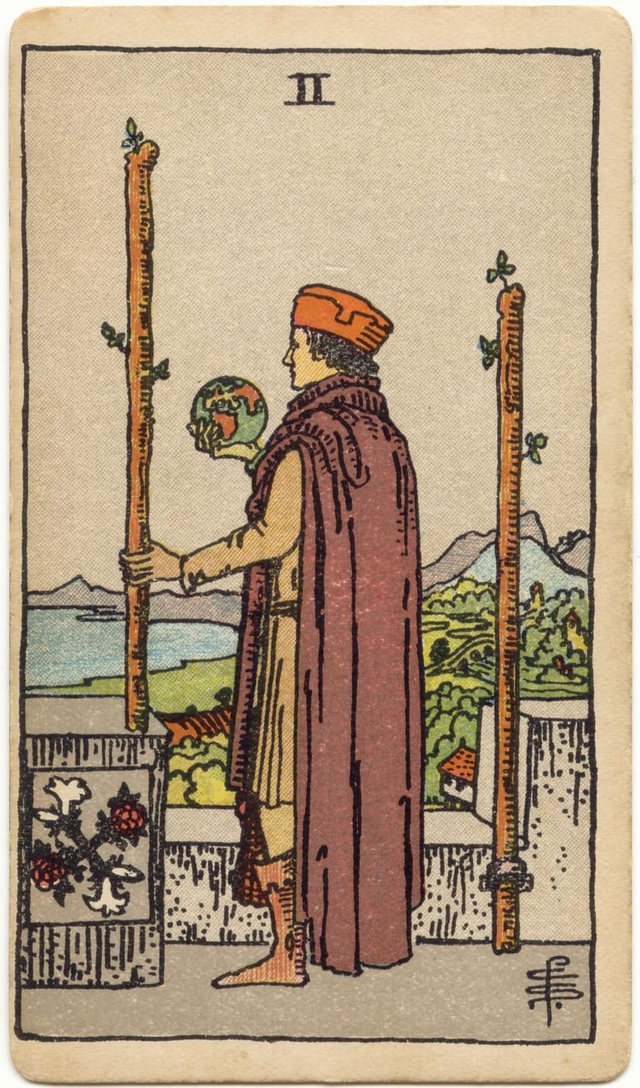
Two of Wands
Upright planning · the wider view · ambition · a decision to expand
Reversed fear of leaving · plans without action · restlessness · unexpected turns
- Arcana
- Minor · pip card
- Number
- Two
- Element
- 🜂 Fire
- Astrology
- ♂ Mars in ♈ Aries
- Golden Dawn title
- Lord of Dominion
- Yes or no
- Maybe
Two of Wands upright
A man in a red cap and a long brownish-purple cloak stands on the battlements of a castle, turned away from us so that we see him in profile. In one hand he holds a small globe; with the other he grips a tall wand that rests against the parapet. A second wand is fixed to the wall by an iron ring. Below him lies a broad view: water on the left, green fields and a red-roofed house, blue-grey mountains in the distance.
The Ace gave the spark. The Two is the moment of deciding what to do with it, and the picture is all about scale. The man already has a castle; he is secure. The globe in his hand says that the secure place is no longer enough. The card often appears when someone has a solid base and is weighing a bigger move: a new market, a move abroad, a change of direction that would take them past the walls they built. It is ambition still on paper.
Waite noticed something odd in it. He saw in the lord with his globe a kind of melancholy, comparing it to the sadness of Alexander amid all the wealth of the world. Holding everything can feel strangely flat. The card can describe the restlessness of a success that has stopped satisfying, as much as the excitement of what might come next.
Two of Wands reversed
Reversed, the Two of Wands tends to describe a plan that never leaves the battlements. You can see the horizon and keep not going, out of fear of losing what you have, or because the decision feels too large to make. The globe becomes something to turn over in your hand rather than a map.
Some readers follow Waite's own reversed list, which runs to surprise, wonder and trouble: an unexpected turn that upsets the plan, for better or worse. Others read it as a world that has shrunk, a feeling of being boxed in by the very security you worked for. Either way the question is the same one the upright asks, put more sharply: what is stopping you from moving?
In love and relationships
In love the Two of Wands often appears at a point of choice: whether to stay with what is comfortable or reach for something larger, such as moving in together, changing cities for someone, or ending a relationship that is safe but small. The figure stands alone, so the card can also describe someone who keeps a partner at arm's length while working out their own plans. Reversed, it may point to a relationship stalled because one person cannot commit to a shared future.
In work and purpose
This is a strong card for strategy: expansion plans, a business looking beyond its home market, a career move that needs relocation or retraining. It belongs to the stage of research and decision rather than launch. If you hold a comfortable position, it asks whether you are content to keep it or curious about what lies past it. Reversed, it can describe analysis that never ends, or a plan so cautious it never leaves the meeting room.
As advice
Take the long view, then choose. Map out what lies beyond the walls: what it would cost, what it would offer, whom it would take you away from. Planning helps only until it becomes a way of not deciding, so set yourself a point at which you will commit one way or the other.
Yes or no?
Maybe The Two of Wands shows a decision still being weighed, so the answer depends on what you choose to do with it. How yes-or-no readings work here.
Questions to sit with
- What would I attempt if I trusted the base I have already built?
- Is my hesitation about the risk itself, or about what I might leave behind?
- Has something I once wanted become too small for me?
Symbolism in the card
The globe
A small globe, coloured green and red, rests in the man's hand like an apple. It is the world made portable: reach, ambition, everything beyond the castle. Holding it, the card quietly points out, is not the same as travelling it.
The battlements
He stands on a stone rampart with square merlons, high above the land. The height gives him his view but also keeps him apart from the country he surveys: secure, and slightly removed.
The two wands
One wand is in his hand; the other is held to the wall by an iron ring. One is carried and chosen, the other already fixed in place: what he has achieved, and what he is weighing up next.
The rose, cross and lily
On the stone block at the left, red roses and white lilies cross each other in a diagonal pattern. Waite asked readers to notice the Rose and Cross and Lily here. Roses and lilies also grow together in the Magician's garden: desire and purity, joined.
The red cap and dark cloak
He wears a red cap and a heavy brownish-purple cloak over a plain tunic. The rich, dark colours give him the air of a merchant or a lord, dressed for authority rather than for travel.
The landscape below
Water, fields, a red-roofed house and blue-grey mountains stretch away on either side. The land is fertile and peaceful. The question is not whether the world is worth reaching but whether he will go.
Water, rivers and pools in tarotMountains in tarotHouses and cities in tarot
“here is a lord overlooking his dominion and alternately contemplating a globe; it looks like the malady, the mortification, the sadness of Alexander amidst the grandeur of this world's wealth.”
Numbers, elements and astrology
Two
Two brings a second thing, and with it relationship, choice and balance. Twos are about pairs, partnerships and decisions between options.
Fire: the suit of Wands
Fire is will, energy, desire and creativity: the drive that starts things.
By Golden Dawn tradition each numbered card from two to ten rules ten degrees of the zodiac (a decan): the Two of Wands is Mars in the first decan of Aries. They are a symbolic system, not astronomy. How we checked them.
A little history
Earlier tarots, including the Tarot de Marseille, show the numbered cards of this suit as arrangements of crossed batons with no scene at all. Smith's lord on his battlements is her own composition. The Golden Dawn called the card the Lord of Dominion, which fits the picture well. Waite's divinatory list for it is unusually frank about its own confusion: he says that between the two traditional readings, riches on one hand and sadness on the other, no marriage is possible.