
Staff and wand in tarot
The staff is the oldest tool of authority and magic: Moses' rod, Aaron's rod that blossomed, the herald's staff of Hermes, the bishop's crozier. The Magician holds a white wand aloft; the Fool carries a staff over his shoulder; the Hermit leans on a long one; the World's dancer holds two wands. In the Wands suit every staff is living wood with leaves, the energy of fire still growing. The Emperor's sceptre ends in an ankh, the Hierophant's in a triple cross. In readings a staff means will, authority and support. Notice whether it is raised, carried or leaned on.
Cards that show staff and wand
-
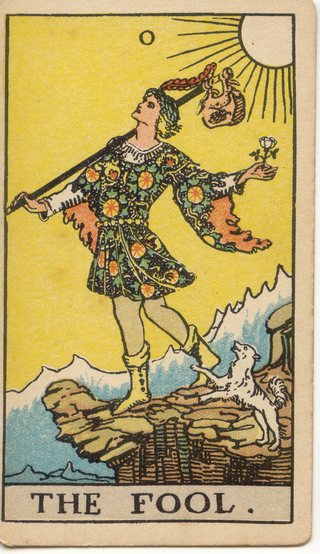 The Fool
: The staff and bundle
A black staff rests on his right shoulder with a small embroidered bag tied to the end. It is all the luggage he has. Waite said its 'dim signs' held memories stored in the soul; most readers simply notice how little the Fool needs to set out.
-
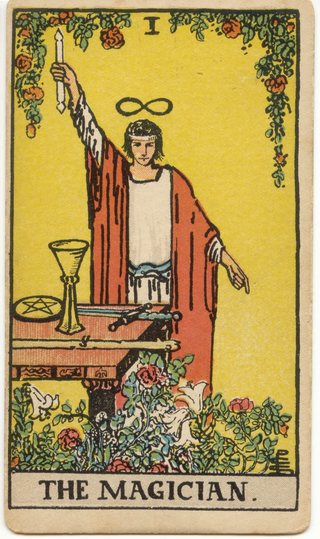 The Magician
: The raised wand and pointing hand
His right arm lifts a white wand, pointed at both ends, while his left hand points to the earth. Waite reads the gesture as grace 'drawn from things above and derived to things below': the familiar 'as above, so below', an idea brought down into practice.
-
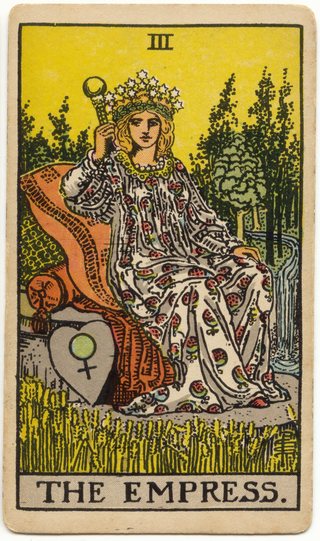 The Empress
: The sceptre and globe
She holds a short golden sceptre topped with a round globe. Waite calls it 'the globe of this world': her rule is over the earth and living things, not over doctrine or armies.
-
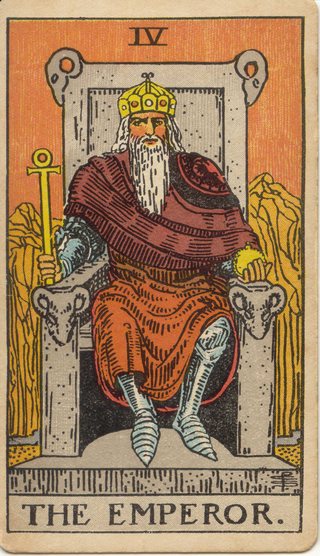 The Emperor
: The ankh sceptre
His right hand holds a golden sceptre shaped like an ankh, the Egyptian sign of life, which Waite calls 'a form of the Crux ansata'. It suggests that his authority is meant to serve life, not merely to command it.
-
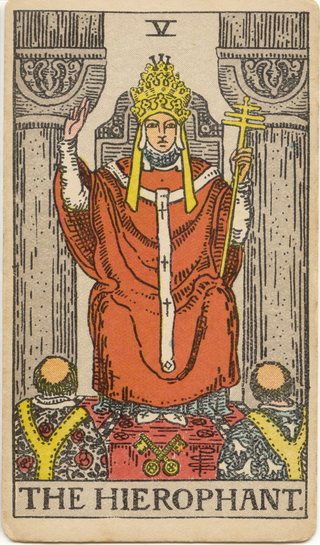 The Hierophant
: The triple cross
In his left hand is a long golden staff ending in three crossbars. The triple cross is a papal emblem; here it suggests an authority that claims to reach over spiritual, intellectual and bodily life alike.
-
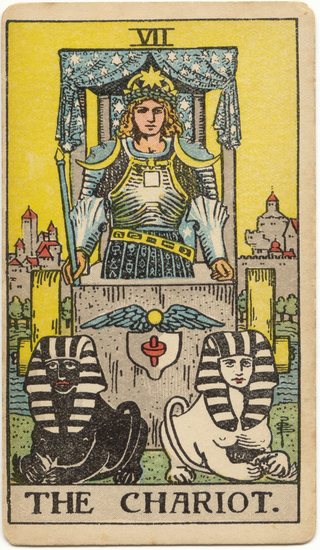 The Chariot
: The wand
His right hand holds a long wand or sceptre while his left rests on the chariot's edge. Waite's text speaks of a drawn sword, but Smith drew a wand: authority and directed will rather than violence.
-
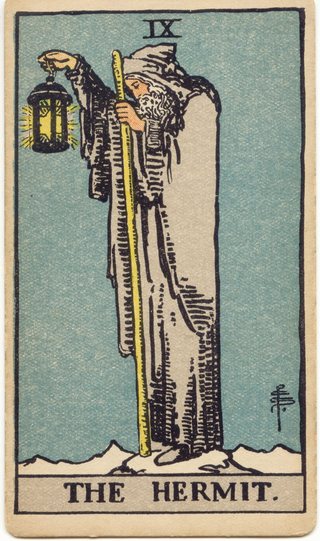 The Hermit
: The staff
A tall yellow staff in his left hand steadies him on the uneven peak. It is the pilgrim's staff, the support of experience and the authority of age, and it echoes the wands carried by the Fool and the Magician.
-
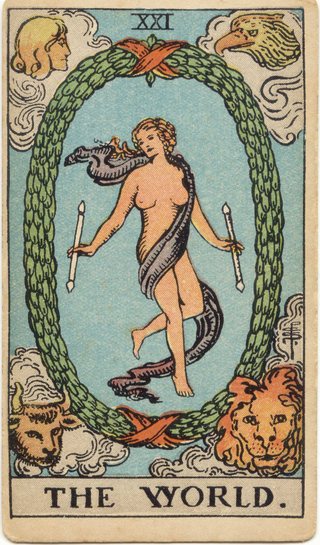 The World
: The two wands
She holds a slim white wand in each hand, each with small knobbed ends. Where the Magician raises a single wand, she carries two. Readers often see them as balance between opposite forces, both held lightly.
-
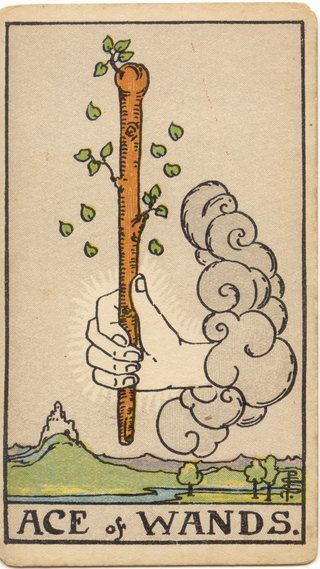 Ace of Wands
: The living wand
The wand is a rough, knotted branch of orange-brown wood, thick as a club, with green shoots growing from it. Waite stressed that the wands of this suit are always in leaf: this is the suit of growth and animation, not dead timber.
-
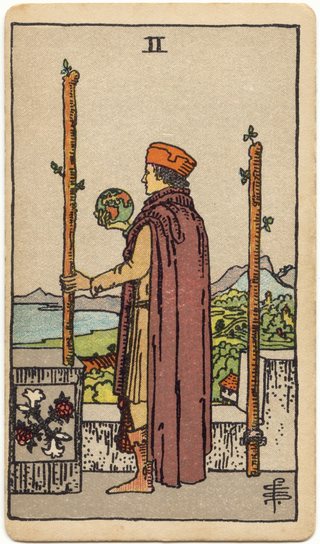 Two of Wands
: The two wands
One wand is in his hand; the other is held to the wall by an iron ring. One is carried and chosen, the other already fixed in place: what he has achieved, and what he is weighing up next.
-
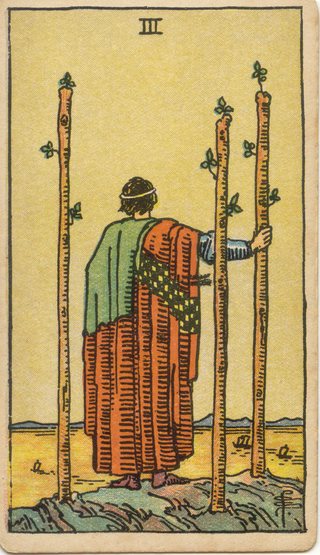 Three of Wands
: The three planted wands
Three leafy wands stand upright in the rock and he holds one of them. They are rooted rather than carried, an image of the established strength that both Waite and the Golden Dawn attached to this card.
-
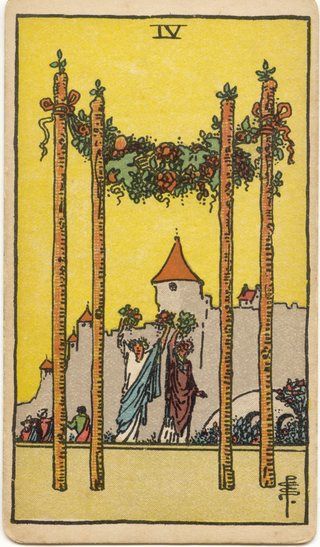 Four of Wands
: The garlanded wands
Four upright wands hold up a thick garland of leaves, red flowers and fruit, tied with red ribbons. The shape is a gateway or canopy, like those raised for weddings and harvest festivals: a structure built for celebration.
-
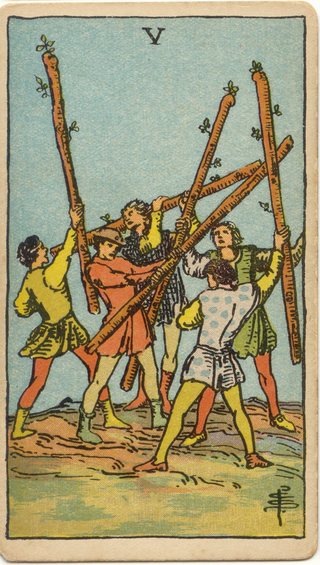 Five of Wands
: The crossing wands
The staves cross and clash in the air, but none clearly lands on anyone. The pattern of crossing lines is the card in miniature: energy colliding rather than flowing in one direction.
-
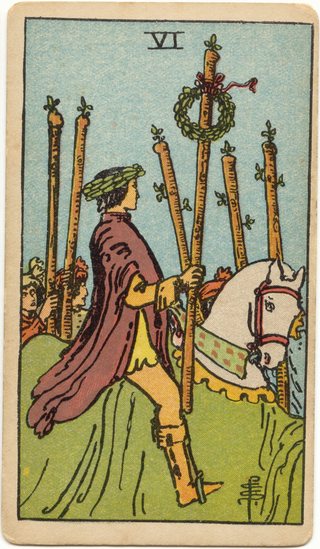 Six of Wands
: The footmen with wands
Men on foot crowd around the rider with their wands raised; Waite calls them footmen. They are escort and supporters, and a reminder that a public victory is carried by many hands.
-
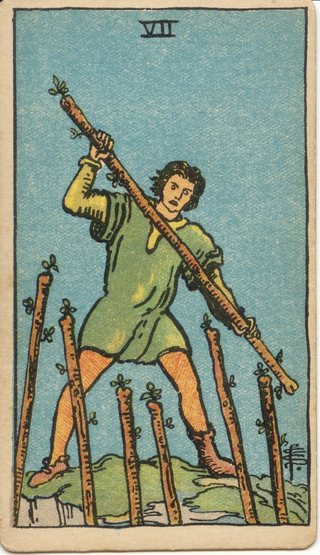 Seven of Wands
: The six wands from below
Six leafy wands rise from beyond the edge of the hill, their bearers out of sight. Hidden opponents are a good image for pressure that seems to come from everywhere at once: criticism, competition, doubt.
-
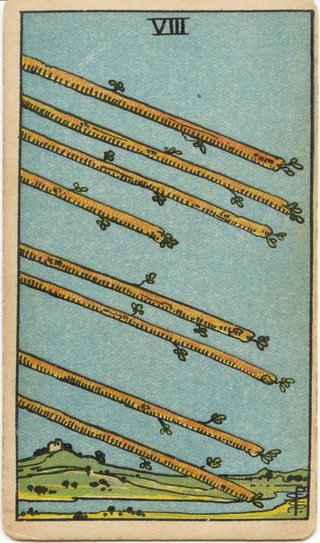 Eight of Wands
: The eight flying wands
Eight leafy wands cross the sky in parallel, all tilted at the same angle. Nothing holds them. They are pure motion, and their orderly alignment suggests force with a direction rather than chaos.
-
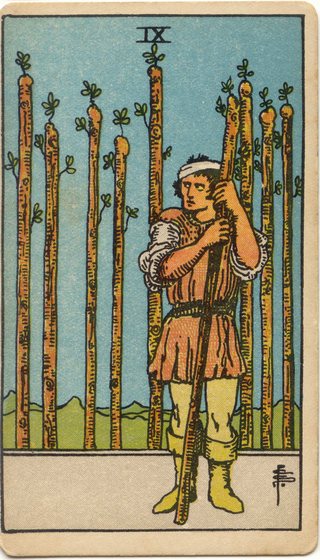 Nine of Wands
: The wand held close
He clutches one wand upright against his chest with both hands and leans on it. It is support and weapon at once, the last resource he keeps closest to him.
-
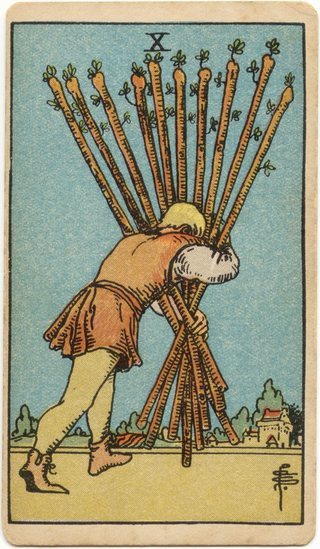 Ten of Wands
: The bundle of ten wands
Ten leafy wands are gathered into one awkward bundle, held upright and fanning out above his head. Each is still alive and in leaf: these are not dead weights but good things that have become too many.
-
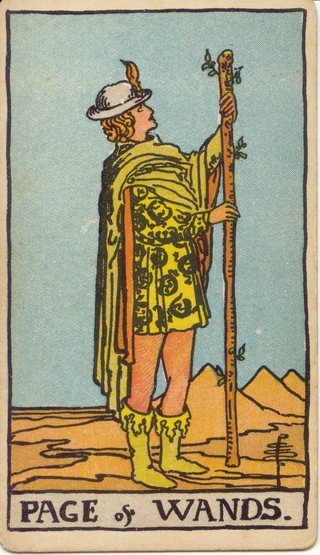 Page of Wands
: The wand held upright
He holds a tall wand in both hands, its tip in leaf, and looks up at it intently. His gaze turns the wand into something to study: possibility being examined, not yet put to use.
-
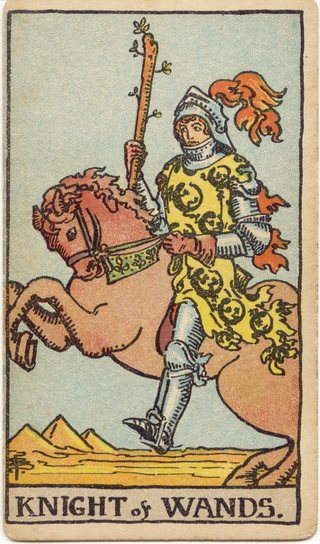 Knight of Wands
: The short wand
He holds a short leafy wand upright, more like a baton than a lance. Waite notes that he is armed with a short wand and not on a warlike errand: this is energy, not aggression.
-
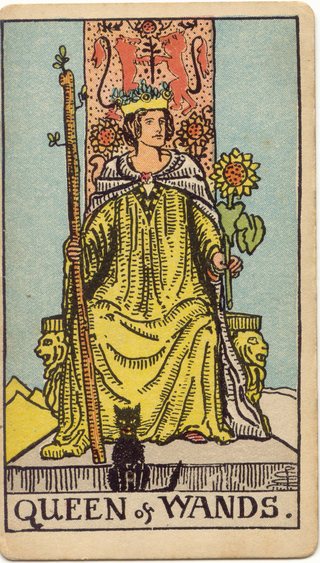 Queen of Wands
: The leafy wand
She holds a tall wand in her right hand, sprouting leaves near the top. Waite chose this card to remark that the wands of this suit are always in leaf, a suit of life and animation.
-
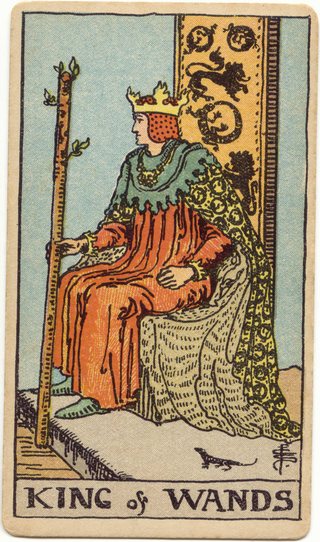 King of Wands
: The leafy wand
He holds a tall wand upright, its top sprouting leaves. Waite says the King uplifts a flowering wand: authority that is still alive and growing, not a dead sceptre.
-
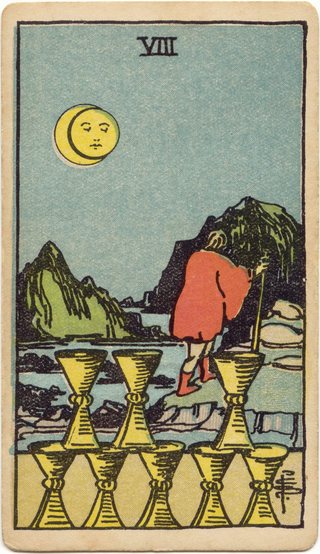 Eight of Cups
: The red-cloaked traveller
A man in a red cloak and red boots walks away from the viewer, leaning on a long staff. Red gives his departure energy and resolve, and the staff marks him as a pilgrim or wanderer.
-
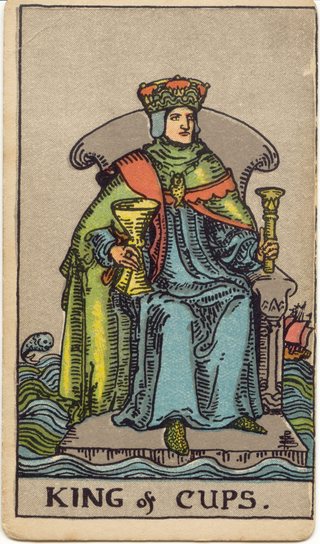 King of Cups
: The cup and sceptre
He holds a large gold cup in his right hand and a short gold sceptre in his left. Cup and sceptre together join feeling with authority: he rules, but through understanding.
-
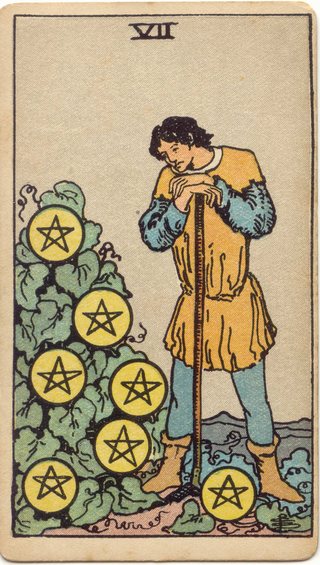 Seven of Pentacles
: The tool
He leans on a long handle that ends in a dark blade at the soil, like a hoe. Waite simply calls it his staff. It shows that the growth beside him is the result of work, not luck.
-
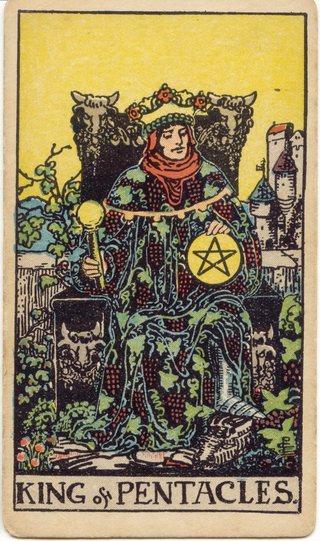 King of Pentacles
: The orb sceptre
In his right hand he holds a sceptre topped with a golden orb. Orb and sceptre are traditional signs of worldly rule: authority over the material world.