Four of Wands
Upright celebration · homecoming · a milestone reached · belonging · settled happiness
Reversed celebration delayed · tension at home · transition · quieter joy
- Arcana
- Minor · pip card
- Number
- Four
- Element
- 🜂 Fire
- Astrology
- ♀ Venus in ♈ Aries
- Golden Dawn title
- Lord of Perfected Work
- Yes or no
- Yes
Four of Wands upright
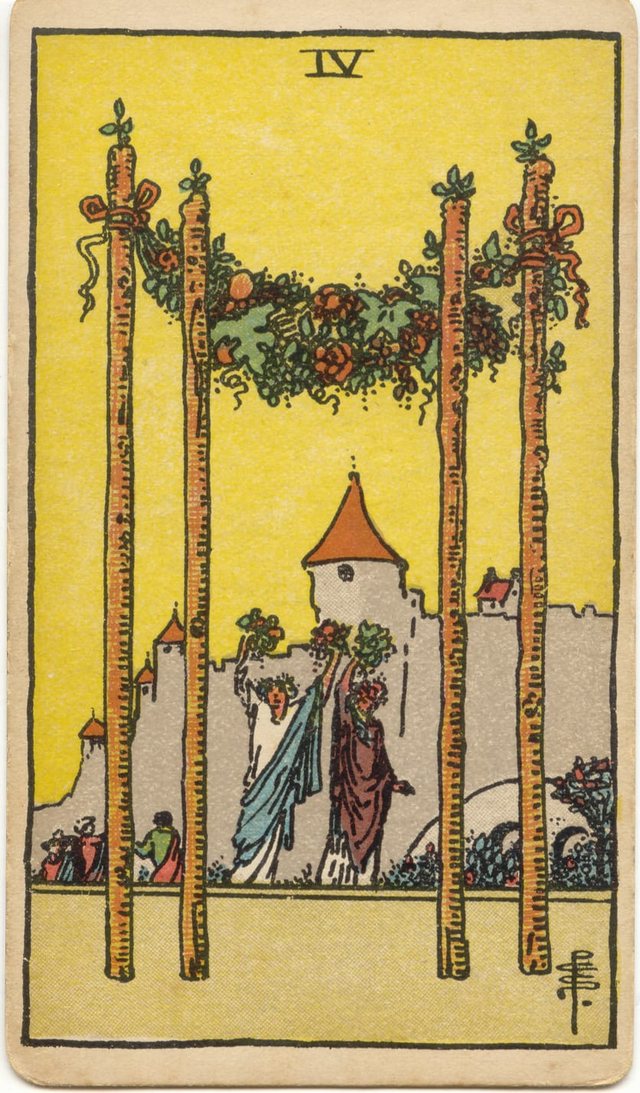
Four tall wands stand in the foreground with a heavy garland of leaves, red flowers and fruit slung between them, tied at the corners with red ribbons. Behind, two women in long robes, one in blue and white, the other in deep red, raise bunches of flowers above their heads. Further back stands a grey castle wall with a round tower roofed in red, a few small figures gathered at its foot, and on the right an arched bridge. The sky is a strong, bright yellow.
This is one of the plainest happy cards in the tarot. Waite himself said its meanings were, for once, almost on the surface: country life, refuge, a kind of harvest-home, peace and harmony. The four wands make a frame, almost a canopy, the kind you might walk under at a wedding or a village festival. The card often marks a milestone that deserves to be celebrated together: moving into a home, finishing a long piece of work, a reunion, a homecoming.
Its stability is the welcoming kind. Four is a number of structure, and in Wands that structure is festive rather than rigid: posts that exist to hold up flowers. The two women come out from the walled town toward whoever approaches, so the card is as much about arriving and being received as about having.
Four of Wands reversed
Waite's reversed reading for this card is unusual: he says the meaning remains unaltered, still prosperity, increase and beauty. Many readers follow him and treat the reversed Four as a gentler version of the upright, a celebration that is smaller, later or quieter than hoped, but still real.
Others read it as friction around home or belonging: a family gathering under strain, a move between homes, or a sense of not quite being welcome. Even then it is rarely a hard card. It asks what would make you feel at home, and whom you would want under the garland with you.
In love and relationships
In love the Four of Wands is a card of commitment that is shared with others: an engagement, a wedding, moving in, meeting each other's families, or simply a relationship that feels like a safe place to come back to. For someone single, it can describe a settled and sociable period, surrounded by friends rather than searching. Reversed, it may point to a couple who are happy in private but meet friction from family, or plans for a shared home that are on hold.
In work and purpose
At work the card fits a project delivered, a team marking a success, a launch, a business that has found its footing, or a workplace that genuinely feels like a community. It encourages you to acknowledge achievements together before rushing on to the next target. Reversed, it may describe a team out of step with itself, a celebration that rings hollow, or a move to a new role where the place does not yet feel like yours.
As advice
Stop and mark what you have done. Gather the people who helped and let them share it. A milestone that passes uncelebrated is easily forgotten, and the gathering builds something of its own: a sense of belonging that will carry you through the harder stretches later on.
Yes or no?
Yes A card of celebration and secure foundations, the Four of Wands is a confident yes. How yes-or-no readings work here.
Questions to sit with
- What have I achieved lately that I have not stopped to celebrate?
- Where do I feel most at home, and who is there with me?
- What would help me feel welcome rather than merely present?
Symbolism in the card
The garlanded wands
Four upright wands hold up a thick garland of leaves, red flowers and fruit, tied with red ribbons. The shape is a gateway or canopy, like those raised for weddings and harvest festivals: a structure built for celebration.
The two women with flowers
Two women, one in blue and white and one in deep red, lift bunches of flowers high over their heads. Waite calls them two female figures uplifting nosegays. Their gesture is greeting and thanksgiving.
The castle and its tower
A grey wall with a round, red-roofed tower stands behind them, with more turrets and a house beyond. Waite calls it an old manorial house: home, shelter and settled life.
The bridge
On the right a pale arched bridge crosses toward the castle; Waite describes it as a bridge over a moat. It is the way in, the point where a traveller arrives and is received.
The gathered townsfolk
Small figures cluster by the wall on the left. The celebration is not private. The card's joy is communal: a town or a family coming out together.
The yellow sky
The background is a saturated yellow, one of the brightest skies in the deck. Like the yellow skies of the Fool and the Empress, it signals warmth, openness and good feeling.
“They are for once almost on the surface—country life, haven of refuge, a species of domestic harvest-home, repose, concord, harmony, prosperity, peace, and the perfected work of these.”
Numbers, elements and astrology
Four
Four is the square: stability, structure and rest, with the risk of standing still. Fours in tarot often show something held in place.
Fire: the suit of Wands
Fire is will, energy, desire and creativity: the drive that starts things.
By Golden Dawn tradition each numbered card from two to ten rules ten degrees of the zodiac (a decan): the Four of Wands is Venus in the third decan of Aries. They are a symbolic system, not astronomy. How we checked them.
A little history
The Golden Dawn named this card the Lord of Perfected Work, and Waite's closing phrase, the perfected work of these, nods to that title. Earlier decks give the Four of Batons no scene, only four staves arranged in a pattern. Smith's garlanded gateway and festive town are her own. Waite's notes on the card are unusual in another way: he gives it a reversed meaning that is almost the same as the upright, something he does for very few cards.