Six of Wands
Upright victory · recognition · public success · confidence · good news
Reversed fall from favour · self-doubt · credit withheld · pride
- Arcana
- Minor · pip card
- Number
- Six
- Element
- 🜂 Fire
- Astrology
- ♃ Jupiter in ♌ Leo
- Golden Dawn title
- Lord of Victory
- Yes or no
- Yes
Six of Wands upright
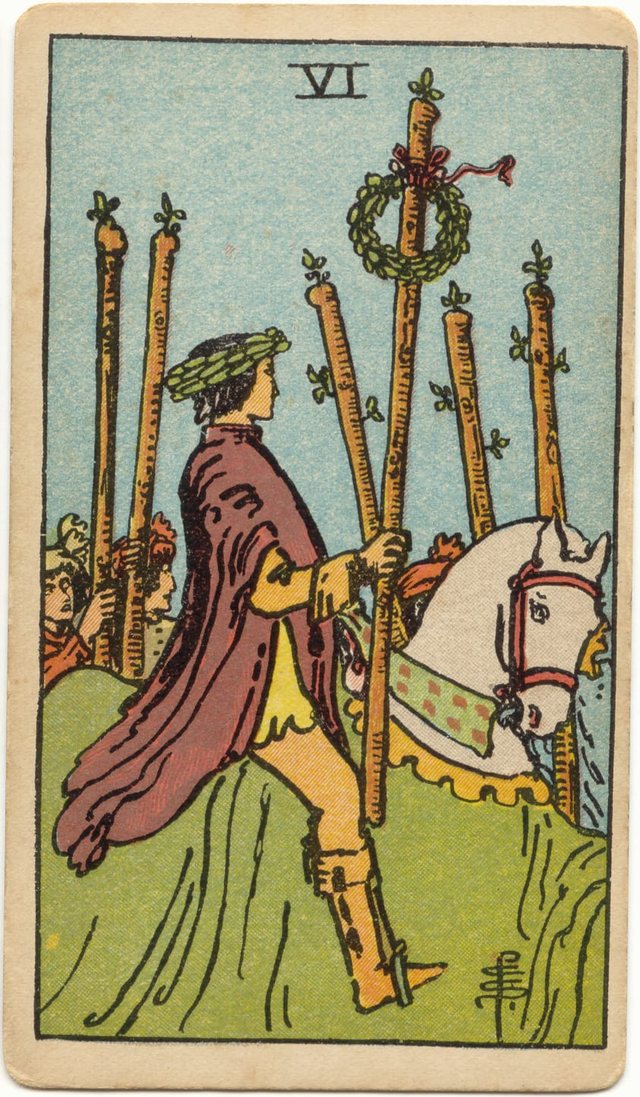
A young man rides a white horse toward the right, a laurel wreath on his head and another, tied with a red ribbon, hung from the top of the wand he carries. The horse wears a long green cloth with a yellow border that falls almost to the ground. Around him, men on foot hold up their own wands, and the faces at the left turn toward him. It is a procession, and he is its centre.
The Six of Wands is the card of being seen to succeed. Waite reads it as a victor triumphing, but also as great news carried in state by a royal courier, and as hope fulfilled. The laurel has a long history as the reward of victory, and here it is worn openly. The card often follows a hard effort that worked and was noticed: an exam passed, a pitch won, a performance applauded. It is the pleasure of recognition, and the card allows it.
The crowd is part of the meaning. His wand is one among several: the footmen carry staves too, and the victory belongs partly to them. The card can quietly ask whether the rider remembers that, and whether he can carry praise lightly. For some readers it is also about confidence as a resource, the kind of self-belief that comes from results rather than wishes.
Six of Wands reversed
Reversed, the Six of Wands can describe recognition that does not come: work unacknowledged, credit taken by someone else, a public setback. It can also point inward, to a lack of confidence that makes even real success feel undeserved, as if the wreath belonged to someone else.
Some readers see pride before a fall, the rider too pleased with himself to notice the mood of the crowd turning. Waite's reversed meanings include fear of a victorious enemy at the gate, disloyalty and indefinite delay. The shared thread is that applause is unreliable footing: enjoy it when it comes, but do not build on it.
In love and relationships
In love the Six of Wands can describe a relationship you are proud of and happy to show the world, or a time of feeling admired and wanted. It suits a new partnership that goes public, or someone single who feels confident and attractive after a stretch of doubt. Reversed, it may point to insecurity, needing a partner's approval too much, or a relationship that looks enviable from outside but feels less certain within.
In work and purpose
This is one of the more welcome cards to draw at work: a promotion, an award, a successful launch, good feedback, a public role going well. It encourages you to accept recognition rather than brush it off, and to share credit generously with the people who helped. Reversed, it may describe being passed over, a project that did not land, or a leader whose need for acclaim is starting to cost them support.
As advice
Let yourself be seen. Accept the praise you have earned, say thank you, and name the people who helped you get there. Then keep riding: recognition is a good moment, not a place to settle and live. The confidence it gives you is most useful when you spend it on the next thing.
Yes or no?
Yes The Six of Wands is a card of victory and good news, and reads as a clear yes. How yes-or-no readings work here.
Questions to sit with
- What success am I reluctant to let others see?
- Who walked beside me to get here, and have I thanked them?
- How much does my confidence depend on applause?
Symbolism in the card
The laurel wreaths
One wreath crowns the rider's head; a second, tied with a red ribbon, hangs from his wand. Laurel crowned victors in ancient games and in Roman triumphs. One wreath is worn and one is shown to the crowd: success that is both personal and public.
The white horse
The horse is white, with a red bridle and a long green cloth bordered in yellow. White horses also carry the riders of Death and the Sun in this deck: mounts for moments that everyone notices.
The footmen with wands
Men on foot crowd around the rider with their wands raised; Waite calls them footmen. They are escort and supporters, and a reminder that a public victory is carried by many hands.
The rider's cloak
He wears a red-brown cloak over a yellow tunic, with tall boots. It is festive dress, the clothing of the man of the moment, someone who knows he is being watched.
The direction of travel
Horse and rider face right, the direction many readers associate with moving forward. He is riding on through the crowd, not stopping to take a bow.
“on the surface, it is a victor triumphing, but it is also great news, such as might be carried in state by the King's courier; it is expectation crowned with its own desire, the crown of hope”
Numbers, elements and astrology
Six
Six restores harmony after the five's upset: generosity, recovery, sharing and passage onward.
Fire: the suit of Wands
Fire is will, energy, desire and creativity: the drive that starts things.
By Golden Dawn tradition each numbered card from two to ten rules ten degrees of the zodiac (a decan): the Six of Wands is Jupiter in the second decan of Leo. They are a symbolic system, not astronomy. How we checked them.
A little history
The Golden Dawn called this card the Lord of Victory. Earlier tarots give the Six of Batons no figures, and Smith's procession is her own. It draws on the old imagery of the triumph, the victory parade of ancient Rome that Renaissance Italy loved to stage and paint; the early Italian name for the tarot trumps, trionfi, comes from the same tradition. Waite's additional meanings for the card are oddly gloomy, mentioning servants who lose their masters' confidence and a young lady betrayed by a friend.