Three of Cups
Upright friendship · celebration · community · shared success · a happy gathering
Reversed overindulgence · a strained friendship · feeling left out · gossip · celebration gone sour
- Arcana
- Minor · pip card
- Number
- Three
- Element
- 🜄 Water
- Astrology
- ☿ Mercury in ♋ Cancer
- Golden Dawn title
- Lord of Abundance
- Yes or no
- Yes
Three of Cups upright
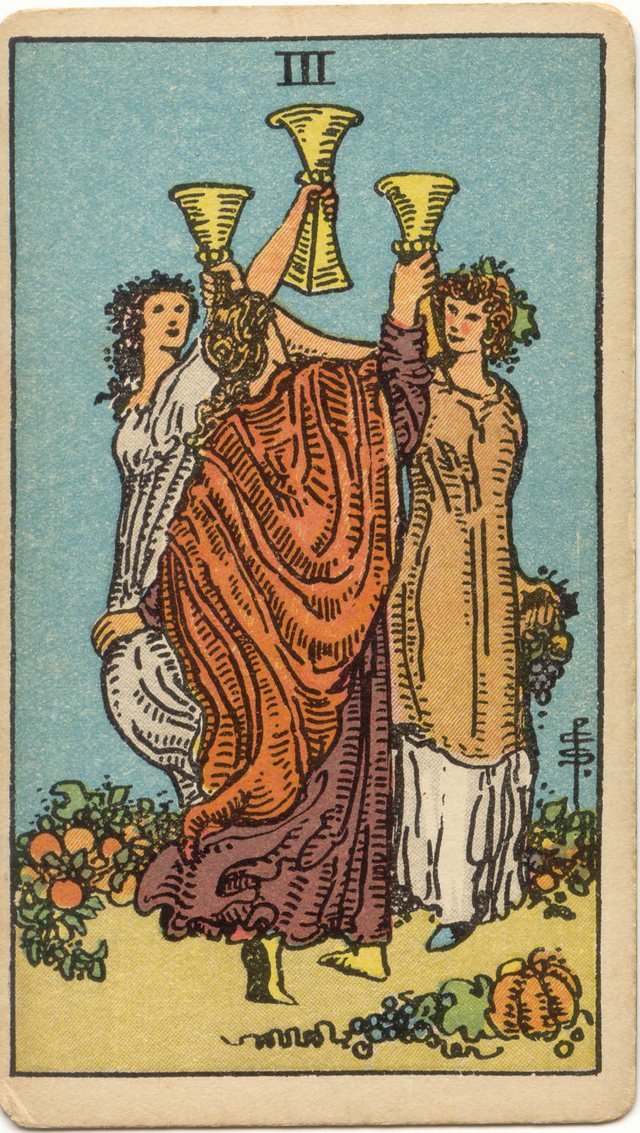
Three young women raise their cups high above their heads, as if in a toast. The one in the middle has her back to us, wrapped in a heavy red cloak over a purple gown; on the left a dark-haired woman in white, on the right a fair one in a tan dress with leaves in her hair and a bunch of grapes in her hand. They seem almost to be dancing. Around their feet the ground is heaped with harvest: orange fruit among leaves, a pumpkin, grapes on the vine.
The Three of Cups is the suit's card of company. Where the Two is about one bond, the Three widens the circle to friends, family, a team or a community, and the mood is celebration. It often turns up around weddings, reunions, birthdays and good news worth sharing, but its real subject is the pleasure of being among people who are glad for you, and of being glad for them.
Notice that none of the three is more important than the others, and that the one in the centre faces away, so the picture is not about any single person's triumph. The harvest at their feet makes the point that this happiness has been grown and gathered. Friendship of this kind takes tending, and the card honours both the effort and the reward.
Three of Cups reversed
In the reversed card the gathering loses its balance. Many readers see too much of a good thing: a party that runs on long after it stopped being fun, or socialising used as a way to avoid something. Waite himself includes 'the side of excess in physical enjoyment' among its meanings.
The reversal can also show friction inside a group: a friend who feels excluded, gossip, a three-way dynamic in which someone is left out, or a falling-away of old friendships. Some readers take it more quietly, as a time when you would rather be alone. The useful question is whether your circle is still feeding you, or whether you are staying for the noise.
In love and relationships
In love the card often reflects the social side of a relationship: meeting someone through friends, introducing a partner to the people who matter, or celebrating together with family. It can mark a happy milestone. Because it shows three people, some readers also read it as a caution about a third party, especially when reversed: someone else taking up emotional space, or a friendship that blurs into flirtation. Upright, it mostly describes love that is supported by a wider circle.
In work and purpose
At work the Three of Cups favours teams that genuinely enjoy one another: a project finished together, a launch worth marking, a group of colleagues whose goodwill makes hard work easier. It suggests that sharing credit and celebrating small wins pays off. Reversed, it may point to office cliques, gossip, a team member left out of the loop, or a social culture that has started to crowd out the actual work.
As advice
Make time for the people who make you feel at home, and mark good moments with them rather than rushing past. Share credit freely. If you have drifted from friends, reach out first: a message, a meal, an invitation. Just watch that the celebration stays a pleasure and does not become an escape.
Yes or no?
Yes Raised cups and a full harvest make this one of the plainest yeses in the suit, with others likely to share in it. How yes-or-no readings work here.
Questions to sit with
- Who are the people I feel most myself with, and when did I last spend real time with them?
- What recent success have I not yet allowed myself to celebrate?
- Is there anyone in my circle who might be feeling left out?
Symbolism in the card
The three raised cups
Three gold cups are lifted high above the women's heads, the middle one highest. A raised cup is a toast: shared joy, goodwill and the act of honouring a moment together.
The three women
They stand close in a ring, the central one turned away from us. Many readers compare them to the Three Graces of classical art, figures of charm, joy and abundance. Their equality is part of the meaning: no leader, only company.
The red cloak
The woman in the centre is wrapped in a heavy orange-red cloak over a purple gown. The warm colour gives the group its energy and puts the passion of the moment at the centre of the picture.
The harvest at their feet
The ground is strewn with orange fruit among leaves on the left and a pumpkin and grapes on the right. It shows the scene as a harvest celebration: joy that follows growth and work, not luck alone.
The grapes and vine leaves
The woman on the right carries a bunch of grapes and wears leaves in her hair. Grapes belong to wine, festivity and sharing, and they remind the reader that the card also holds the risk of excess.
The plain blue sky
Behind the women there is nothing but clear blue sky, with no building or landscape. It keeps the eye on the figures and gives the card an open, untroubled mood.
“Maidens in a garden-ground with cups uplifted, as if pledging one another. Divinatory Meanings: The conclusion of any matter in plenty, perfection and merriment; happy issue, victory, fulfilment, solace, healing.”
Numbers, elements and astrology
Three
Three is the first number that makes a shape: two things meet and produce a third. It is the number of growth, collaboration and first results.
Water: the suit of Cups
Water is feeling, intuition, relationships and the imagination.
By Golden Dawn tradition each numbered card from two to ten rules ten degrees of the zodiac (a decan): the Three of Cups is Mercury in the second decan of Cancer. They are a symbolic system, not astronomy. How we checked them.
A little history
The Tarot de Marseille Three of Cups is a pattern card, three cups arranged among stylised foliage, without figures. The Golden Dawn called it the Lord of Abundance, and Waite's meanings of plenty and happy conclusion follow that title. Smith's dancing women are her own invention for the 1909 deck. The resemblance to the classical Three Graces is often pointed out, though neither Waite nor Smith is known to have said that this was intended.