Five of Wands
Upright competition · friction · clashing ideas · a free-for-all · testing yourself
Reversed conflict easing · avoided disagreement · infighting · tension below the surface
- Arcana
- Minor · pip card
- Number
- Five
- Element
- 🜂 Fire
- Astrology
- ♄ Saturn in ♌ Leo
- Golden Dawn title
- Lord of Strife
- Yes or no
- Maybe
Five of Wands upright
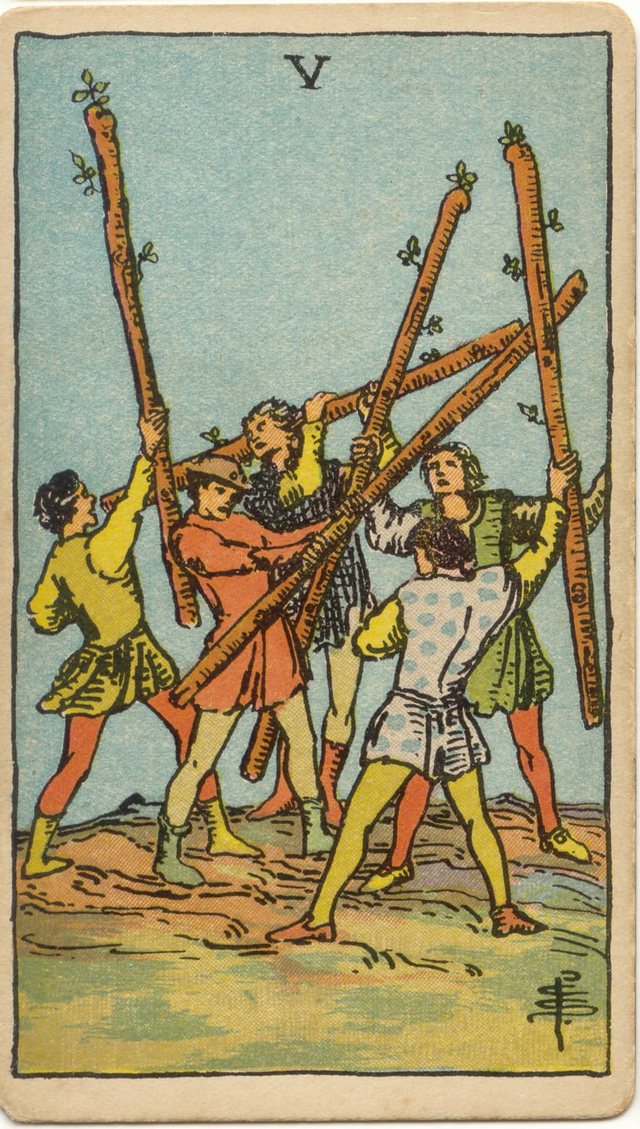
Five young men brandish their wands in a tangle under a pale blue sky. They are all dressed differently: one in yellow, one in red with a hat, one in a dark mesh tunic, one in green, and in the foreground one in white with blue spots, his back to us. The staves cross in every direction, raised high, but look closely and nobody is actually being struck. The ground is rough and uneven, and no one is clearly winning.
Waite called this mimic warfare, a sham fight. That ambiguity is the heart of the card. It describes situations full of friction: a meeting where everyone talks over everyone, a crowded market, a household where every decision turns into a debate, a group with no leader in which each person pushes their own way. The energy is high and mostly unfocused. It is tiring, but it is not necessarily hostile.
There is also something healthy in it. Sparring is how the young learn their strength, and competition can sharpen ideas that would stay soft in agreement. The card asks what kind of contest this really is. If it is play, enjoy it and learn from it. If it has quietly become a real fight, someone needs to call time and give the group a common aim.
Five of Wands reversed
Reversed, the Five of Wands can go two ways. Some readers see the conflict winding down: agreement found, rivalry cooling, everyone lowering their stick. Others see the opposite, the tension going underground, where disagreements that were never aired turn into resentment or sniping behind backs.
Waite's reversed meanings lean to the harder end: disputes, trickery, contradiction. A practical way to read it is to ask whether peace has really been made, or whether people have simply stopped saying things out loud. Avoiding every conflict is not the same as settling one, and sometimes the honest argument is the kinder path.
In love and relationships
In love the card often describes bickering: small arguments about how to do things, competing priorities, two strong wills that keep bumping into each other. Not every quarrel signals trouble, and some couples spar as a form of closeness. It can also show rivalry, with several people interested in the same person, or a dating scene that feels like a contest. Reversed, it may show arguments finally easing, or a couple who have stopped fighting only because they have stopped engaging.
In work and purpose
At work the Five of Wands fits competitive settings: crowded markets, meetings without a clear chair, teams where everyone has an opinion and nobody has authority. It can be productive friction that improves an idea, or energy wasted on point-scoring, and it helps to know which. If you lead, it suggests giving people a shared goal and clear roles. Reversed, it may describe a disagreement that has been resolved, or one that has gone quiet and is festering.
As advice
Decide whether this contest is worth having. If it is, join in honestly and let the friction sharpen you. If it is not, step out of it, or give everyone something to aim at together. Keep it sporting: argue about ideas, not about people.
Yes or no?
Maybe The Five of Wands shows a contest still in play, so the outcome is open and depends on how the friction is handled. How yes-or-no readings work here.
Questions to sit with
- Is this conflict sharpening me, or just wearing me out?
- What am I really competing for, and with whom?
- Where could a shared goal turn this scramble into a team?
Symbolism in the card
The five youths
Five young men in mismatched clothes, each in different colours, face in different directions. They are of an age and none stands above the others: a group of equals with no leader, each pulling his own way.
The crossing wands
The staves cross and clash in the air, but none clearly lands on anyone. The pattern of crossing lines is the card in miniature: energy colliding rather than flowing in one direction.
The youth with his back to us
In the foreground a youth in a white tunic with blue spots faces into the fray, his back to the viewer. He puts us inside the scuffle, almost as if we were the sixth player.
The clear sky
The sky is plain, pale blue and empty. There is no storm here, nothing like the black sky of the Tower or the torn clouds of the Five of Swords. Whatever this contest is, it is not a catastrophe.
The rough ground
The youths stand on uneven, hummocky earth. No one has firm footing or the high ground, which is part of why the struggle stays even and unresolved.
“A posse of youths, who are brandishing staves, as if in sport or strife. It is mimic warfare”
Numbers, elements and astrology
Five
Five breaks the square. It brings disruption, conflict and loss, the necessary instability that keeps a story moving. Most tarot fives are hard cards.
Fire: the suit of Wands
Fire is will, energy, desire and creativity: the drive that starts things.
By Golden Dawn tradition each numbered card from two to ten rules ten degrees of the zodiac (a decan): the Five of Wands is Saturn in the first decan of Leo. They are a symbolic system, not astronomy. How we checked them.
A little history
In the Golden Dawn system the Five of Wands is the Lord of Strife. Earlier decks show only five batons, and Smith's scene of squabbling youths is her own. Waite's notes preserve a striking contradiction from older fortune-telling lists: alongside sham fights and the struggle for fortune, he records that some attributions make this a card of gold, gain and opulence. Smith's drawing leans firmly toward the game, and her figures look more like boys at play than soldiers.