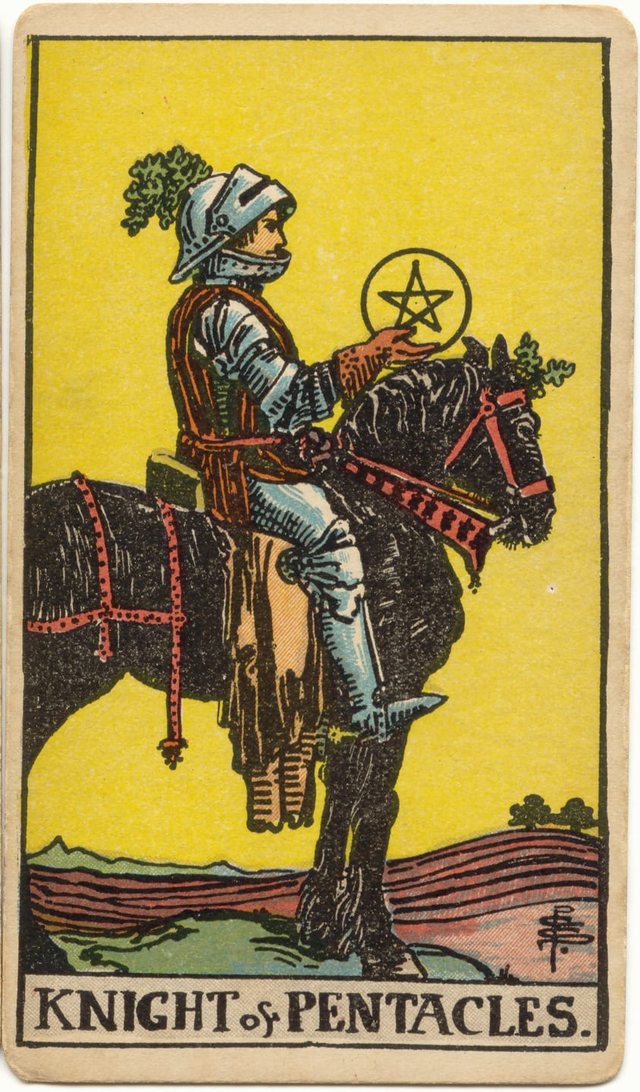
Knight of Pentacles
Upright reliability · persistence · routine · patience · responsibility
Reversed stagnation · boredom · stubbornness · perfectionism · inertia
- Arcana
- Minor · court card
- Number
- Knight
- Element
- 🜃 Earth
- Sub-element
- Fire or Air of Earth (varies)
- Yes or no
- Yes
Knight of Pentacles upright
A knight in plate armour sits on a heavy black horse that stands perfectly still on a green rise. He holds a pentacle up in one gloved hand, and both his helmet and his horse's bridle are decorated with sprigs of green leaves. Behind him, under a yellow sky, a ploughed field runs to the horizon in long brown furrows.
Every other Knight in the tarot is moving. This one has stopped. Waite called the horse "slow, enduring, heavy", and said the rider's "own aspect corresponds". It is easy to read that as dullness, and the card has a reputation for being the least exciting court card. But the stillness has a purpose: the furrowed field behind him shows ground that has been worked, row by row, by someone who does not give up halfway.
As a person, the Knight of Pentacles is the colleague who finishes things, the friend who turns up when they said they would, the partner who shows love by fixing the boiler. As an approach to a situation, the card favours method over inspiration: a schedule, a checklist, the same useful work done again tomorrow. It promises no quick results. What it offers is something many people undervalue, which is the certainty that the job will actually get done.
Knight of Pentacles reversed
Reversed, steadiness turns into standing still. Readers often see stubbornness, a routine that has become a rut, or a project stalled because nobody is willing to change approach. It can also describe someone so cautious that they never take the risk a situation needs, or so focused on doing things the proper way that they lose sight of why they started.
Waite's reversed meanings include "inertia, idleness, repose of that kind, stagnation", along with "placidity, discouragement, carelessness". Some readers take the reversal as the other extreme instead: an uncharacteristic lapse in reliability, or work left half-done because the routine finally became too dull to bear.
In love and relationships
In love, the Knight of Pentacles is the slow and sincere suitor: someone who takes their time, builds trust through consistency and shows commitment in practical ways. A relationship with this energy may not be thrilling, but it is dependable. For a couple, the card can suggest a stable phase, or a need to put steady work into the relationship. Reversed, it may describe a relationship that has become routine and predictable, or a partner whose caution feels like reluctance.
In work and purpose
At work this is the card of the dependable worker and the long project: maintenance, logistics, accounts, research and anything that needs care over time. It favours good habits, clear processes and keeping promises to clients and colleagues. You may not be noticed for flair, but people will trust you. Reversed, it suggests a task that has become tedious, resistance to new methods or a promising project slowed to a crawl by caution.
As advice
Keep going, one row at a time. Make a plan you can actually follow and do the next part of it, even on days when it feels dull. Let others be faster; your strength is that you finish. Just check now and then that you are still ploughing the right field.
Yes or no?
Yes The Knight brings steady progress that gets there in the end, so it reads as a yes, but a slow one. How yes-or-no readings work here.
Questions to sit with
- What would change if I simply kept doing the useful thing every day?
- Where has my caution turned into reluctance to move at all?
- Which promises have I kept lately, and which have I let slide?
Symbolism in the card
The still black horse
A heavy black horse stands with all four hooves on the ground, the only motionless horse among the four Knights. It is Waite's 'slow, enduring, heavy' mount: strength that is all endurance and no speed.
The armoured knight
The rider wears full plate armour with a dark red tabard over it. His body is upright and steady, a picture of someone prepared, protected and in no hurry.
The pentacle in his hand
He holds the coin up in front of him, but his gaze seems to go past it. Waite notes that 'he exhibits his symbol, but does not look therein': he carries his responsibility without needing to stare at it.
The green sprigs
A tuft of green leaves rises from his helmet and another decorates the horse's head. They are a small sign of growth and earth, tying this armoured figure to the land he works.
The ploughed field
Behind him, long brown and reddish furrows stretch to the horizon. Ploughing is patient, repetitive work done long before any harvest, and it is the clearest statement of this Knight's character.
The yellow sky
A clear yellow sky fills the background, with a couple of small trees on the far right. The mood is calm and steady, without the urgency of the other Knights.
“He rides a slow, enduring, heavy horse, to which his own aspect corresponds. He exhibits his symbol, but does not look therein.”
Numbers, elements and astrology
Knight
Knights are the suit in motion: action, pursuit and sometimes excess, the energy as a quest.
Earth: the suit of Pentacles
Earth is the body, money, work, home and the slow growth of material things.
In the Golden Dawn system each court card is an element within its suit's element. Pages and Queens are agreed; Knights and Kings are Fire or Air depending on whether you follow the Golden Dawn's names or later practice. They are a symbolic system, not astronomy. How we checked them.
A little history
Knights appear among the court cards of the earliest Italian tarots, including the Visconti-Sforza, and in the Tarot de Marseille as the Cavalier de Deniers, usually shown on horseback with a coin in the air before him. The Golden Dawn used its own court system of Knights, Queens, Princes and Princesses; Waite kept the older King, Queen, Knight and Page. Smith's motionless horse and ploughed field are her own way of distinguishing this Knight from the more active riders of the other suits.