Knight of Swords
Upright decisive action · ambition · directness · speed · fighting for a cause
Reversed recklessness · impatience · aggression · scattered energy · rushing in
- Arcana
- Minor · court card
- Number
- Knight
- Element
- 🜁 Air
- Sub-element
- Fire or Air of Air (varies)
- Yes or no
- Yes
Knight of Swords upright
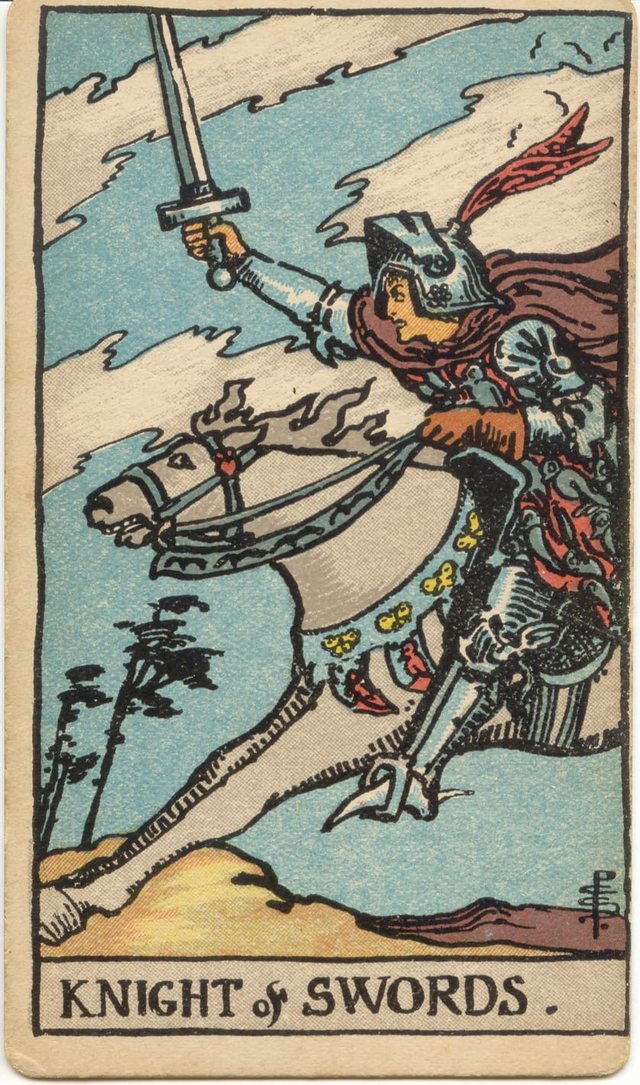
A knight in full armour charges across the card on a white horse, sword raised high above his head. He leans forward into the gallop, a red plume and a dark red cloak streaming behind him. The horse's mane flies back like flame and its legs are stretched in mid-stride. Grey clouds are torn into streaks across the sky, small birds scatter in the upper corner, and on the left a pair of trees are bent nearly flat by the wind. Small yellow butterflies decorate the horse's breast strap.
Of all the court cards, this one moves fastest. The Knight of Swords is the mind in full pursuit: of an idea, an argument, a cause, a goal. Waite called him "a prototypical hero of romantic chivalry", almost Galahad. As a person, he might be a brilliant, impatient colleague, a crusading friend, someone who says exactly what they think, or you at your most driven.
As an approach, the card favours speed and directness, the moment to stop deliberating and act. Its warning is built into the picture. A charge like this cannot easily turn or stop. Conviction without listening can flatten other people, and there is a fine line between courage and simply not looking where you are going.
Knight of Swords reversed
Reversed, the energy runs ahead of good sense. It can show rash decisions, harsh words said in the heat of the moment, starting fights that need not happen, or rushing from one plan to the next without finishing anything. Waite's reversed meanings were brief: "imprudence, incapacity, extravagance".
Some readers also see the reversal as a stalled charge, someone full of intent who cannot get moving, or a frustrated drive turning into irritability. In either case the remedy is similar: slow down long enough to choose one direction, and check that the cause is still worth the charge.
In love and relationships
In love, the Knight of Swords can describe someone who pursues a relationship quickly and intensely, a whirlwind start, or a partner who is exciting but blunt to the point of tactlessness. It can also show a need to have a hard conversation now rather than later. The danger is steamrolling the other person's feelings in the name of honesty. Reversed, it suggests impulsive decisions, arguments, or someone who moves on as quickly as they arrived.
In work and purpose
At work the card fits ambitious pushes, launching something fast, arguing hard for an idea, or a crisis that calls for someone to take charge. It suits debate, campaigning, law and other work where conviction and speed help. The caution is to bring others with you and check the ground. Reversed, it may describe burnout from constant urgency, conflicts caused by bluntness, or decisions made too quickly to hold up.
As advice
Act on what you know, and do it with conviction. Hesitating much longer may cost more than moving. But before you charge, take one breath to check where you are going and who is in the way. Speed is useful; collisions are not.
Yes or no?
Yes The knight charges straight ahead, so the card reads as yes, provided you are ready to move fast and accept the risks of speed. How yes-or-no readings work here.
Questions to sit with
- What am I charging towards, and do I truly understand it?
- Who might be in my path that I have not noticed?
- Where would a little patience serve me better than speed?
Symbolism in the card
The raised sword
His sword is held high, the arm fully extended, as he rides. It is the decisive mind at its most forceful, ready to strike. Waite described him 'as if scattering his enemies'.
The galloping white horse
A pale horse in full stride, mouth open and mane streaming back like flames. Horses often carry the drive that bears us forward; here that drive is at its fastest and hardest to rein in.
The armour and red cloak
He is completely armoured, with a helmet, a red plume and a long dark red cloak flying back. The armour shows readiness for conflict; the red shows passion and urgency beneath the cool steel of the suit.
The butterflies on the harness
The strap across the horse's chest is decorated with small yellow butterflies. Butterflies are creatures of air, the suit's element, worked into the gear of the most airborne court card, and an old image of the restless, changeable mind.
The wind-bent trees
Two thin trees on the left lean hard in the wind. They show the force of the air the knight rides through, and the effect such force has on anything standing in its way.
The streaked clouds and flying birds
Clouds are pulled into long ragged streaks across the sky, and a few birds scatter near the top right. Everything in the background moves in the same direction as the knight, as if the whole scene were caught in his rush.
“In the design he is really a prototypical hero of romantic chivalry. He might almost be Galahad, whose sword is swift and sure because he is clean of heart.”
Numbers, elements and astrology
Knight
Knights are the suit in motion: action, pursuit and sometimes excess, the energy as a quest.
Air: the suit of Swords
Air is thought, speech, truth and conflict: the mind and its sharp edges.
In the Golden Dawn system each court card is an element within its suit's element. Pages and Queens are agreed; Knights and Kings are Fire or Air depending on whether you follow the Golden Dawn's names or later practice. They are a symbolic system, not astronomy. How we checked them.
A little history
The Knight, or Cavalier, is the mounted court figure of the Tarot de Marseille. In the Golden Dawn system the mounted figure was ranked as the king of the suit, while a separate Prince rode in a chariot, so Golden Dawn and later Thoth decks name these cards differently. Waite kept the Knight in its traditional place below the Queen. Smith gave him one of the most dynamic poses in the deck, with the horse at full gallop.