Eight of Wands
Upright speed · momentum · news arriving · swift action · things in motion
Reversed delays · haste · crossed signals · jealousy · energy misdirected
- Arcana
- Minor · pip card
- Number
- Eight
- Element
- 🜂 Fire
- Astrology
- ☿ Mercury in ♐ Sagittarius
- Golden Dawn title
- Lord of Swiftness
- Yes or no
- Yes
Eight of Wands upright
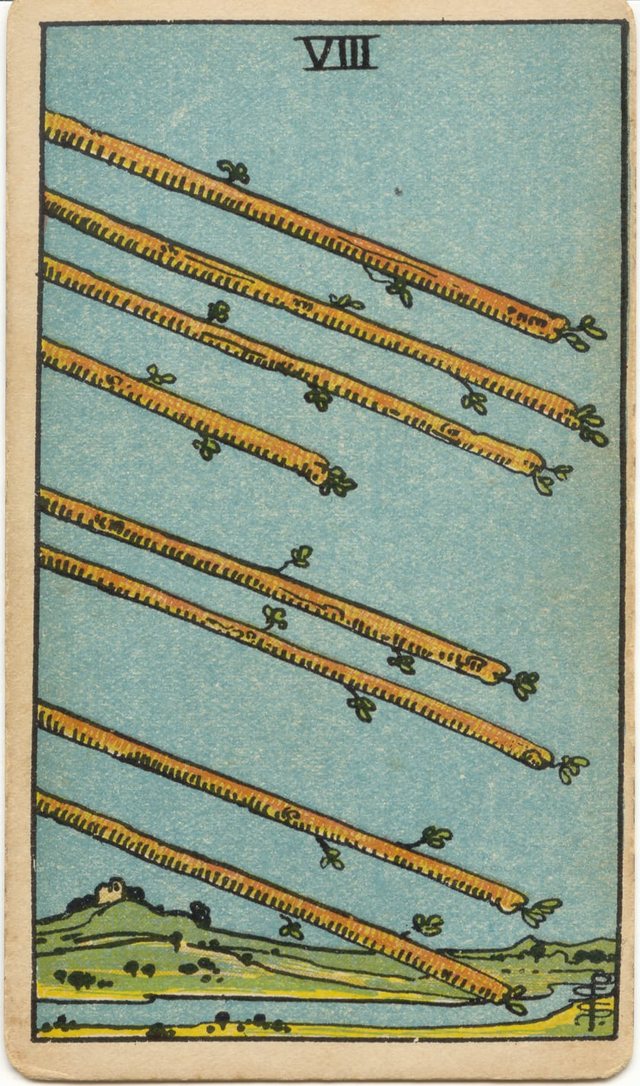
Eight wands fly in parallel across a clear blue sky, slanting down from the upper left toward the lower right, each sprouting small green leaves. There are no people at all. Beneath them lies open country: a green hill with a small building on its top and a river running along the bottom of the card. The wands look as if they are about to come to earth.
Waite describes the card as motion through the immovable: a flight of wands over open country that is nearing the end of its course. That last part matters. This is not the beginning of a journey but its arrival. Things that were set in motion are landing: messages, decisions, events that have been building out of sight. The card often turns up when life suddenly speeds up, when replies come in all at once or a stalled matter moves overnight.
Because nothing in the picture is human, the momentum can feel impersonal, bigger than any one person. The task is to keep up, respond promptly and not mistake speed for panic. Waite also listed the arrows of love among its meanings, and some readers take the card as a sudden infatuation, or a message crossing a long distance.
Eight of Wands reversed
When the card is reversed, the wands do not land cleanly. It can describe the kind of trouble that comes from bad timing: messages that go astray, plans that stall at the last moment, or the opposite, haste that causes mistakes. The energy is still there, but it is pointed the wrong way or released too early.
Waite turns the arrows of love into arrows of jealousy and adds quarrels and stings of conscience. In that light the reversal can describe fast tempers rather than fast events. Readers who do not use reversals may simply take the card as a note about timing: slow down long enough to aim.
In love and relationships
In love the Eight of Wands is quick: a fast-moving romance, a sudden declaration, messages flying back and forth, or a long-distance relationship kept alive by calls and letters. It describes attraction that does not want to wait, which can be thrilling or rash. Reversed, it may point to mixed signals, a romance that cooled as fast as it began, or jealousy flaring up out of nowhere. Either way, it is worth asking whether the speed is carrying you somewhere you want to go.
In work and purpose
At work this is the card of a busy week: deadlines converging, emails arriving in bursts, a project that suddenly gets the go-ahead. It favours decisive, quick responses, and anything involving travel or communication over distance. It is less suited to slow deliberation. Reversed, it may describe bottlenecks, decisions held up, crossed wires between teams, or the fallout from rushing something that needed more care. If you are the one waiting, it suggests getting ready now, so you can act the moment the answer comes.
As advice
Move with it. When things speed up, answer promptly, keep your messages clear and let small details go. There will be time to reflect once everything lands; for now, being responsive matters more than being perfect. Just check, before you let something fly, that it is aimed.
Yes or no?
Yes Momentum is on your side in the Eight of Wands, so it reads as a yes: things are moving. How yes-or-no readings work here.
Questions to sit with
- What is landing in my life right now, and am I ready to catch it?
- Where am I confusing speed with urgency?
- What message have I been meaning to send?
Symbolism in the card
The eight flying wands
Eight leafy wands cross the sky in parallel, all tilted at the same angle. Nothing holds them. They are pure motion, and their orderly alignment suggests force with a direction rather than chaos.
The downward slant
The wands descend from upper left to lower right, toward the ground. Waite says they draw to the term of their course: what they signify is at hand, perhaps already on the threshold.
No human figure
No person appears anywhere on the card, which is rare among the numbered Minor Arcana. Events have their own momentum here; the reader is a witness to them rather than the one throwing.
The open sky
A clear blue sky without a single cloud fills most of the card. Nothing blocks the flight, which is why the card is read as speed without obstruction: the way is open.
The river
A river runs across the bottom of the card, below the green fields. Moving water mirrors the flight above: everything in this landscape is on its way somewhere.
The hill with a building
On the left a green hill rises with a small building on its top, drawn very simply. It gives the flight a destination: somewhere the wands, or the news they carry, are heading.
“The card represents motion through the immovable—a flight of wands through an open country; but they draw to the term of their course. That which they signify is at hand; it may be even on the threshold.”
Numbers, elements and astrology
Eight
Eight is movement and mastery: effort repeated until it becomes skill, and the momentum to leave what no longer serves.
Fire: the suit of Wands
Fire is will, energy, desire and creativity: the drive that starts things.
By Golden Dawn tradition each numbered card from two to ten rules ten degrees of the zodiac (a decan): the Eight of Wands is Mercury in the first decan of Sagittarius. They are a symbolic system, not astronomy. How we checked them.
A little history
The Golden Dawn named this card the Lord of Swiftness, and swiftness duly appears in Waite's list of meanings. In older decks the Eight of Batons was a pattern of interlaced staves. Smith turned the pattern into flight, keeping the abstract quality of a pip card while giving it direction and speed. With no figure at all, it is one of the very few numbered cards in her deck where nobody appears.