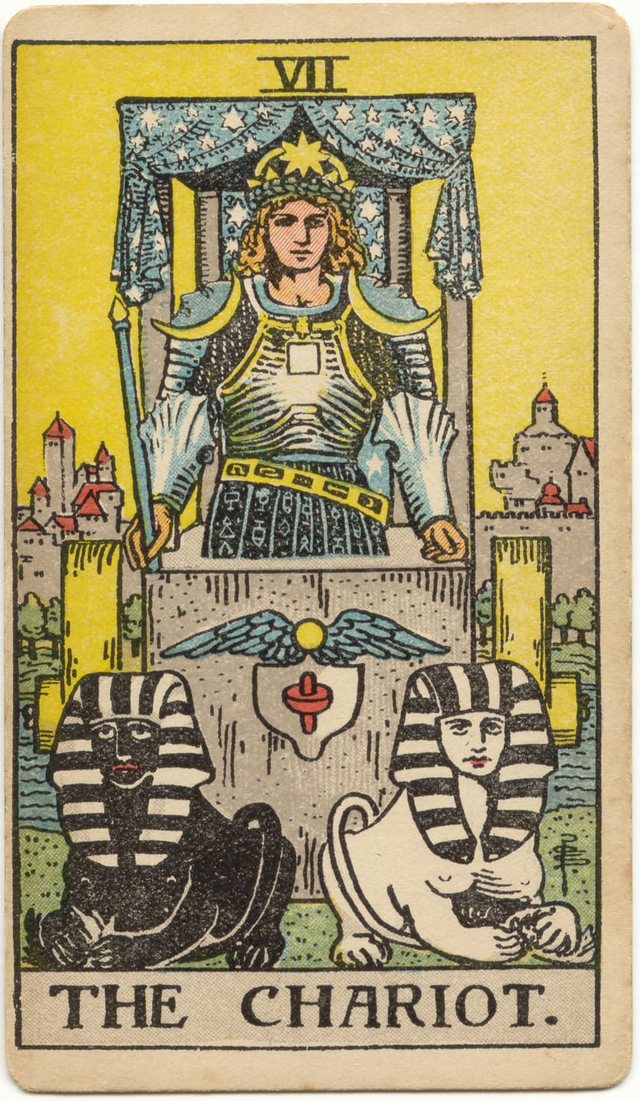
Major Arcana · VII
The Chariot
Upright determination · willpower · victory · self-control · direction
Reversed lack of direction · loss of control · aggression · stalled progress
- Arcana
- Major
- Number
- VII
- Element
- 🜄 Water
- Astrology
- ♋ Cancer
- Hebrew letter
- Cheth ח
- Yes or no
- Yes
The Chariot upright
A young charioteer stands in a square stone chariot under a canopy of stars. He wears armour with crescent moons on the shoulders and a crown with a gold star, and holds a long wand in his right hand. There are no reins in sight. In front of the chariot lie two sphinxes, one black and one white, and behind it, beyond a river, rise the walls and red roofs of a town. The sky is yellow.
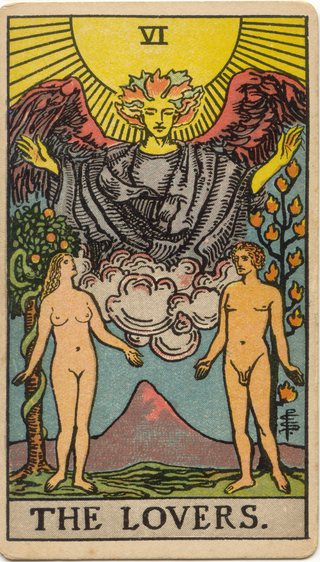
The Chariot is will in motion. After the choice of the Lovers comes commitment: setting a direction and holding to it against resistance. The card often appears when a goal is within reach but needs focus, discipline and a refusal to be pulled off course. It suits exams, competitions, moves and any push that depends on sustained effort rather than a single burst.
Look at what is pulling him. The two sphinxes are opposite in colour and nothing visibly binds them to the car, so whatever keeps them working together is his concentration. That is the heart of the card: control that comes from inner steadiness rather than force. The opposing pulls might be feeling and reason, ambition and doubt, or two people with different aims. The Chariot does not remove the tension. It shows someone who has learned to drive with it.
The Chariot reversed
Upside down, the Chariot loses its grip. The opposing forces win: plans pull in two directions, effort scatters, or progress stalls despite a great deal of activity. It can describe the frustration of being stuck, or a feeling that circumstances are doing the driving.
The reversal can also show will hardening into aggression: forcing an outcome, flattening other people, or a need to win that has lost sight of why. Some readers take it as a call to stop and check the map before pressing on. Momentum is only useful if it is taking you somewhere you want to go.
In love and relationships
In love the Chariot favours a clear decision and the effort to follow it through: committing, moving in together, or tackling a difficulty as a team. It can describe two strong-willed people learning to pull in the same direction. It may also suggest that a relationship needs more steering and less drifting. Reversed, it can point to a power struggle, one partner always in charge, or feelings overriding good sense on both sides.
In work and purpose
At work the Chariot is ambition with a plan behind it: a promotion pursued, a deadline met, a project brought home by sheer persistence. It favours competitive situations and leadership under pressure. It also suggests handling conflicting demands, two departments or two priorities, without letting either take over. Reversed, it can warn of exhaustion from pushing too hard, a project losing its direction, or a strategy that relies on force rather than coordination.
As advice
Decide where you are going and keep your attention there. Hold your conflicting impulses steady instead of letting either take control, and keep moving when progress feels slow. Discipline will carry you further than force, and a clear destination makes every small correction easier.
Yes or no?
Yes The Chariot is a card of determined progress and victory, so it reads as yes if you are willing to commit and stay the course. How yes-or-no readings work here.
Questions to sit with
- What goal am I truly committed to, and what keeps pulling me away from it?
- Which opposing forces in me need to work together instead of competing?
- Am I steering this situation, or being carried along by it?
Symbolism in the card
The sphinxes
A black sphinx and a white sphinx lie before the chariot, both in striped headdresses. They stand for opposites, light and dark, mercy and severity, which the charioteer must hold together. Waite took the sphinxes from Éliphas Lévi in place of the older horses.
The starry canopy
A pale blue canopy scattered with white stars hangs over him on four posts. It suggests the heavens and a protection from above: he acts under the influence of the sky, not only his own strength.
The crescent moons
Two crescent moons sit on his shoulders as part of the armour. Waite says they are supposed to be the Urim and Thummim, the oracular objects worn by the Hebrew high priest. They hint at intuition carried inside the armour of action.
The armour and square
He wears a breastplate with a bright square on its chest, and a belt and skirt marked with signs. The square is an emblem of earth and stable matter; the armour shows him protected and ready for struggle.
The wand
His right hand holds a long wand or sceptre while his left rests on the chariot's edge. Waite's text speaks of a drawn sword, but Smith drew a wand: authority and directed will rather than violence.
The star crown
His crown carries a gold eight-pointed star above a green band of leaves. The star marks aspiration and guidance from above; the green band suggests a victor's wreath.
The winged disc and shield
On the chariot's front is a winged sun disc, an Egyptian emblem of the divine, above a white shield bearing a red device like a spinning top. Its meaning is disputed; it is usually read as a sign of opposites joined.
The town and river
Behind him, beyond a strip of river, stand the walls, towers and red roofs of a town. He has left settled life behind and crossed water: the chariot is heading out into the world.
Houses and cities in tarotTowers and castles in tarotWater, rivers and pools in tarot
“He has thus replied to the sphinx, and it is on this account that I have accepted the variation of Éliphas Lévi; two sphinxes thus draw his chariot. He is above all things triumph in the mind.”
Numbers, elements and astrology
Number 7: Seven
Seven is the number of testing and reflection: the point mid-way where results are weighed, and imagination, doubt or courage are asked for.
Water
Water is feeling, intuition, relationships and the imagination. The Golden Dawn tied The Chariot to Cancer, a sign of Water.
These are the traditional attributions of the Hermetic Order of the Golden Dawn (1888), which Waite and Smith followed: each trump is matched to a Hebrew letter and to an element, planet or zodiac sign. They are a symbolic system, not astronomy. How we checked them.
A little history
The card draws on the triumphal processions of Renaissance Italy. In the Visconti-Sforza cards a richly dressed woman rides a chariot drawn by white horses. The Tarot de Marseille's Le Chariot shows a crowned man in a canopied car pulled by two horses, with masks on his shoulders. In the nineteenth century Éliphas Lévi redrew the card with two sphinxes in place of the horses, and Waite adopted the change, as he says himself. Smith kept Lévi's pairing of a black and a white sphinx, and set a river and a walled town behind the chariot, so that the charioteer is seen leaving settled life behind.