Page of Wands
Upright enthusiasm · curiosity · a message · exploration · a free spirit
Reversed restlessness · plans that fizzle · bad news · indecision
- Arcana
- Minor · court card
- Number
- Page
- Element
- 🜂 Fire
- Sub-element
- Earth of Fire
- Yes or no
- Yes
Page of Wands upright
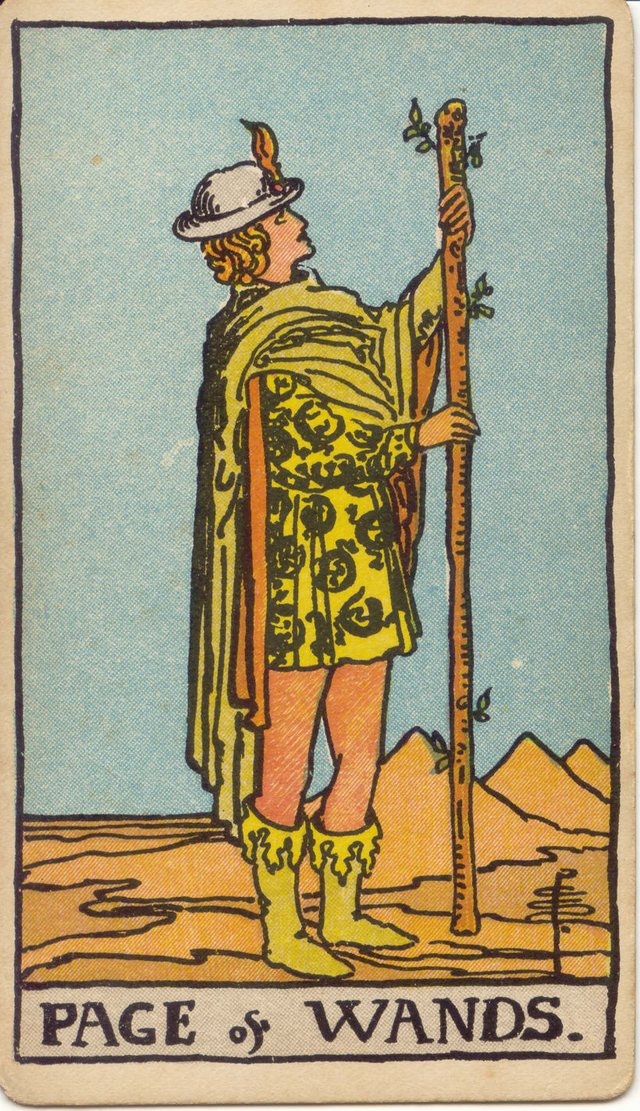
A young man stands in a dry, sandy landscape, holding a tall wand upright with both hands and gazing up at its leafy tip. He wears a pale hat with an orange plume that curls like a flame, a yellow tunic covered in black curling shapes, and a long yellow-green cloak. His boots have jagged, flame-like tops. Behind him three pyramids rise out of the desert.
Pages are the youngest of the court cards, and in Wands they carry the suit's fire at its freshest. The Page of Wands is curious, eager and full of ideas, but not yet seasoned. Waite describes him in the act of proclamation, faithful, bearing strange news. As a person, he might be a young or young-at-heart friend with big plans, a student, a new colleague who brings energy into the room. As an approach to a situation, he asks you to be curious and to try something without knowing how it ends.
The way he looks at his wand is the key to the card. He studies it as if only now discovering what it can do. That is the Page's gift: real wonder at his own possibilities. It is also his limit. A message that excites you is the start of something, not the whole of it.
Page of Wands reversed
Reversed, the Page's enthusiasm turns restless or scattered: many beginnings and little follow-through, ideas dropped when the novelty fades, impatience with the slow parts of learning. As a person, he can be the charming friend whose plans never quite happen, or someone whose excitement is easily knocked by a first setback.
Waite's reversed meanings include indecision and the instability that goes with it, and also bad news. Some readers take the reversal as a message that disappoints or a project that does not take off. It asks what would help the spark take hold: a small commitment, a mentor, or simply finishing one thing before starting the next.
In love and relationships
In love the Page of Wands is flirtatious and playful: a fresh crush, a lively first date, a feeling declared boldly and perhaps a little impulsively. It may describe a new admirer or the giddy early days of something. It is better at excitement than at staying power, at least for now. Reversed, it may suggest someone who is all charm and no follow-through, or a romance that flares brightly and fades just as fast.
In work and purpose
At work the Page suits beginnings: an apprenticeship, a new course, a creative project, a first job, an idea you are itching to pitch. It values enthusiasm and willingness to learn over experience. It can also bring news of an opening. Reversed, it may warn of starting too many things at once, ideas running ahead of skills, or a junior colleague whose energy is not yet matched by reliability or patience.
As advice
Be curious. Pick up the thing that excites you and find out what it can do, even if you are new to it, and let your enthusiasm show. Then commit to one small next step, so the spark has somewhere to land.
Yes or no?
Yes A card of fresh enthusiasm and good tidings, the Page of Wands leans to yes, especially for something new. How yes-or-no readings work here.
Questions to sit with
- What excites me right now, and what would it take to explore it?
- Where am I a beginner, and can I enjoy being one?
- What news or idea am I eager to share, and with whom?
Symbolism in the card
The wand held upright
He holds a tall wand in both hands, its tip in leaf, and looks up at it intently. His gaze turns the wand into something to study: possibility being examined, not yet put to use.
The plumed hat
A pale grey hat carries a curling orange plume shaped like a flame. The feather gives him a messenger's flourish and a touch of swagger; its shape ties him to the suit of fire.
The salamander tunic
His yellow tunic is patterned with black curled creatures, usually read as salamanders, the lizard that old lore said could live in fire. The same pattern appears on the Knight's tunic and the King's cloak.
The flame-topped boots
His boots are pale yellow with jagged, flame-like tops. Even his footwear seems to burn: the suit's element runs all the way through him, from the plume on his hat to his feet.
The pyramids
Three pointed pyramids stand behind him in the sandy distance. Waite, describing the Knight in the same scene, called them mounds or pyramids. They suggest far-off, ancient places: horizons the young messenger has not yet reached.
The desert
The ground is a dry, sandy expanse with almost no features. It is hot, open country, the natural setting for a fire suit, with plenty of room for his enthusiasm to roam.
“In a scene similar to the former, a young man stands in the act of proclamation. He is unknown but faithful, and his tidings are strange.”
Numbers, elements and astrology
Page
Pages are students and messengers: curiosity, news, the beginner's first approach to the suit.
Fire: the suit of Wands
Fire is will, energy, desire and creativity: the drive that starts things.
In the Golden Dawn system each court card is an element within its suit's element. Pages and Queens are agreed; Knights and Kings are Fire or Air depending on whether you follow the Golden Dawn's names or later practice. They are a symbolic system, not astronomy. How we checked them.
A little history
In Italian decks the lowest court card was the fante, a foot servant; the Tarot de Marseille calls him the valet. Waite used Page, an English title with the same sense of a young attendant. The Golden Dawn called the corresponding card the Princess of the Shining Flame. Smith set the Page, Knight and Queen of Wands in the same pyramid country and dressed the Page in salamanders and flame shapes, weaving the suit's element into his costume.