Nine of Cups
Upright contentment · a wish fulfilled · satisfaction · enjoyment · self-assurance
Reversed smugness · overindulgence · hollow satisfaction · a wish that disappoints · inner contentment
- Arcana
- Minor · pip card
- Number
- Nine
- Element
- 🜄 Water
- Astrology
- ♃ Jupiter in ♓ Pisces
- Golden Dawn title
- Lord of Material Happiness
- Yes or no
- Yes
Nine of Cups upright
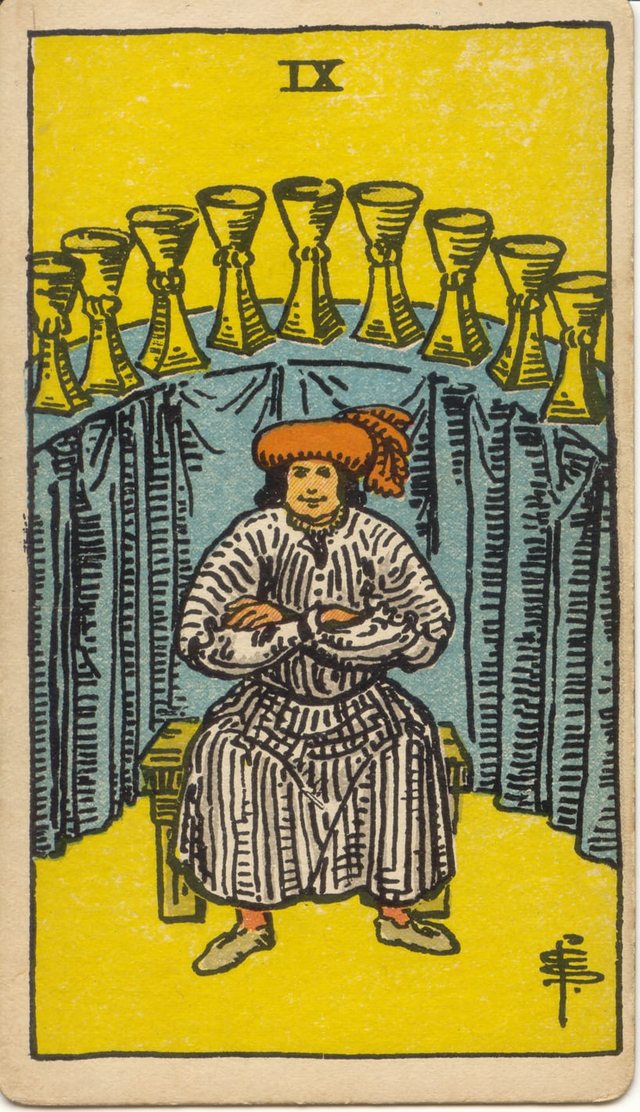
A stout, comfortable man sits on a plain wooden bench, arms folded across his chest, a broad smile on his round face. He wears a soft red cap with a feather, a long white robe striped with black, red stockings and soft pale shoes. Behind him nine gold cups stand in a curved row on a high counter draped with blue cloth, and the whole background is a warm, flat yellow.
The Nine of Cups is the card of having what you wanted. Waite describes a man who 'has feasted to his heart's content', and the picture is unashamedly about pleasure: good food, good wine, comfort, a sense of being well provided for. In card-reading tradition it is often called the wish card, and readers take it as a sign that a hope is being met, or that you have more reason for satisfaction than you allow yourself.
It also invites a closer look. The man's folded arms and the cloth hiding whatever lies behind the counter give the scene a slightly closed, self-contained air. Waite himself adds that 'The picture offers the material side only, but there are other aspects'. The card is generous, but it asks what kind of contentment you are reaching for: the kind that comes from accumulating, or the kind that would still be there if the cups were taken away.
Nine of Cups reversed
Reversed, the satisfaction tends to sour or thin out. Many readers see smugness, complacency, or pleasure taken too far: eating, drinking or spending as a way of filling a gap. It can describe a wish that has come true and turned out to be less than hoped.
Other readers turn the reversal inward, as a shift from outward comfort towards a quieter contentment that does not depend on possessions or approval. Waite's own reversed meanings, 'Truth, loyalty, liberty', have that more serious tone, though he admits that 'the readings vary'. Readers who do not use reversals read these cautions into the upright card when the spread around it is uneasy.
In love and relationships
In love the Nine of Cups suggests a relationship that is enjoyable and secure, or a single person who is genuinely content and not looking to anyone else to complete them. It can describe a wish around love being met, or simple pleasure in each other's company. It can also ask whether comfort has replaced closeness: the folded arms are not a gesture of welcome. Reversed, it may point to self-absorption, or a relationship that looks satisfying from outside but feels thin within.
In work and purpose
At work the card fits a goal reached, a good result, or a period when things are going well and you can enjoy it. It favours hospitality, food, events and any work centred on pleasure and comfort. It can also caution against coasting on success or becoming self-satisfied. Reversed, it may describe an achievement that feels emptier than expected, or a sense that outward success is covering a lack of real engagement.
As advice
Enjoy what you have. Let yourself feel satisfied without immediately reaching for the next thing. At the same time, be honest about which pleasures actually nourish you and which only fill time. Share your good fortune, and uncross your arms now and then.
Yes or no?
Yes Often called the wish card, the Nine of Cups reads as a clear yes, especially for questions about something you hope for. How yes-or-no readings work here.
Questions to sit with
- What have I already been given that I have not stopped to enjoy?
- If my wish came true tomorrow, would it be enough?
- What does contentment feel like to me when it does not depend on anything I own?
Symbolism in the card
The seated man
A plump, smiling man sits squarely on a bench facing the viewer, his feet planted apart. He is the picture of ease and well-being: someone who has eaten well, has no urgent needs and is pleased with himself.
The folded arms
His arms are crossed firmly over his chest. It can be read as satisfaction and confidence, or as something more guarded: what he has is his, and he is not reaching out or sharing.
The red cap and feather
He wears a broad, soft red cap with a curling feather. Red adds warmth and appetite to the picture, and the feather is a small mark of flourish, pride or celebration.
The arc of nine cups
Nine gold cups stand in a curved row along a high counter behind him, like a display. Waite reads them as 'abundant refreshment of wine', suggesting that 'the future is also assured'.
The blue cloth
The counter is hung with a long blue cloth that falls to the floor behind him. It hides whatever lies behind the display, and some readers take it as a sign that the scene's comfort is more surface than depth.
The striped white robe
His long robe is white with dense black stripes, with red stockings beneath. It gives him the look of a comfortable host or merchant, someone at home among good things.
The yellow background
The whole field behind the scene is a flat, bright yellow. Like the yellow skies of other Smith cards, it gives the card warmth, optimism and a sense of good fortune.
“A goodly personage has feasted to his heart's content, and abundant refreshment of wine is on the arched counter behind him, seeming to indicate that the future is also assured.”
Numbers, elements and astrology
Nine
Nine stands just short of completion: the fullness of a suit's energy, sometimes as fulfilment and sometimes as its burden.
Water: the suit of Cups
Water is feeling, intuition, relationships and the imagination.
By Golden Dawn tradition each numbered card from two to ten rules ten degrees of the zodiac (a decan): the Nine of Cups is Jupiter in the second decan of Pisces. They are a symbolic system, not astronomy. How we checked them.
A little history
In the Tarot de Marseille the Nine of Cups is an arrangement of nine cups with no figure. The Golden Dawn called it the Lord of Material Happiness, which Smith's well-fed man illustrates almost literally. Its popular name, the wish card, is usually traced to playing-card fortune-telling, where the nine of hearts, the suit that corresponds to cups, was given the same name. The figure on the bench is Smith's own invention for the 1909 deck.