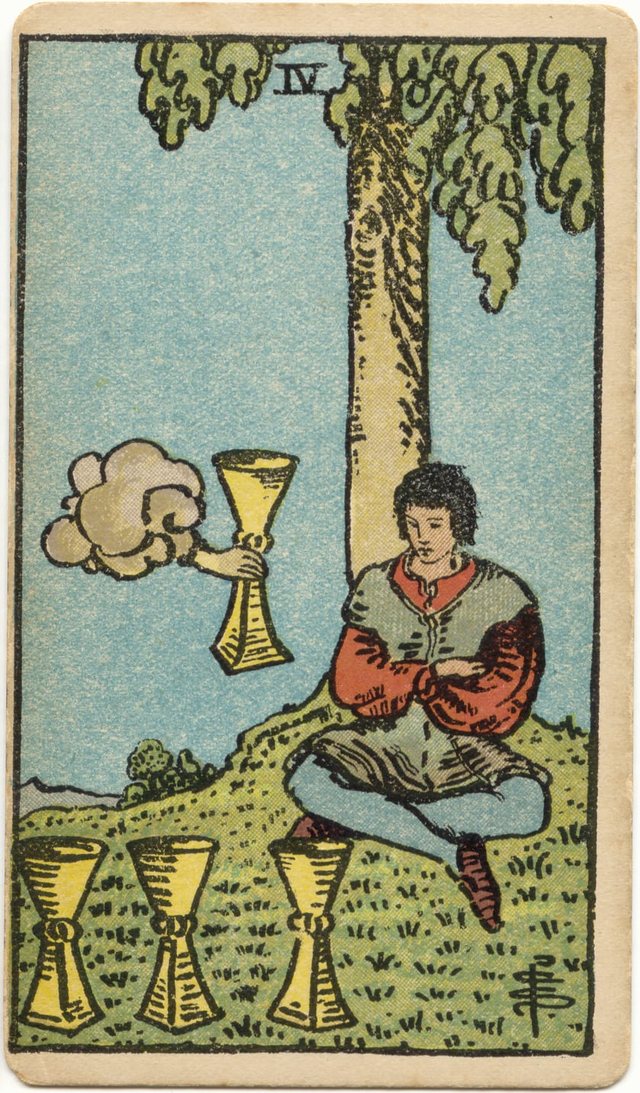
Four of Cups
Upright apathy · withdrawal · discontent · contemplation · an overlooked offer
Reversed waking up · renewed interest · accepting an offer · leaving a rut
- Arcana
- Minor · pip card
- Number
- Four
- Element
- 🜄 Water
- Astrology
- ☽ Moon in ♋ Cancer
- Golden Dawn title
- Lord of Blended Pleasure
- Yes or no
- Maybe
Four of Cups upright
A young man sits cross-legged on a grassy rise with his back against a tree, arms folded tight across his chest. His eyes are lowered to three gold cups standing in a row on the grass in front of him. To his right, a hand reaches out of a small cloud and offers him a fourth cup. He does not seem to see it, or does not care to.
This is the card of having enough and feeling nothing about it. Waite's phrase for it is 'as if the wine of this world had caused satiety only'. The Four of Cups describes boredom, disenchantment, a sulk, or the flat mood that settles in when life is comfortable but no longer moving you. The folded arms say a great deal: this is a closed posture, protective and a little stubborn.
Yet the card is not simply a reproach. Sitting still under a tree is also the posture of meditation, and some readers take the Four as a necessary pause: turning inward to work out what you actually want, rather than reaching for the next cup out of habit. The danger is the hand at the edge of the picture. Something is being offered, and a mood can make it invisible. The card asks you to look up for a moment before deciding it is not for you.
Four of Cups reversed
As a reversal, the slumped figure often seems to be getting up. Many readers take the reversal as the end of a slump: interest returning, a willingness to say yes to something new, or a decision to leave a situation that has gone stale. Waite's reversed meanings include 'Novelty' and 'new relations'.
It can also show the opposite turn: withdrawal deepening into isolation, or someone who has disengaged so completely that they no longer notice what they are refusing. Readers differ here, and the surrounding cards usually decide which way it leans. Either way the reversal asks whether the pause has done its work, and what would help you step back into your life.
In love and relationships
In love the Four of Cups can describe a relationship that has gone flat: no crisis, just less attention than there used to be, with one or both partners quietly elsewhere. For someone single it may show indifference to dating or a habit of turning down people before giving them a chance. It can also be a sign that someone is interested in you and you have not noticed. Reversed, it suggests renewed curiosity and readiness to try again.
In work and purpose
At work the card fits the job that pays the bills but no longer engages you, the meeting where everyone is half-present, or a period of boredom that saps motivation. It can warn that an opportunity, a new project or an offer of help is being dismissed too quickly. Used well, it is time to reassess what you want from work. Reversed, it suggests motivation returning, or the decision to finally act on a long dissatisfaction.
As advice
Before you turn something down, look at it properly. Your low mood may be telling you something true about what no longer fits, but it can also hide what might. Take the pause you need, and then deliberately notice one thing being offered to you that you have not yet considered.
Yes or no?
Maybe The card shows an offer that has not yet been accepted, so the answer depends on whether you are willing to look up and take it. How yes-or-no readings work here.
Questions to sit with
- What am I tired of, and what is that tiredness really about?
- What has been offered to me recently that I dismissed without much thought?
- Am I resting and reflecting, or am I sulking?
Symbolism in the card
The seated young man
He sits cross-legged on a grassy mound, wearing a green jerkin over red sleeves and blue hose. His closed posture and lowered gaze show withdrawal: a person turned inward, either brooding or quietly working something out.
The folded arms
His arms are crossed tightly over his chest. It is a defensive, unreceptive gesture: whatever is offered, his hands are not free to take it.
The three cups on the grass
Three gold cups stand in a neat row before him. They are what he already has, and his downward stare suggests he has stopped valuing them. Familiar comforts can lose their taste.
The cup from the cloud
A hand reaches from a small grey cloud on the left of the card and holds out a fourth cup. It echoes the hand of the Aces: a gift from outside, perhaps a new chance or a new feeling, which the young man appears not to notice.
Hand from a cloud in tarotClouds in tarotCups and chalices in tarot
The tree
A tall tree with a pale trunk and hanging foliage shelters him. Sitting beneath a tree is a traditional image of contemplation and retreat, which gives his stillness a more generous reading.
The distant hills
Low grey-blue hills show on the far left under a clear blue sky. The wider world is there and open, but he has his back to most of it.
“Weariness, disgust, aversion, imaginary vexations, as if the wine of this world had caused satiety only; another wine, as if a fairy gift, is now offered the wastrel, but he sees no consolation therein.”
Numbers, elements and astrology
Four
Four is the square: stability, structure and rest, with the risk of standing still. Fours in tarot often show something held in place.
Water: the suit of Cups
Water is feeling, intuition, relationships and the imagination.
By Golden Dawn tradition each numbered card from two to ten rules ten degrees of the zodiac (a decan): the Four of Cups is Moon in the third decan of Cancer. They are a symbolic system, not astronomy. How we checked them.
A little history
In the Tarot de Marseille the Four of Cups is a symmetrical arrangement of four cups and foliage, with no scene. The Golden Dawn titled it the Lord of Blended Pleasure, and Waite repeats the phrase in his own text: 'This is also a card of blended pleasure.' Smith's figure under a tree, with a hand offering a cup from a cloud, is her own design. It is unusual among the Smith pips in borrowing the hand from a cloud that otherwise marks the four aces.