Eight of Cups
Upright walking away · moving on · disillusionment · searching for meaning · leaving behind
Reversed fear of leaving · drifting · returning · staying too long · aimless wandering
- Arcana
- Minor · pip card
- Number
- Eight
- Element
- 🜄 Water
- Astrology
- ♄ Saturn in ♓ Pisces
- Golden Dawn title
- Lord of Abandoned Success
- Yes or no
- No
Eight of Cups upright
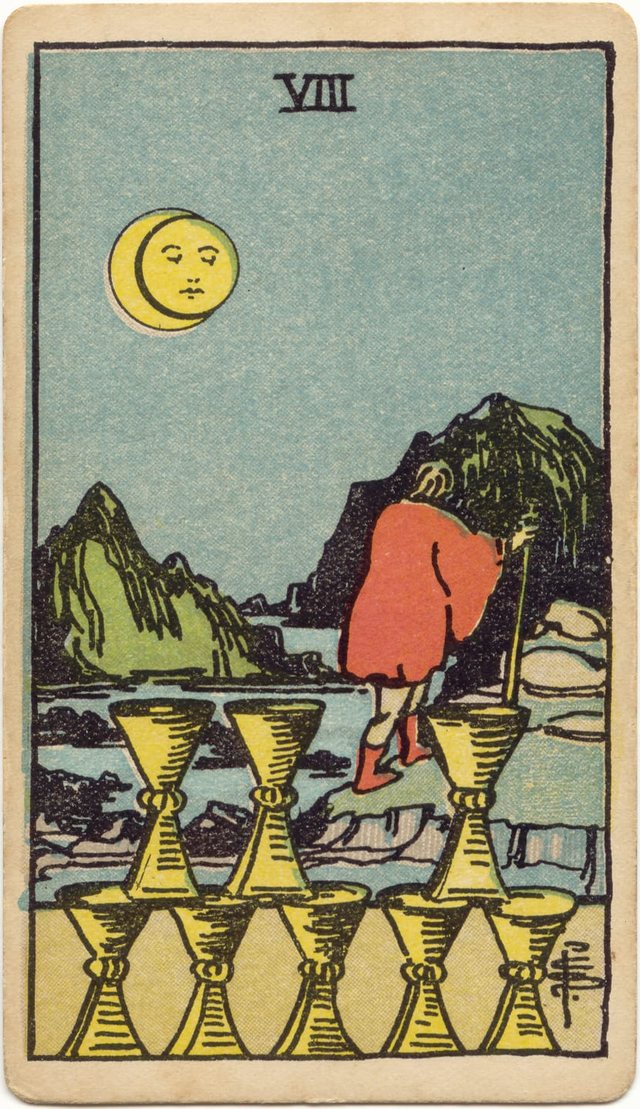
Eight gold cups are stacked carefully in the foreground, five below and three above, with a gap in the upper row where another might have stood. A man in a red cloak and red boots has turned his back on them and is walking away with a staff, across a strip of water and rocks towards dark mountains. Above, a moon hangs in the sky with a sleeping face, a thin crescent drawn across the full disc.
This is the card of leaving. The cups are not broken or spilled; they are upright and neatly arranged, which is exactly the point. The Eight of Cups describes walking away from something that looks perfectly good from outside: a relationship, a job, a way of life, a version of yourself. Waite says it can mean 'that a matter which has been thought to be important is really of slight consequence'.
The gap in the stack hints at why he goes. Something is missing that no number of cups will supply, and he has stopped pretending otherwise. It is a quiet, deliberate departure, made at night, without a scene. The card does not promise that what he is walking towards is better. It respects the courage it takes to leave what is comfortable because it has stopped being true.
Eight of Cups reversed
The reversed Eight often shows the struggle before the leaving: knowing a situation is finished but staying anyway, out of fear, guilt or habit. It can also describe a false start, walking away and then turning back, or drifting from one thing to another without ever settling what you are looking for.
Some readers take the reversal more brightly. Waite's reversed meaning is 'Great joy, happiness, feasting', and readers who follow him see a return to the table after a period away, or a decision to stay that is right after all. As always, the surrounding cards and your own sense of the situation matter more than any single rule.
In love and relationships
In love the Eight of Cups often describes the moment someone realises a relationship, however pleasant, is not what they need, and begins to step back. It can be painful and still be right. It may also point to emotional withdrawal within a relationship, one partner quietly checking out. For someone single, it can mean leaving behind an old pattern of choosing partners. Reversed, it may show staying out of fear of being alone, or a hesitant return to someone.
In work and purpose
At work the card fits leaving a secure job for something more meaningful, abandoning a project that was nearly finished, or stepping away from a career path that once seemed like the goal. It suggests the decision is about meaning more than money or status. Reversed, it may describe staying in a role you have outgrown, or moving from job to job without ever asking what you are actually looking for.
As advice
If something no longer feeds you, admit it, even if it looks fine to everyone else. You do not need a dramatic exit or a perfect plan. Take the staff, take a step, and trust that knowing what you are leaving is enough to begin with. Clarity about where you are going can come on the road.
Yes or no?
No The figure is turning his back on what is in front of him, so the card reads as a no to the situation as it stands. How yes-or-no readings work here.
Questions to sit with
- What in my life looks complete but leaves me feeling empty?
- What am I afraid I would lose if I walked away?
- What am I actually looking for, beyond what I already have?
Symbolism in the card
The stacked cups
Eight cups stand neatly in two rows in the foreground, five below and three above. They are intact and orderly: what is being left is not ruined, only no longer enough.
The gap in the upper row
The top row of three has a clear space in it, as if one cup were missing. Many readers take the gap as the thing the traveller cannot find among his cups, the reason he has to go looking.
The red-cloaked traveller
A man in a red cloak and red boots walks away from the viewer, leaning on a long staff. Red gives his departure energy and resolve, and the staff marks him as a pilgrim or wanderer.
The moon
A pale yellow moon hangs in the sky with a calm, sleeping face, a crescent drawn across the full disc. It suggests night, intuition and the inner tides that move the decision more than reason.
The mountains
Steep green mountains rise on both sides, the darker ones on the right where the traveller is heading. They stand for the harder, higher ground ahead: a search for meaning that will take effort.
The water and rocks
Between the cups and the mountains runs a band of water broken by rocks and pools. He has to cross it: the emotional threshold between the life left behind and the one being sought.
“In practice, it is usually found that the card shews the decline of a matter, or that a matter which has been thought to be important is really of slight consequence”
Numbers, elements and astrology
Eight
Eight is movement and mastery: effort repeated until it becomes skill, and the momentum to leave what no longer serves.
Water: the suit of Cups
Water is feeling, intuition, relationships and the imagination.
By Golden Dawn tradition each numbered card from two to ten rules ten degrees of the zodiac (a decan): the Eight of Cups is Saturn in the first decan of Pisces. They are a symbolic system, not astronomy. How we checked them.
A little history
The Tarot de Marseille Eight of Cups is a pattern of cups and leaves, with no traveller. The Golden Dawn called it the Lord of Abandoned Success, a title that fits Smith's scene closely. Waite's own divinatory notes are unusually uncertain: he says the card 'speaks for itself on the surface, but other readings are entirely antithetical'. The departing figure, the moon and the mountains are Smith's composition for the 1909 deck.