Nine of Swords
Upright anxiety · sleepless nights · guilt · worry · mental anguish
Reversed hope returning · reaching out · fears easing · despair turned inward
- Arcana
- Minor · pip card
- Number
- Nine
- Element
- 🜁 Air
- Astrology
- ♂ Mars in ♊ Gemini
- Golden Dawn title
- Lord of Despair and Cruelty
- Yes or no
- No
Nine of Swords upright
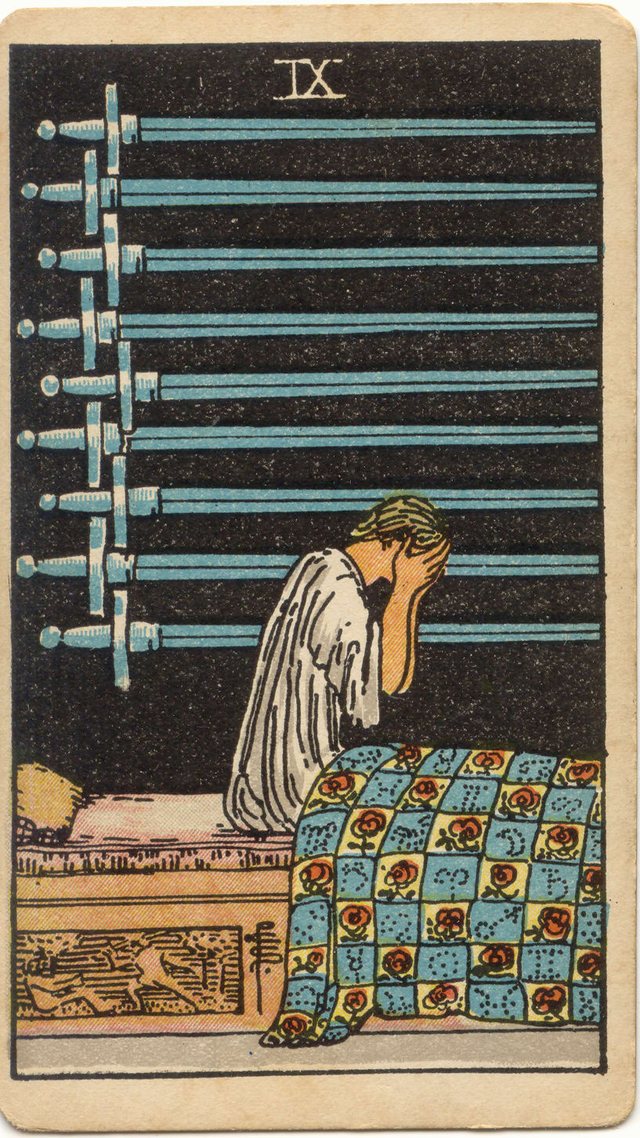
A woman sits up in bed in the dark with her face buried in her hands. Behind her, against a solid black background, nine swords hang horizontally one above another, their hilts stacked along the left edge. She wears a plain white nightgown. The quilt across her lap is a bright patchwork of red roses and blue and yellow squares marked with small dotted signs, and the side of the bed is carved with a scene of one figure falling upon another.
This is the card of three in the morning. Nothing in the picture is actually happening to her: the swords hang on the wall and do not touch her. The suffering is in the mind, in worry, guilt, dread, and the replaying of conversations. Waite described her as "one who knows no sorrow which is like unto hers", and that is how anxiety feels, uniquely awful and impossible to explain to anyone else.
The card takes that distress seriously. It does not say the fears are silly. But it often points out that the worst of it is happening at night, alone, in the imagination, where everything is enlarged. Daylight, other people and practical next steps are the usual remedies, and if the anxiety is persistent, so is proper support from someone qualified to help.
Nine of Swords reversed
The worst of the night may be passing when this card appears reversed. Fears begin to look smaller, you start to talk about what has been weighing on you, or you find you have slept properly for the first time in a while. Many readers take it as hope returning.
Others read the reversal as despair that has gone deeper and more private: worry hidden from everyone, or guilt you will not let yourself put down. Waite's reversed meanings include "suspicion, doubt, reasonable fear, shame". If this sounds familiar, the card's quiet suggestion is to tell someone. Spoken aloud to a person who cares, most night-time fears lose some of their size.
In love and relationships
In love, the Nine of Swords can show anxiety about a relationship: lying awake wondering what a message meant, fear of being left, guilt about something you said or did. Often the imagined scenarios are worse than anything that has happened. A calm, direct conversation tends to do more than another night of rehearsing. Reversed, it may show these fears beginning to lift, or someone finally confiding in a partner or a friend.
In work and purpose
At work the card fits stress that follows you home: dreading the inbox, catastrophising about a mistake, imposter feelings, or worry about a situation you cannot control. It asks what is actually known and what is being imagined. Writing down the real risks and one small action for each can help bring the problem back to size. Reversed, it can show relief after a stressful period, or the point where asking for help becomes possible.
As advice
Get the fears out of your head and into the daylight. Write them down, say them to someone you trust, and separate what has happened from what you are afraid might happen. You do not have to solve everything tonight. If this weight is constant, reach out for proper support.
Yes or no?
No The card reflects worry and dread rather than a clear opening, so it reads as no, or as a sign the question is being asked from fear. How yes-or-no readings work here.
Questions to sit with
- What am I most afraid of right now, put in one plain sentence?
- How much of this worry is about what has happened, and how much about what might?
- Who could I tell about this, so I am not carrying it alone?
Symbolism in the card
The woman with her face in her hands
She sits upright in bed, head bowed into both hands, long hair falling forward. Her face is hidden. It is the universal gesture of despair, shame or exhaustion, the moment when thinking has become too much.
The nine horizontal swords
Nine swords hang flat across the black background in a neat stack, their hilts to the left. They do not pierce her or even touch her. That detail is central to the card: the threat is in the mind rather than in the room.
The black background
Everything behind the figure is solid black. It is night, and also the narrowing of anxiety, when nothing else is visible. The same black appears behind the Ten of Swords.
The patchwork quilt
The quilt is the brightest thing in the picture, patterned with red roses and blue and yellow squares holding small dotted signs, often identified as astrological symbols. It hints at the comfort, beauty and wider order the sleeper cannot yet see.
The carved bed panel
The side of the bed carries a small relief, hard to make out in the scan, that appears to show one figure attacking or falling upon another. Many readers take it as the violence of the thoughts that keep her awake.
The white nightgown
Her plain white gown makes her look exposed and vulnerable, a person stripped of the defences of the day and left alone with her mind.
“One seated on her couch in lamentation, with the swords over her. She is as one who knows no sorrow which is like unto hers. It is a card of utter desolation.”
Numbers, elements and astrology
Nine
Nine stands just short of completion: the fullness of a suit's energy, sometimes as fulfilment and sometimes as its burden.
Air: the suit of Swords
Air is thought, speech, truth and conflict: the mind and its sharp edges.
By Golden Dawn tradition each numbered card from two to ten rules ten degrees of the zodiac (a decan): the Nine of Swords is Mars in the second decan of Gemini. They are a symbolic system, not astronomy. How we checked them.
A little history
Older decks show the nine of swords as a pattern of blades. The Golden Dawn titled it the Lord of Despair and Cruelty, and Waite's divinatory meanings, beginning "death, failure, miscarriage, delay", are among the bleakest he gives. Smith turned that list into an interior, domestic scene of a single sleepless woman, which has done much to shape the modern reading of the card as anxiety rather than outward disaster.