Eight of Swords
Upright feeling trapped · self-limiting beliefs · helplessness · restriction · fear
Reversed release · new perspective · freeing yourself · facing fear
- Arcana
- Minor · pip card
- Number
- Eight
- Element
- 🜁 Air
- Astrology
- ♃ Jupiter in ♊ Gemini
- Golden Dawn title
- Lord of Shortened Force
- Yes or no
- No
Eight of Swords upright
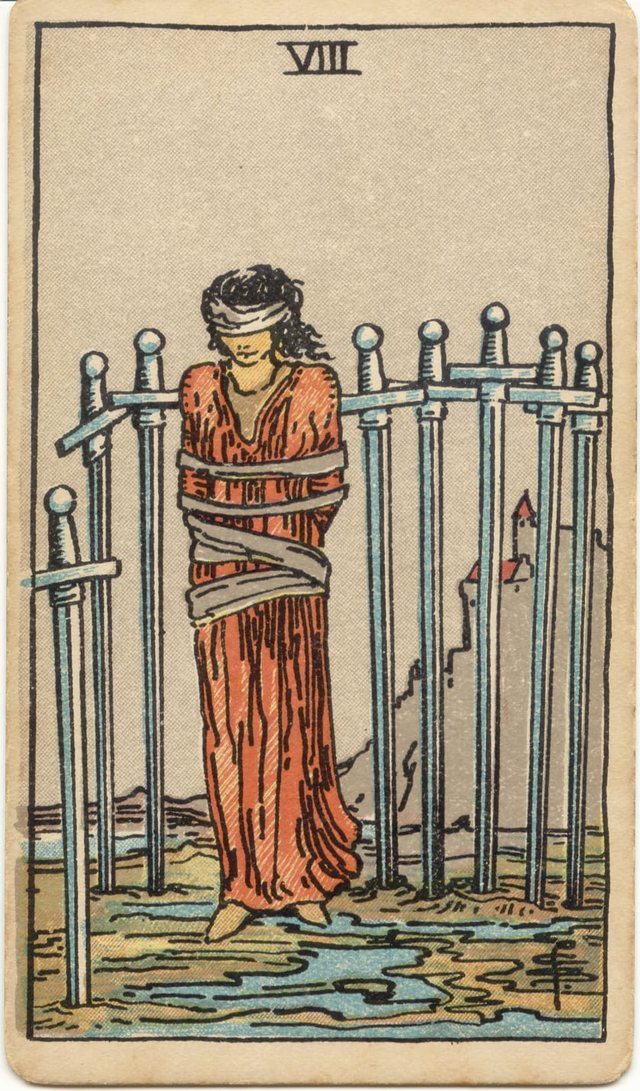
A woman in a long orange-red robe stands on wet, marshy ground. Her eyes are covered with a grey blindfold and her upper body is wrapped in grey bands that pin her arms to her sides. Eight swords stand in the earth around her, three to one side and five to the other, like the posts of an unfinished fence. Behind her, on a rocky hill to the right, rises a castle with red roofs. Puddles of water lie at her feet, and the sky is a flat grey.
The card describes a feeling of being boxed in, with no visible way out. But look at what is actually drawn: her legs are free, the swords do not close in front of her, and the binding would not stop her walking. Waite himself called it "rather a card of temporary durance than of irretrievable bondage". The prison is real enough to feel, but less complete than it seems from inside.
That is why the Eight of Swords is so often read as a card about the mind. The restriction may be outside you, in a job, a family, a situation you did not choose, yet the sense that nothing can be done usually comes from how you are thinking about it. The first move is rarely a grand escape. It is taking the blindfold off and seeing the gaps.
Eight of Swords reversed
With the card upside down, the bindings start to loosen. You may begin to see options that were invisible before, ask for help, or simply realise that the fear was bigger than the facts. It is commonly read as release, recovery of agency, and a clearer view.
Some readers note a darker possibility: panic that makes the trap feel tighter, or a person stepping out of one restriction straight into another. Waite's reversed meanings, "disquiet, difficulty, opposition", lean that way. If you use reversals, let the surrounding cards decide. Either way, the card keeps its central point: the next step depends more on what you can see than on what is holding you.
In love and relationships
In love, the Eight of Swords can show feeling stuck in a relationship, or stuck outside one, held back by fear of being alone, guilt, or a story about what you deserve. It may describe someone who believes they have no choices when they have several. It is worth separating real obligations from imagined ones. Reversed, it can show someone finally seeing a relationship clearly and recognising that they are free to choose what to do about it.
In work and purpose
At work the card fits feeling trapped in a role, a contract or a career path, or being so overwhelmed by constraints that you cannot see options. It can describe a culture of fear where nobody speaks up. Practical help often lies in small, concrete steps: talking to someone, updating a CV, asking what is actually allowed. Reversed, it suggests a shift in perspective that opens a way out, or confidence returning after a difficult period.
As advice
Test the walls before you accept them. Write down what is truly stopping you and what you have only assumed. Ask someone outside the situation what they see. You may not be able to leave at once, but you can probably take one step, and that step will show you more.
Yes or no?
No The card describes feeling blocked, so it reads as no for now, though the block may be less fixed than it seems. How yes-or-no readings work here.
Questions to sit with
- Which of the things holding me back are facts, and which are fears?
- If I took the blindfold off, what gap would I see?
- Who could help me see this situation from outside?
Symbolism in the card
The blindfold
A grey band is tied across the woman's eyes. She cannot see the swords, the gaps between them or the way out. It stands for confusion, fear or a fixed belief that keeps the real shape of the situation hidden.
The bindings
Grey cloth bands wrap her torso and pin her arms, but her legs and feet are free. Restraint and freedom exist together: she is limited, yet not so much that she cannot move if she chooses.
The eight swords
Eight swords stand point-down in the earth, five on one side and three on the other, with an open space before her. They look like a cage only from her position. Swords are thoughts, so the fence is often read as a mental one.
The marshy ground
Shallow pools of water lie on the ground at her feet. Water suggests emotion, and here it is shallow and underfoot: feelings that make the ground unsteady without being deep enough to drown in.
The castle on the crag
Behind her, a grey castle with red-roofed towers rises on a rocky hill. It may be the home or authority she has been cast out from, or the safety she could walk back to. Either way it is within reach.
The orange-red robe
Her long robe is warm red-orange against a grey world. Red carries life and passion, and suggests that the energy to break free is still there inside the restriction.
“A woman, bound and hoodwinked, with the swords of the card about her. Yet it is rather a card of temporary durance than of irretrievable bondage.”
Numbers, elements and astrology
Eight
Eight is movement and mastery: effort repeated until it becomes skill, and the momentum to leave what no longer serves.
Air: the suit of Swords
Air is thought, speech, truth and conflict: the mind and its sharp edges.
By Golden Dawn tradition each numbered card from two to ten rules ten degrees of the zodiac (a decan): the Eight of Swords is Jupiter in the first decan of Gemini. They are a symbolic system, not astronomy. How we checked them.
A little history
As with the other swords pips, older decks show the eight as an ornamental pattern of blades. The Golden Dawn titled it the Lord of Shortened Force. Smith's bound and blindfolded woman is original to the 1909 deck, and she echoes the blindfolded woman of the Two of Swords, a visual link many readers trace between the two cards.