Three of Swords
Upright heartbreak · painful truth · grief · separation · sorrow named
Reversed healing begins · lingering hurt · releasing grief · confusion after loss
- Arcana
- Minor · pip card
- Number
- Three
- Element
- 🜁 Air
- Astrology
- ♄ Saturn in ♎ Libra
- Golden Dawn title
- Lord of Sorrow
- Yes or no
- No
Three of Swords upright
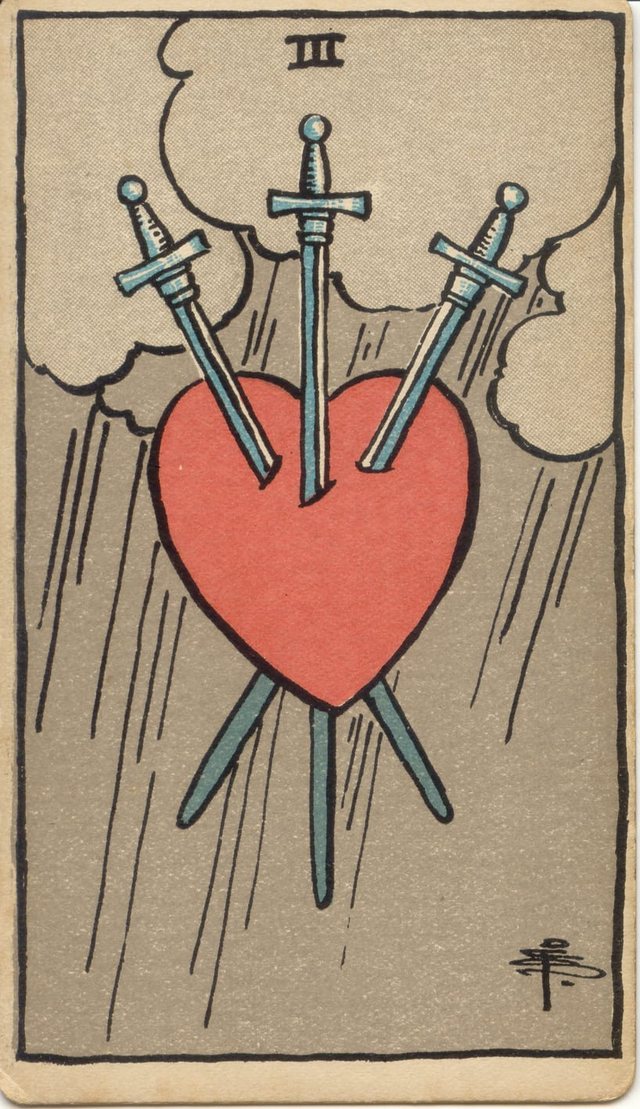
A large red heart hangs in a grey sky, and three swords have been driven through it: one straight down the centre, two at angles from either side, their points coming out below. Behind it, heavy grey clouds fill the top of the card and rain falls in long slanting lines. No one stands in the scene and there is nowhere to shelter: it is one of the very few minor cards with no human figure at all.
The meaning is as direct as the picture. This is the card of hurt that arrives through knowledge: a betrayal discovered, a rejection put into words, a loss you can no longer pretend is temporary. Swords belong to the mind, so the wound here is often made by a thought or a sentence. Someone said it, or you read it, or you finally admitted it to yourself.
Nothing in the picture is hidden or softened. There are no excuses and no scenery to get lost in, only the fact of the pain. That plainness can be a strange relief. Grief that has been named can be felt and, in time, carried; grief that is denied tends to leak out sideways. The Three of Swords does not say how long the rain will last. It says that this is real and worth taking seriously, and that the first honest step is to stop arguing with it.
Three of Swords reversed
Reversed, the card is often read as the beginning of recovery: the storm thinning, the swords loosening, the hurt becoming something you can talk about rather than something that floods you. It may also describe forgiveness, or a willingness to let an old injury stop defining you.
Other readers take it the opposite way, as pain that has been pushed down and is now coming out as confusion, bitterness or distraction, close to Waite's "mental alienation, error, loss, distraction". Both readings ask the same thing: what would help this grief move? Sometimes the answer is time; sometimes it is finally talking to the person involved, or to someone outside the situation who can simply listen.
In love and relationships
In love, the Three of Swords is the card most people fear: a breakup, an affair brought into the open, unrequited feeling, or words that cannot be taken back. It can also describe the sorrow of a separation both people know is right. If you are already hurting, it validates that hurt rather than predicting more. Reversed, it suggests the sharpest pain is passing, or that an old heartbreak is still shaping how you approach new people and might be ready to be looked at.
In work and purpose
At work the card fits a hard piece of news: being passed over, a project cancelled, a falling-out with a colleague you trusted, or critical feedback that lands on a sore spot. It can describe a team grieving a change nobody chose. The useful response is usually to acknowledge the disappointment before planning around it. Pretending to be fine tends to cost more later. Reversed, it may mark the point where you can look back at a setback and take something useful from it.
As advice
Let yourself feel this. You do not need to explain the hurt away, find the silver lining or forgive anyone yet. Name what happened in plain words, to yourself or someone you trust. Grief that is acknowledged moves; grief that is argued with stays.
Yes or no?
No The card describes sorrow and separation, so it answers no, or at least not without pain. How yes-or-no readings work here.
Questions to sit with
- What truth hurt me, and have I let myself fully admit it?
- Which part of this pain is about the event, and which part is the story I tell about it?
- Who could I let see how much this has affected me?
Symbolism in the card
The red heart
A plain, bright red heart floats at the centre of the card, the only warm colour on it. It stands for feeling, love and the inner life, and its size makes the hurt the whole subject of the picture.
The three swords
Three blue-grey swords with round pommels pass right through the heart, the middle one vertical, the others slanting inward. Swords are thought and speech, so the wound is usually read as one made by words, knowledge or a decision rather than by chance.
The storm clouds
Dark grey clouds crowd the upper half of the card. They set a mood of heaviness and closeness, the kind of weather that blocks the light without yet promising when it will clear.
The rain
Long diagonal streaks of rain fall across the whole scene. Rain is the obvious picture of tears, but it is also what washes and eventually clears the air, which is why many readers see the card as grief that leads somewhere.
The empty grey ground
Below the heart there is nothing but grey. With no figure or setting, the card offers no distraction or story, only the plain fact of sorrow, which is part of why it hits so directly.
“Removal, absence, delay, division, rupture, dispersion, and all that the design signifies naturally, being too simple and obvious to call for specific enumeration.”
Numbers, elements and astrology
Three
Three is the first number that makes a shape: two things meet and produce a third. It is the number of growth, collaboration and first results.
Air: the suit of Swords
Air is thought, speech, truth and conflict: the mind and its sharp edges.
By Golden Dawn tradition each numbered card from two to ten rules ten degrees of the zodiac (a decan): the Three of Swords is Saturn in the second decan of Libra. They are a symbolic system, not astronomy. How we checked them.
A little history
Most early decks show the three as a pattern of crossed blades with no scene. The pierced heart has a clear precedent in the Sola Busca tarot, an Italian deck of the 1490s with fully illustrated minor cards, whose three of swords shows a heart run through by three blades. Smith is widely thought to have seen photographs of the Sola Busca, and this card is the most often cited sign of its influence on her work. The Golden Dawn titled it the Lord of Sorrow.