
Swords in tarot
The sword is the emblem of the suit of Swords and of air: thought, speech and judgement, and the conflict they cause. In the Bible the word of God is sharper than a two-edged sword, and in Renaissance art Justice holds a sword beside her scales. Justice holds hers upright; the sphinx atop the Wheel of Fortune bears one; the Magician has one on his table; the Ace of Swords is crowned. In readings a sword means clarity and decision, or wounding and argument. Notice whether it is raised, sheathed, crossed or pointing down.
Cards that show swords
-
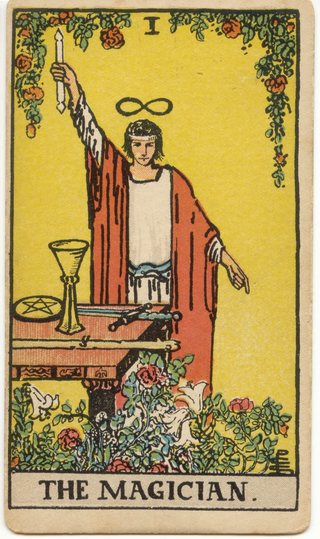 The Magician
: The four suit emblems
A cup, a sword, a coin engraved with a pentagram and a wand lie on the table. They are the emblems of the four suits and of the classical elements, water, air, earth and fire. The whole of the Minor Arcana is within his reach.
-
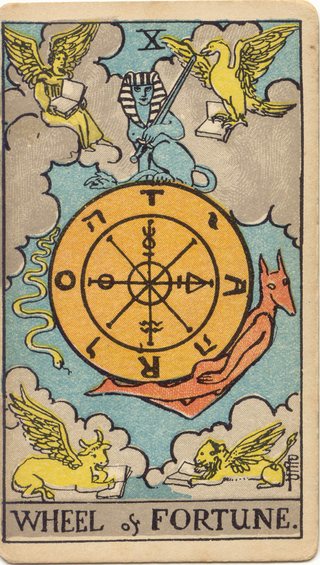 Wheel of Fortune
: The sphinx
A blue sphinx in a striped headdress sits on top of the wheel holding an upright sword. Waite calls it 'the equilibrium therein': judgement and wisdom staying steady while everything beneath it turns.
-
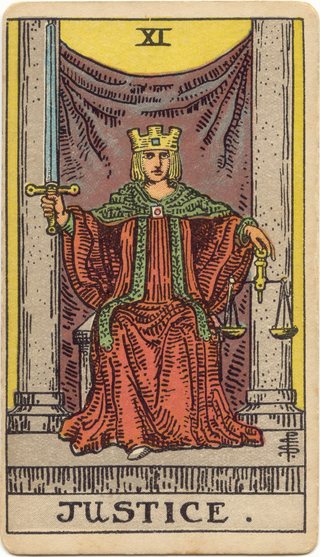 Justice
: The upright sword
Held in the figure's right hand on the viewer's left, a straight blue blade with a gold hilt points directly upward. A raised sword is the power to decide and to cut through confusion. Pointing up, it suggests a decision made in service of something higher than personal advantage.
-
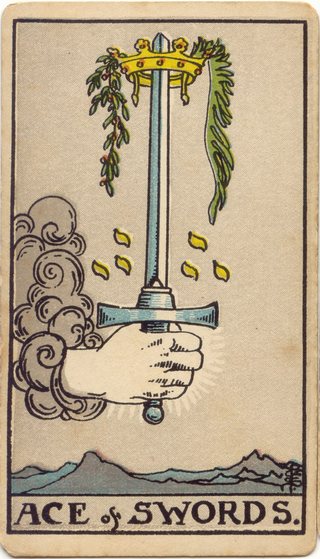 Ace of Swords
: The upright sword
A plain steel blade, double-edged and perfectly vertical, with a short crossguard and a round pommel. The sword is the emblem of the whole suit: discrimination, the ability to separate one thing from another, and the power of words and decisions.
-
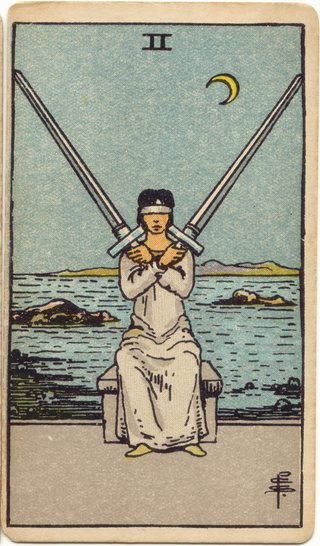 Two of Swords
: The crossed arms and two swords
Her wrists cross over her heart, each hand holding a sword whose blade lies against the opposite shoulder. The pose is both balanced and defensive: the swords guard the heart and also lock her in position, since lowering one would upset the other.
-
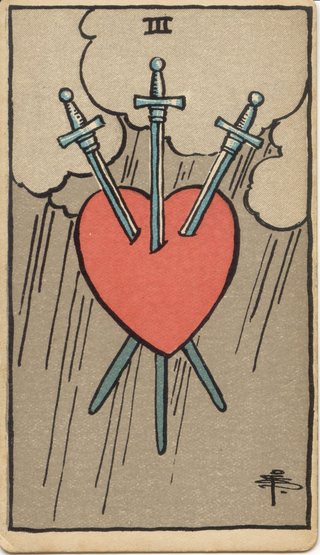 Three of Swords
: The three swords
Three blue-grey swords with round pommels pass right through the heart, the middle one vertical, the others slanting inward. Swords are thought and speech, so the wound is usually read as one made by words, knowledge or a decision rather than by chance.
-
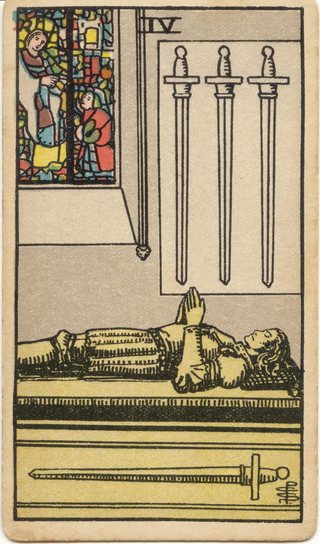 Four of Swords
: The three swords on the wall
Three plain swords hang point-down on a pale panel above the tomb. They are out of hand but not gone: the conflicts and thoughts of the suit, set aside for now and waiting.
-
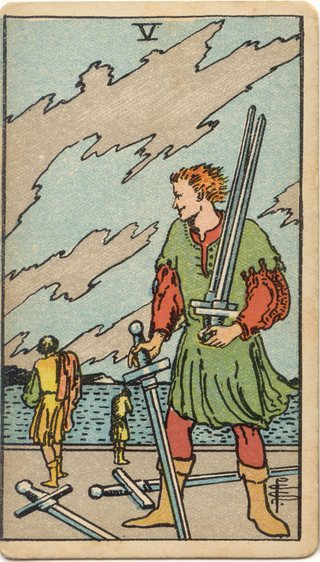 Five of Swords
: The gathered swords
He holds two swords against his shoulder and grips the hilt of a third, while two more lie on the ground. Collecting the weapons of the defeated is a mark of total victory, but also of having more than anyone can use.
-
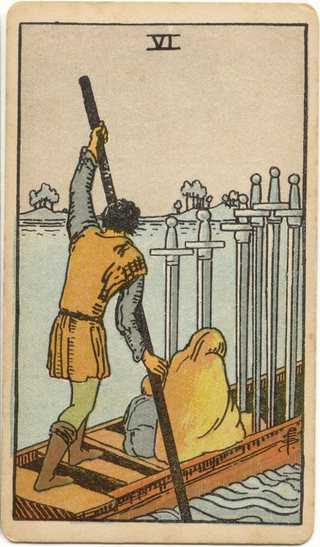 Six of Swords
: The six swords in the bow
Six swords stand upright in the front of the boat, close to the passengers. They travel with them: the thoughts, memories and lessons of a hard time, not discarded but carried along.
-
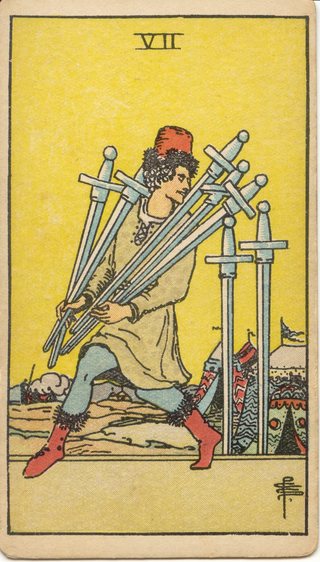 Seven of Swords
: The five carried swords
He holds five swords bunched together, gripped by the blades rather than the hilts. It is an awkward, risky way to carry them, which suits a plan more clever than safe.
-
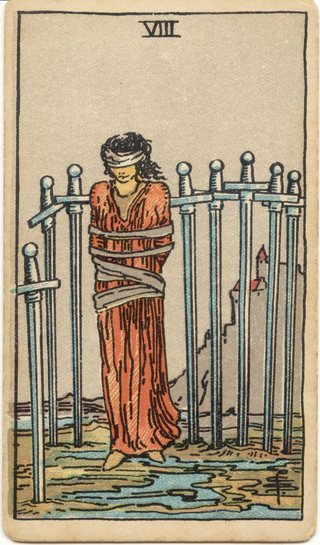 Eight of Swords
: The eight swords
Eight swords stand point-down in the earth, five on one side and three on the other, with an open space before her. They look like a cage only from her position. Swords are thoughts, so the fence is often read as a mental one.
-
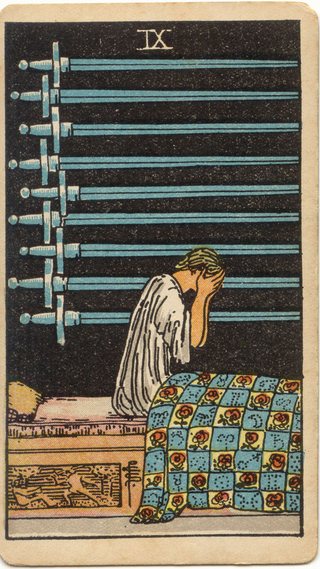 Nine of Swords
: The nine horizontal swords
Nine swords hang flat across the black background in a neat stack, their hilts to the left. They do not pierce her or even touch her. That detail is central to the card: the threat is in the mind rather than in the room.
-
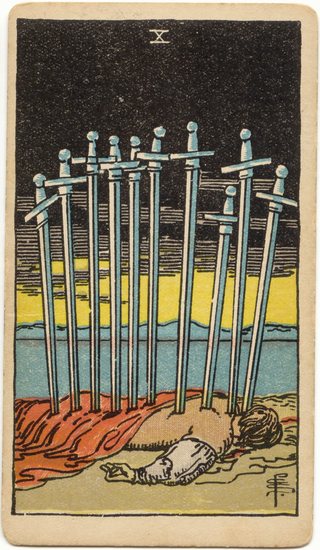 Ten of Swords
: The ten swords
Ten swords stand upright in his back in a crowded row. It is more than any single attack would need, which many readers take as a hint of exaggeration: pain amplified by the mind, the suit of thought driven to its limit.
-
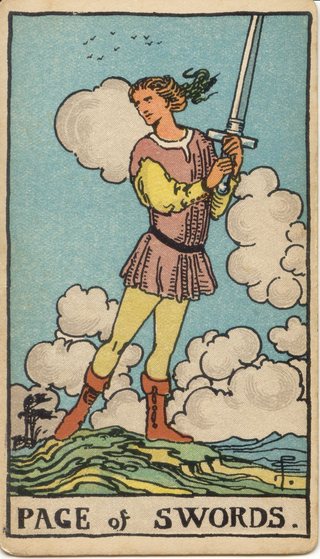 Page of Swords
: The raised sword
He holds the sword upright in both hands, slightly angled, as if ready to strike or block at any moment. It is a young mind's newly found ability to cut through things, held with energy but not yet with mastery.
-
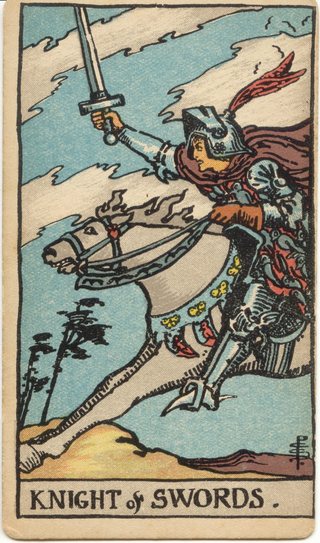 Knight of Swords
: The raised sword
His sword is held high, the arm fully extended, as he rides. It is the decisive mind at its most forceful, ready to strike. Waite described him 'as if scattering his enemies'.
-
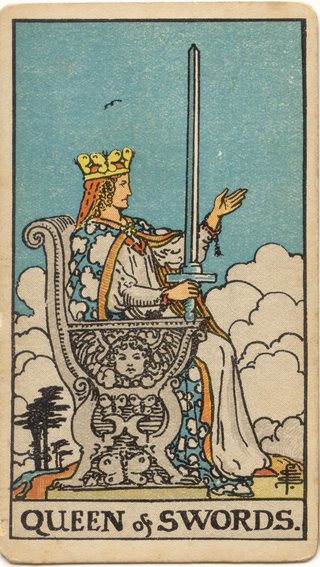 Queen of Swords
: The upright sword
She holds the sword perfectly straight, its hilt resting on the arm of her throne. Upright and steady, it reads as clear judgement, the ability to cut through confusion and pretence without hesitation.
-
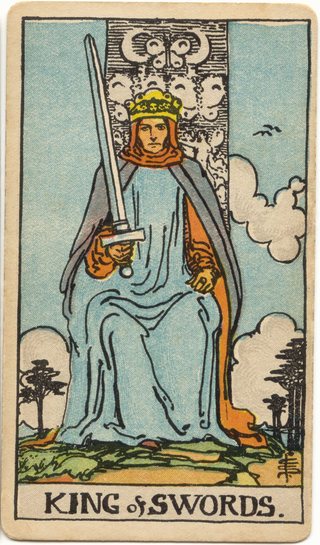 King of Swords
: The sword held slightly off true
The king's sword is long and upright, but tilted slightly away from his body, unlike the perfectly vertical blade of Justice. Some readers see in this the human element in judgement: authority exercised by a person, not an abstraction.