Major Arcana · XVIII
The Moon
Upright uncertainty · intuition · illusion · dreams · anxiety
Reversed confusion lifting · facing fears · truth surfacing · misreading signals
- Arcana
- Major
- Number
- XVIII
- Element
- 🜄 Water
- Astrology
- ♓ Pisces
- Hebrew letter
- Qoph ק
- Yes or no
- Maybe
The Moon upright
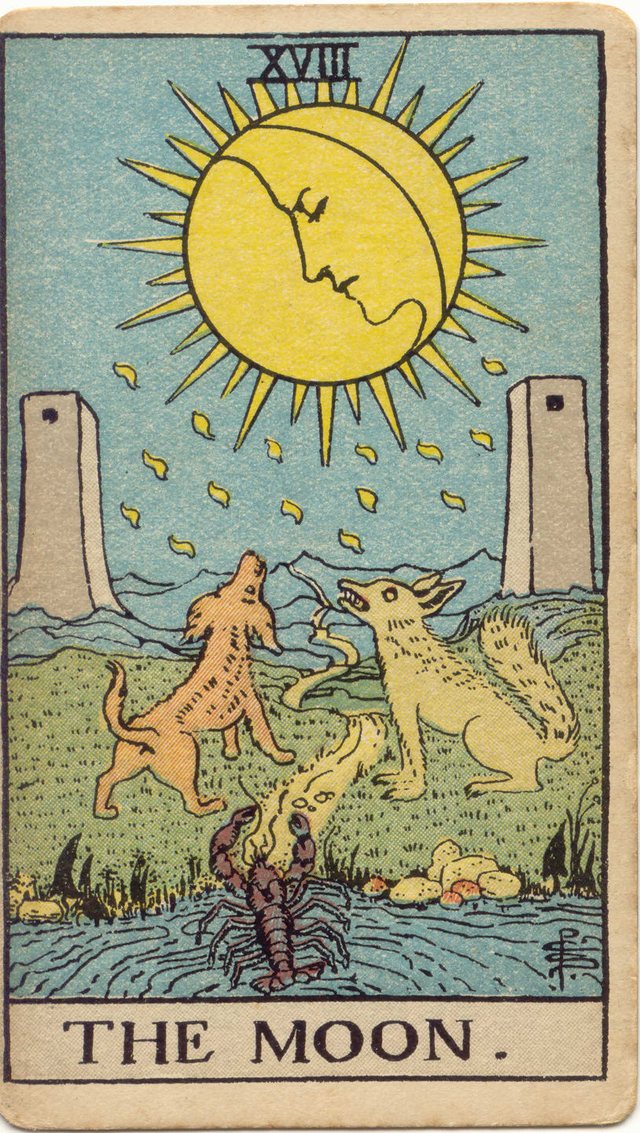
A large yellow moon fills the top of the card, a crescent-shaped face in profile drawn inside the full disc, with long rays around it and yellow drops falling below. Two grey towers stand on either side. Between them a dog and a wolf raise their heads and howl, and from a pool in the foreground a crayfish crawls up onto the bank. A narrow path leaves the water, passes between the animals and the towers, and winds off into distant hills.
This is the card of half-light. Under the moon, shapes are real but misleading: a shadow looks like a figure, a sound becomes a threat. In a reading the Moon describes a time when you cannot see clearly, when anxiety and intuition speak in the same voice and it is hard to tell them apart. Things may not be what they seem, or you may simply not have enough information yet.
The card is not only a warning. The Moon is also the realm of dreams, imagination and the parts of the mind that work beneath reason. The path still runs through the middle of the scene. The task is to keep walking it carefully, paying attention to your instincts without letting every fear decide the route.
The Moon reversed
Many readers treat the reversed Moon as a sign that confusion is starting to clear. Something hidden comes to light, an anxiety loses its grip once it is named, or you realise you misread a situation. It can be a relief, even if the truth is not entirely welcome.
Some readers instead see the reversal as fear turned inward, a low-level unease that is hard to pin to any cause, or as self-deception that is harder to notice than an outside trick. In either reading the useful step is the same: bring the vague thing into daylight, check it against facts, and talk it over with someone you trust.
In love and relationships
In love, the Moon describes uncertainty: mixed signals, insecurity, a sense that something is not being said, or imagining the worst because the facts are thin. It can also show idealisation, falling for a version of someone that exists mostly in your head. It does not prove deception; often it simply asks you to check your fears against what has actually happened. Reversed, it may show a misunderstanding coming out into the open, or a jealousy you have decided to examine instead of obey.
In work and purpose
At work the Moon fits unclear instructions, rumours, shifting priorities and decisions made on incomplete information. It advises caution with agreements whose terms you do not fully understand, and patience while the picture develops. It can also favour creative or intuitive work that thrives on ambiguity. Write down what you actually know and what you are only assuming. Reversed, it suggests that confusing circumstances are starting to clarify, or that a misunderstanding with a colleague is ready to be cleared up.
As advice
Do not make big decisions in the dark. Notice your fears without treating them as facts, and let your intuition speak without assuming it is always right. Keep to the path, gather more light, and wait for the picture to sharpen.
Yes or no?
Maybe The Moon describes a situation that is unclear, so the answer is uncertain until more comes to light. How yes-or-no readings work here.
Questions to sit with
- Which of my worries is based on evidence, and which on imagination?
- What is my intuition telling me that I have been afraid to hear?
- What would help me see this situation more clearly?
Symbolism in the card
The moon with a face
A full yellow disc with long rays, holding a crescent profile with closed eyes. Waite noted that the moon is shown increasing, 'to the right of the observer'. It shines by borrowed light, the light of reflection and imagination rather than direct sight.
The falling drops
Yellow drops shaped like the Hebrew letter yod fall between the moon and the ground. The older cards treated them as dew; Waite calls them 'the dew of thought'. They suggest that even in uncertain light, something nourishing reaches the earth.
The dog and the wolf
On the left a tan dog, on the right a pale wolf, both lifting their heads towards the moon. They are tame and wild versions of the same animal. Waite read them as 'the fears of the natural mind', and they guard the path the traveller has to take.
The crayfish
A dark purplish crayfish climbs out of the pool onto the bank. It stands for what rises from the depths of the mind: half-formed fears, instincts and images that have not yet reached the light. Waite thought it usually sinks back.
The two towers
Two plain grey towers, each with a single small window, frame the scene on left and right. They form a gateway. Beyond them lies unknown country, and the card places you just before passing through.
The winding path
A pale path rises from the edge of the pool, between the dog and the wolf, and curls away towards the hills. Waite called it 'the issue into the unknown'. It is narrow and uneven but continuous: there is a way through.
The pool
The foreground is a band of blue water, with a few pebbles and dark plants along its edge. Water is the traditional image of the unconscious. The whole scene begins here, at the shore of what is not yet understood.
“The card represents life of the imagination apart from life of the spirit. The path between the towers is the issue into the unknown.”
Numbers, elements and astrology
Number 18, reduced to 9 (1 + 8): Nine
Nine stands just short of completion: the fullness of a suit's energy, sometimes as fulfilment and sometimes as its burden.
Water
Water is feeling, intuition, relationships and the imagination. The Golden Dawn tied The Moon to Pisces, a sign of Water.
These are the traditional attributions of the Hermetic Order of the Golden Dawn (1888), which Waite and Smith followed: each trump is matched to a Hebrew letter and to an element, planet or zodiac sign. They are a symbolic system, not astronomy. How we checked them.
A little history
Early Italian Moon cards vary: the Visconti-Sforza card shows a woman holding a crescent, and some other early cards show astronomers studying it. The Tarot de Marseille fixed the familiar scene of a moon with a face shedding drops, two towers, two dogs baying and a crayfish in a pool. Waite notes that some cards show 'a wolf and dog' instead of two dogs, and Smith's card follows that version. The Golden Dawn attributed the card to Pisces.