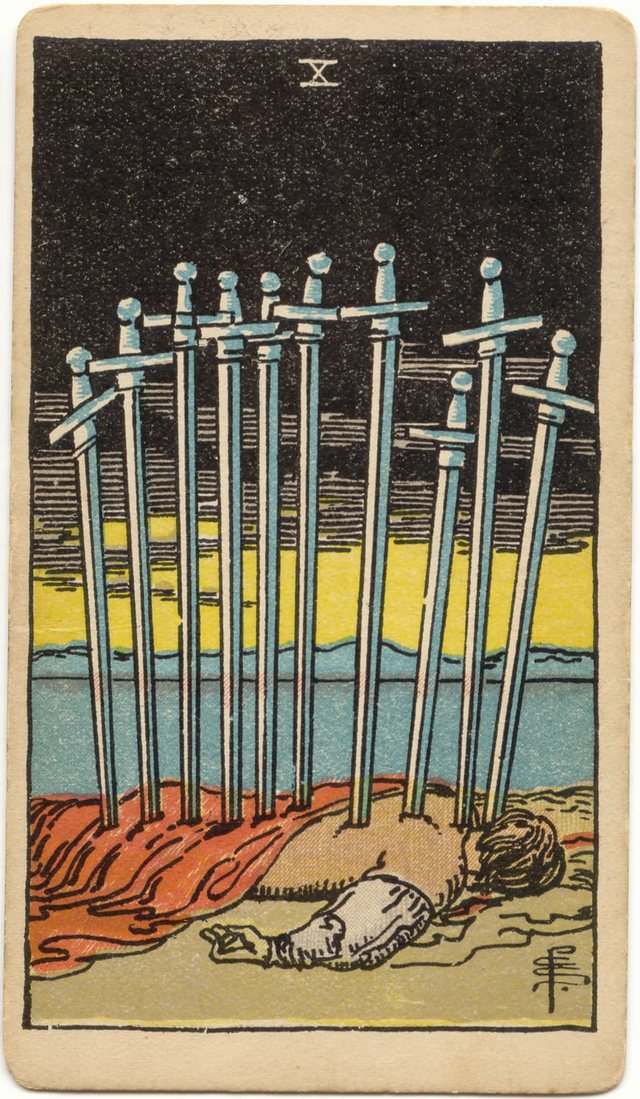
Ten of Swords
Upright painful ending · rock bottom · defeat · the worst is over · exhaustion
Reversed recovery · slow return · resisting an ending · survival
- Arcana
- Minor · pip card
- Number
- Ten
- Element
- 🜁 Air
- Astrology
- ☉ Sun in ♊ Gemini
- Golden Dawn title
- Lord of Ruin
- Yes or no
- No
Ten of Swords upright
A man lies face down on the shore with ten swords driven into his back. A red cloak or cloth is spread out beside him across the ground, and one hand rests in the foreground with its fingers curled. Above him the sky is black, but along the horizon there is a broad band of yellow light over still blue water and a line of distant grey hills.
It is hard to imagine a more final image, and the card's meaning is accordingly blunt: something has ended and there is no going back. A relationship, a plan, a way of seeing yourself or a long struggle has come to its conclusion. Often the feeling is one of total defeat, or of having been let down or betrayed, and ten swords is overkill: the card can also describe dramatising a hurt, feeling more wounded than the facts alone would justify.
Yet Waite insisted it "is not especially a card of violent death", and the picture holds two kinds of comfort. The first is the dawn on the horizon: the darkness above is lifting. The second is simpler. When you are at the very bottom, you cannot fall further. The card marks the point where things stop getting worse and recovery, however slow, can begin.
Ten of Swords reversed
Reversed, the swords are often read as falling away: survival, slow recovery, and the first signs of standing up again. Waite gave the reversal a surprising list, "advantage, profit, success, favour", but warned that "none of these are permanent".
Some readers instead see refusal to let an ending finish, keeping a dead situation going because accepting the loss feels worse. Others see a narrow escape from something that could have been worse. If you read reversals, ask whether you are rising or still clinging. The answer may be both at once: getting up slowly while still half attached to the story of what went wrong.
In love and relationships
In love, the Ten of Swords can describe the definite end of a relationship, a betrayal brought to light, or the exhaustion of having tried everything. It does not soften that, but it does suggest the end is real and complete, which can be a relief after a long, uncertain decline. It may also point to over-identifying with a hurt. Reversed, it suggests healing after heartbreak, or a cautious return to openness.
In work and purpose
At work the card fits a project that fails completely, losing a job, a plan undermined by colleagues, or a burnout that finally forces a stop. It can feel like being stabbed in the back. The honest response is to accept that this version is over and look at what can be salvaged: skills, contacts, lessons. Reversed, it may show the beginning of recovery, or the danger of pouring more energy into something already finished.
As advice
Let it be over. You do not have to pretend it did not hurt, and you do not have to fight any more. Lie still for a moment, then notice the light along the horizon. The card shows the lowest point, not the next one, and getting up slowly is still getting up.
Yes or no?
No The card describes a definite and painful ending, so it answers no to whatever was being hoped for in its current form. How yes-or-no readings work here.
Questions to sit with
- What has truly ended, and have I let myself accept that?
- Am I making this wound larger than it needs to be?
- What light can I see on the horizon, even faintly?
Symbolism in the card
The fallen figure
A man lies face down at the water's edge, his face hidden and one hand stretched out on the ground. He is beyond fighting. The figure represents total defeat, but also complete surrender: there is nothing left to defend.
The ten swords
Ten swords stand upright in his back in a crowded row. It is more than any single attack would need, which many readers take as a hint of exaggeration: pain amplified by the mind, the suit of thought driven to its limit.
The red cloth
A long red cloak or cloth spreads across the ground on the left. It can be read as blood or as the cloak he wore, and red as passion and life drained out onto the shore.
The black sky
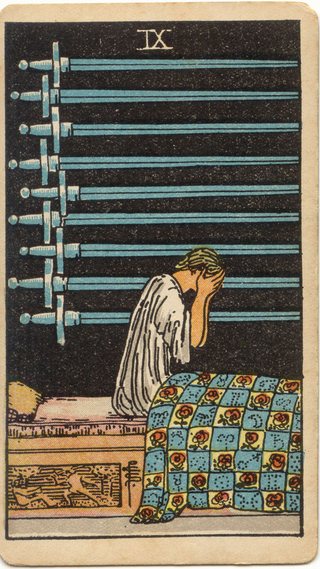
The upper half of the card is solid black, like the background of the Nine of Swords. It is the darkest point, the night that comes before any morning.
The yellow dawn
Between the black sky and the water runs a wide band of yellow light. Readers almost always take it as dawn: proof that the night is ending, and that the scene contains a beginning as well as an ending.
The calm water and hills
Behind him lies flat blue water and a line of grey-blue hills. The landscape is perfectly still. After the storms of earlier swords cards, the wind has dropped and the scene is quiet.
The curled hand
His hand lies in the foreground with fingers bent. Some readers see a gesture of blessing in it, as on the Hierophant, though in this scan the position is ambiguous.
“Whatsoever is intimated by the design; also pain, affliction, tears, sadness, desolation. It is not especially a card of violent death.”
Numbers, elements and astrology
Ten
Ten completes one cycle and begins the next (1 + 0 = 1). Tens show a suit carried to its end, for better or worse.
Air: the suit of Swords
Air is thought, speech, truth and conflict: the mind and its sharp edges.
By Golden Dawn tradition each numbered card from two to ten rules ten degrees of the zodiac (a decan): the Ten of Swords is Sun in the third decan of Gemini. They are a symbolic system, not astronomy. How we checked them.
A little history
Most older decks show the ten of swords as a pattern of crossed blades with no figure. The Golden Dawn titled it the Lord of Ruin. Smith's prone man pierced by every sword of the card follows Waite's description almost word for word, and it has become one of the most recognisable images in the deck. The dawn on the horizon is a detail Waite did not mention.