
Mountains in tarot
Mountains in religious art are places of revelation and trial, from Sinai to the mount of the Transfiguration. In tarot they usually stand for achievement, abstract thought or a goal not yet reached. In Smith's cards they often sit in the background: white peaks behind the Fool, the bare range behind the Emperor, the single peak between the Lovers, the snowy summit where the Hermit stands, the distant blue mountains of Temperance and Judgement. Read them as a goal ahead or a perspective already won. Notice whether a figure faces them, turns away, or already stands on top.
Cards that show mountains
-
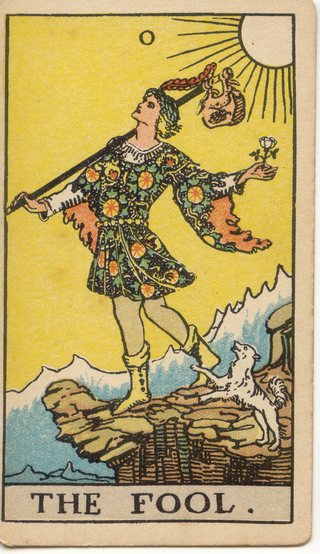 The Fool
: The distant mountains
Icy white peaks fill the background. Mountains often stand for challenges and for the heights of attainment. Here they are far off, a reminder that the road he is starting on is a long one.
-
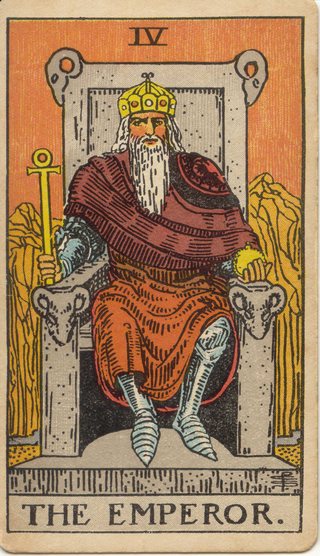 The Emperor
: The mountains and orange sky
Behind the throne rise steep, barren mountains under an orange sky. Nothing grows here, in contrast to the Empress's green garden. It is a landscape of hard achievement and a fiery, ambitious temperament.
-
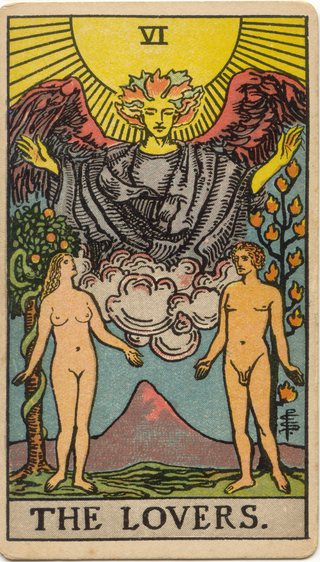 The Lovers
: The mountain
A single reddish peak rises between them in the distance, pointing straight up towards the angel. It can be read as a challenge the couple face together, or as the height of a shared aim.
-
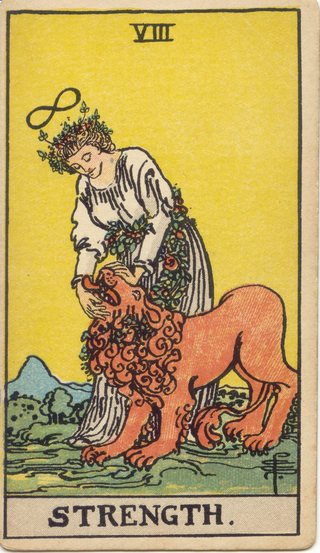 Strength
: The mountain and yellow sky
A blue peak rises in the distance on the left, above green fields and trees, and the whole scene is lit by a flat yellow sky. The mountain suggests a long aim; the yellow gives the card its warmth and openness.
-
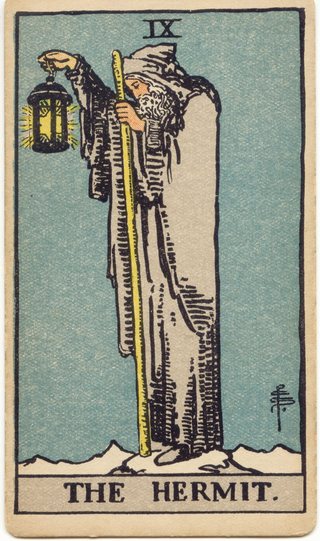 The Hermit
: The snowy height
He stands on white, snow-covered ground at the top of the world. Snow and height suggest isolation, clarity and attainment: he has climbed to where he can see far, though it is cold and solitary there. Waite calls it 'an eminence'.
-
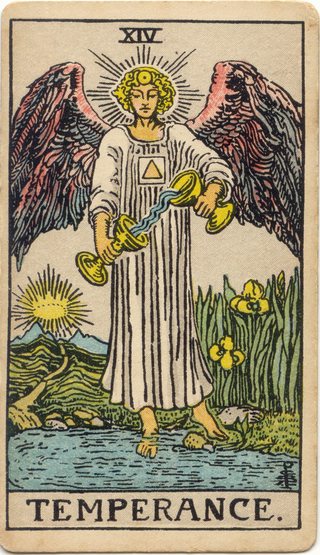 Temperance
: The path to the mountains
A narrow path winds from the edge of the pool across green hills towards distant blue peaks and a rayed light. Waite says a crown can be seen vaguely in it. The path suggests that patience leads somewhere: a long road with a destination.
-
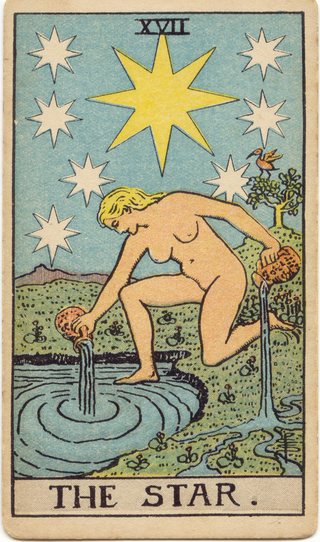 The Star
: The landscape and distant mountain
Behind her the ground rises gently, dotted with small plants, and a low purple mountain sits on the far horizon. The land is green and open, a peaceful contrast with the black sky of the Tower before it.
-
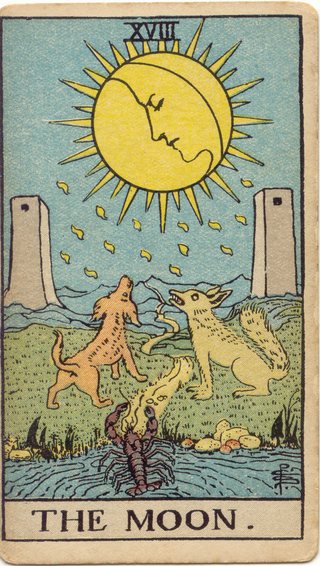 The Moon
: The winding path
A pale path rises from the edge of the pool, between the dog and the wolf, and curls away towards the hills. Waite called it 'the issue into the unknown'. It is narrow and uneven but continuous: there is a way through.
-
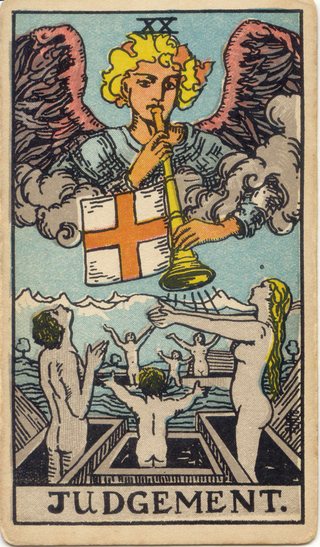 Judgement
: The white mountains
Behind the sea rises a range of white, snow-covered peaks. Mountains often represent challenge and attainment; snowy ones, a cold, pure clarity. They recall the high country behind the Fool and the Lovers.
-
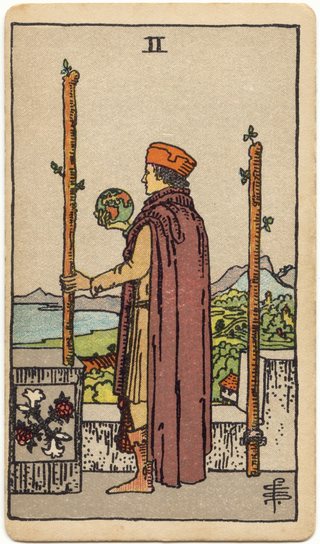 Two of Wands
: The landscape below
Water, fields, a red-roofed house and blue-grey mountains stretch away on either side. The land is fertile and peaceful. The question is not whether the world is worth reaching but whether he will go.
-
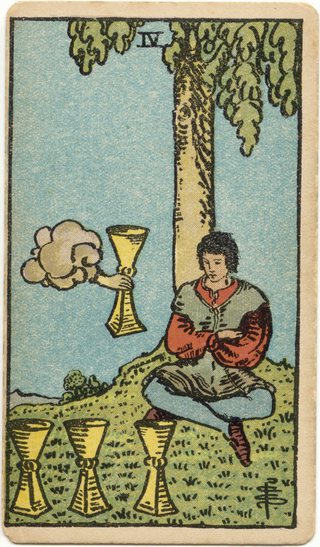 Four of Cups
: The distant hills
Low grey-blue hills show on the far left under a clear blue sky. The wider world is there and open, but he has his back to most of it.
-
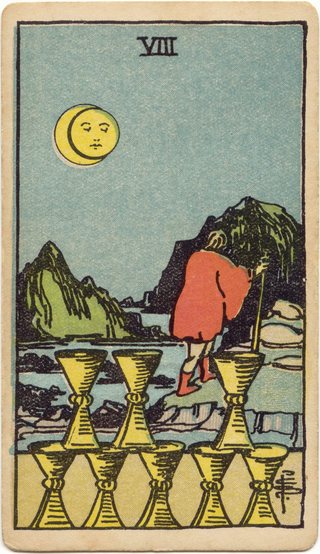 Eight of Cups
: The mountains
Steep green mountains rise on both sides, the darker ones on the right where the traveller is heading. They stand for the harder, higher ground ahead: a search for meaning that will take effort.
-
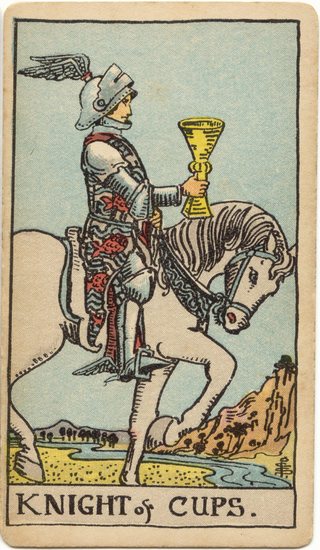 Knight of Cups
: The stream and rocky slope
A narrow blue stream winds across sandy yellow ground, and a brown rocky slope with small trees rises on the right. Water must be crossed and ground climbed: feeling has to meet the real terrain of life.
-
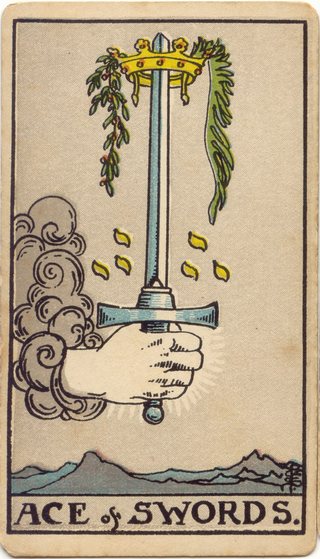 Ace of Swords
: The mountains below
A thin band of grey and blue peaks runs along the bottom of the card. Mountains often stand for the heights of thought or for difficulties ahead; here they are distant, as if the sword is seen from above the climb.
-
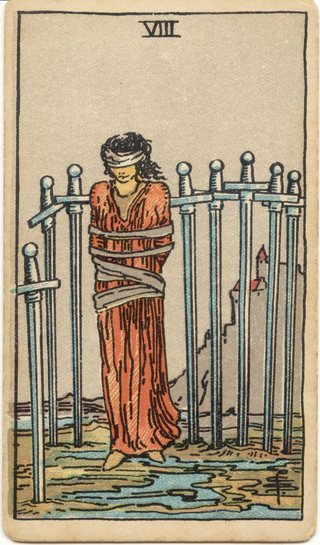 Eight of Swords
: The castle on the crag
Behind her, a grey castle with red-roofed towers rises on a rocky hill. It may be the home or authority she has been cast out from, or the safety she could walk back to. Either way it is within reach.
-
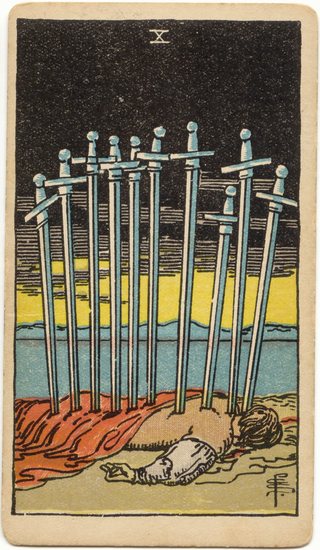 Ten of Swords
: The calm water and hills
Behind him lies flat blue water and a line of grey-blue hills. The landscape is perfectly still. After the storms of earlier swords cards, the wind has dropped and the scene is quiet.
-
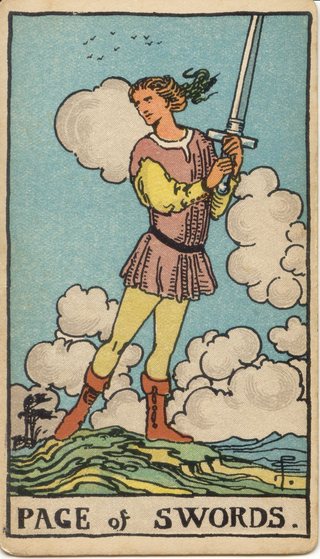 Page of Swords
: The rough high ground
He stands on an uneven green rise above a distant landscape of blue hills and water. High ground gives a good view and an advantage, but the footing here is rough, much like the page's position: alert, but not yet secure.
-
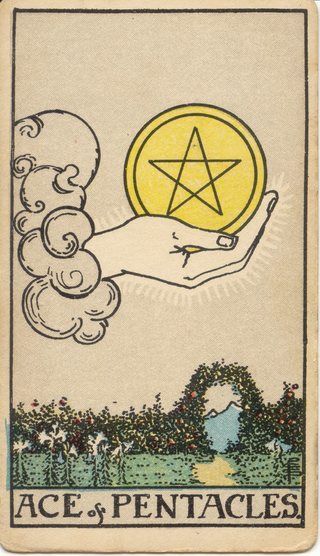 Ace of Pentacles
: The distant mountains
Through the arch, pale blue peaks rise on the horizon. Mountains often stand for goals and challenges further off; here they are framed and distant, visible only once you step through.
-
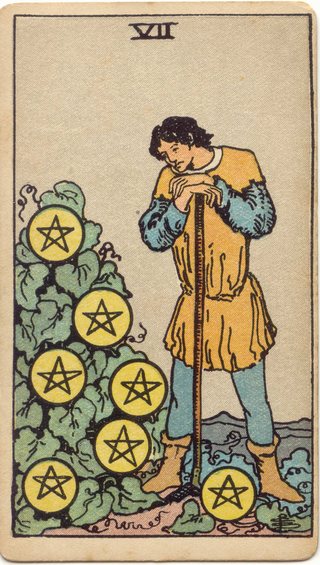 Seven of Pentacles
: The grey hills
Low grey hills run across the horizon behind him, under a plain uncoloured sky. The background is quiet and open; nothing is pressing on him except his own thoughts.
-
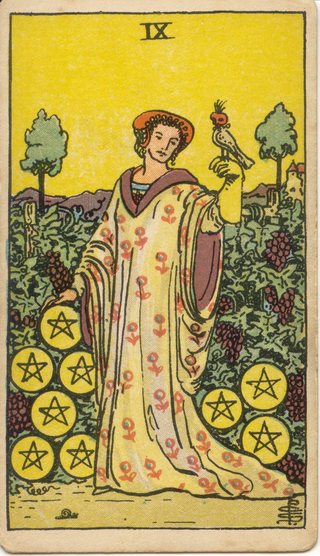 Nine of Pentacles
: The yellow sky and trees
A bright yellow sky fills the top of the card, with two leafy trees and low purple hills on the horizon. Smith uses yellow skies for her most contented scenes, and the trees suggest growth that has had time to mature.
-
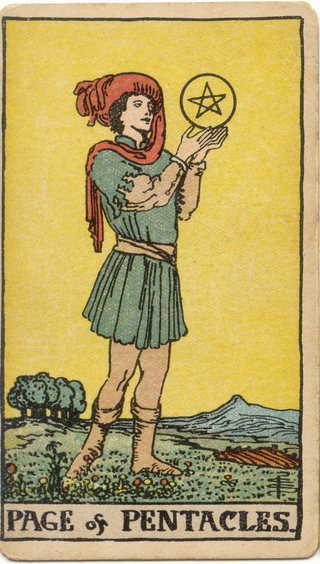 Page of Pentacles
: The trees and mountain
A small grove of round trees stands on the left and a blue mountain rises on the right horizon. The trees suggest steady growth; the distant mountain, a goal still far off.
-
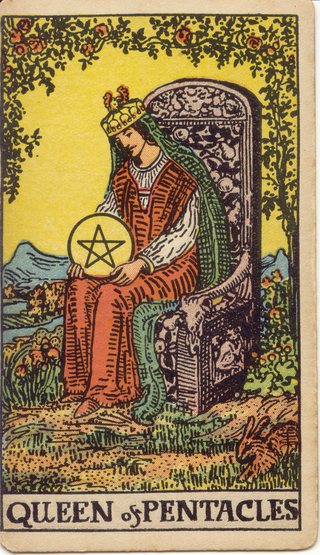 Queen of Pentacles
: The yellow sky and blue hills
A warm yellow sky fills the background, with blue hills in the distance on either side of the throne. The landscape is open and peaceful, a fertile place well looked after.