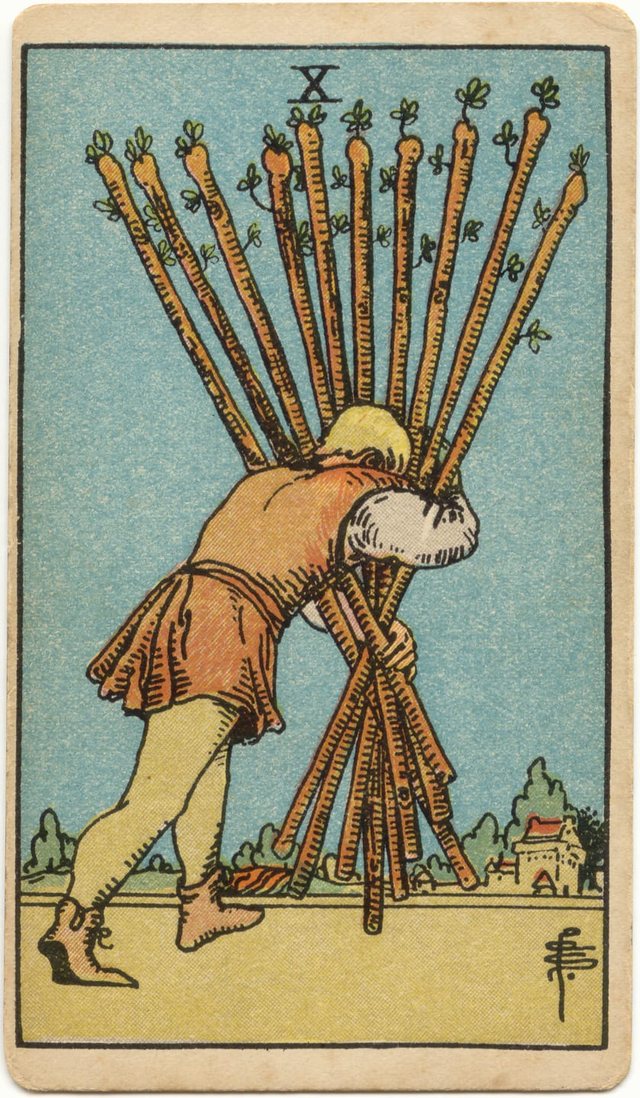
Ten of Wands
Upright burden · overcommitment · responsibility · hard work · the final push
Reversed setting the load down · delegating · strain reaching its limit · release
- Arcana
- Minor · pip card
- Number
- Ten
- Element
- 🜂 Fire
- Astrology
- ♄ Saturn in ♐ Sagittarius
- Golden Dawn title
- Lord of Oppression
- Yes or no
- No
Ten of Wands upright
A man bends forward under a bundle of ten wands, clutching them in both arms so that the staves fan out above his head and block his view. His face is buried among them. He walks with heavy steps across flat yellow ground toward a red-roofed house among trees on the right. He is nearly there, but he cannot see it.
The Ten of Wands is the card of burden: commitments and responsibilities gathered one at a time until together they are almost too much. Waite noted that it can also mean fortune, gain and success, and then the oppression of those very things. That is the card's wisdom. Many loads begin as good things, a promotion, a project, someone who needed us, and grow heavy only by accumulating.
The way he carries them makes it worse. The bundle is clutched in front of him, blocking his sight, when it could have been tied, shouldered or shared. The card invites a practical look at what you are holding and how you are holding it. Some things can be put down, some handed on, some carried differently. And the house is close: sometimes the burden is real, but the end of it is in sight.
Ten of Wands reversed
Reversed, the card can show the load coming off: you begin to delegate, say no, drop commitments that were never yours. It can be a great relief, and it often marks the point when someone finally and honestly admits they cannot do everything.
It can also describe the other way the load comes down, all at once, because it was not set down in time and something simply gave way. Waite lists contrarieties, difficulties and intrigues. Either way the reversed Ten asks the upright's question with more urgency: what are you carrying that you could choose to let go?
In love and relationships
In love the Ten of Wands describes a relationship where one person carries too much: the planning, the emotional work, the practical load. It can also show a couple so stretched by work, family or worry that there is little room left for each other. If you are single, it may suggest you are too busy to let anyone in. Reversed, it can point to the load being shared more fairly, or to an imbalance that has gone on too long.
In work and purpose
This is the card of overwork: too many projects, a role that has grown without support, the person everyone relies on. It asks whether you are taking on more because you must or because you have not found a way to refuse. Prioritise, delegate, renegotiate what was agreed. Reversed, it may mark the relief of finally handing work on, or a clear warning that something has to give before you do.
As advice
Put the bundle down for a moment and look at what is in it. Not every wand is yours to carry. Choose what matters, share or set aside the rest, and carry what remains in a way that lets you see where you are going.
Yes or no?
No The Ten of Wands shows effort under strain, so it reads as a no, or a yes that will cost more than it should. How yes-or-no readings work here.
Questions to sit with
- Which of my responsibilities did I choose, and which did I simply accept?
- What would happen if I put one of these down?
- Am I carrying this in a way that lets me see where I am going?
Symbolism in the card
The bundle of ten wands
Ten leafy wands are gathered into one awkward bundle, held upright and fanning out above his head. Each is still alive and in leaf: these are not dead weights but good things that have become too many.
The bent figure
He leans far forward, head down, legs straining, in a short orange tunic. His whole body is given over to the load. We see his back and never his face.
The blocked view
The wands are held in front so that his head is buried among them. He cannot see where he is going. The burden has taken his line of sight as well as his strength.
The house among the trees
A red-roofed house stands among trees on the right. It is the destination where the load might be set down; Waite adds, darkly, that the place he approaches may suffer from the rods he carries.
The flat ground
The ground is level and plain yellow, with no rocks or slopes. The road itself is easy. All the difficulty lies in what he is carrying.
“The chief meaning is oppression simply, but it is also fortune, gain, any kind of success, and then it is the oppression of these things.”
Numbers, elements and astrology
Ten
Ten completes one cycle and begins the next (1 + 0 = 1). Tens show a suit carried to its end, for better or worse.
Fire: the suit of Wands
Fire is will, energy, desire and creativity: the drive that starts things.
By Golden Dawn tradition each numbered card from two to ten rules ten degrees of the zodiac (a decan): the Ten of Wands is Saturn in the third decan of Sagittarius. They are a symbolic system, not astronomy. How we checked them.
A little history
The Golden Dawn titled the Ten of Wands the Lord of Oppression, and oppression is the word Waite settles on, after remarking that some of the card's older meanings cannot be harmonised with each other. In the earlier Italian and French decks the Ten of Batons was simply ten staves in a pattern. Smith's labourer bowed under his bundle is now one of the most widely recognised of her Minor Arcana scenes.